Why Therapy Didn't Work for You (And Why It's Not Your Fault)
|
12
min read
|
Tanvi


A therapist-backed guide to understanding why therapy sometimes fails, what may have gone wrong, and what to do differently next time
We Understand The Feeling
The session is over.
The therapist smiles and says, “Same time next week?”
You nod. Maybe even smile back. But on the way home, something feels off.
Maybe you thought you were supposed to feel lighter after therapy. Clearer. More understood.
Instead, you feel unsettled.
Maybe emotionally heavier than when you walked in.
You replay the session in your head:
Why did I say that?
Did I explain myself properly?
Was opening all of this up a mistake?
Some people spend the evening overthinking the conversation. Some cry unexpectedly. Some emotionally shut down after finally talking about things they’ve held in for years.
And then the thought quietly appears:
“Maybe therapy works for other people. Maybe I’m just bad at this.”
If therapy didn’t work for you, that does not automatically mean you failed therapy.
Sometimes therapy breaks down because:
The therapist wasn’t the right fit,
The approach didn’t match the problem,
The diagnosis wasn’t complete,
Life outside therapy was overwhelming,
Or the process never felt emotionally safe enough to begin with.
And despite how isolating it can feel, this experience is much more common than most people realise.
Is It Normal for Therapy Not to Work?
Yes. A meaningful number of people either leave therapy early, don’t improve significantly, or continue struggling despite receiving evidence-based treatment.
Therapy is often talked about online as though it works in a dramatic, linear way. Real therapy is rarely that simple.
Research involving nearly 84,000 psychotherapy patients found that almost 1 in 5 people leave therapy before treatment is complete. Other psychotherapy research suggests that around 35–40% of clients may not show clear improvement, even in structured treatment settings. And in one major depression study, many participants still met criteria for depression after treatment ended.
That doesn’t mean therapy is useless.
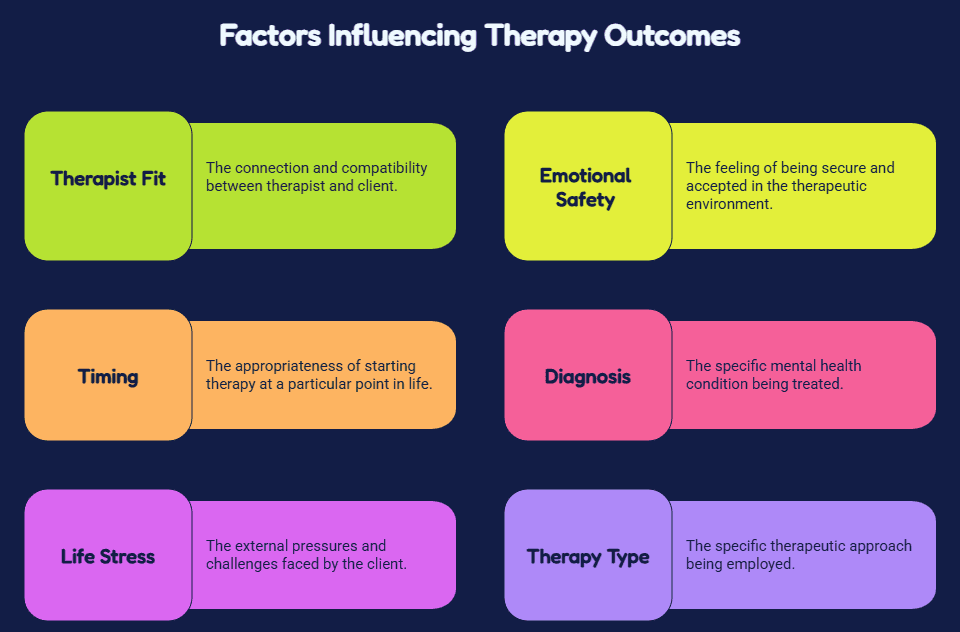
It means therapy outcomes are influenced by many things:
Therapist fit,
Emotional safety,
Timing,
Diagnosis,
Life stress,
And the type of therapy being used.
In India, things can become even more layered.
Many urban professionals begin therapy after years of:
Workplace burnout,
Family pressure,
Emotional suppression,
Untreated anxiety,
Or simply trying to “manage” on their own.
By the time therapy starts, the emotional patterns are often deeply ingrained. The work may require stronger structure, deeper formulation, or more specialised support than the client initially realises.
At the same time, many first-time clients don’t yet know what kind of therapist they actually need. Decisions are often shaped by:
Availability,
Cost,
Referrals,
Or convenience.
And expectations play a role too.
A lot of people expect therapy to feel profound immediately. They expect the first session to bring clarity, relief, or emotional release.
So when therapy feels slow, awkward, emotionally tiring, or simply ordinary, they assume something is wrong.
But therapy often progresses more quietly than people expect.
Sometimes progress looks like:
Sleeping slightly better,
Reacting less intensely,
Understanding your patterns more clearly,
Setting one boundary,
Or feeling a little less overwhelmed than before.
If you’re unsure whether slow progress is normal, here’s an honest look at how long therapy takes for common issues.
➡️ Key takeaway: If your first few therapy sessions didn’t feel life-changing, that doesn’t automatically mean therapy isn’t working.
Did Therapy Fail Because You “Didn’t Try Hard Enough”?

Usually, no. Many clients blame themselves for failed therapy even when therapist behaviour, treatment mismatch, or unsafe dynamics played a major role.
When therapy doesn’t help, many people turn the frustration inward.
They think:
Maybe I wasn’t open enough.
Maybe I didn’t do the work properly.
Maybe I’m too difficult.
Maybe I’m resistant.
Maybe I’m beyond help.
For people living with depression, perfectionism, chronic self-criticism, or years of emotional survival mode, self-blame can feel automatic.
Not because it’s accurate. Because it’s familiar.
If someone has spent years coping alone, minimising their own pain, or adapting to emotionally difficult environments, it makes sense that they would also blame themselves when therapy doesn’t work immediately.
Even healthy change can feel uncomfortable at first.
Sometimes healing feels unfamiliar enough that the mind interprets it as unsafe.
Research on negative therapy experiences found that many clients blamed themselves even when therapists were:
Emotionally unavailable,
Dismissive,
Culturally mismatched,
Or working outside their strongest area of expertise.
That can look like:
A trauma survivor working with someone trained mainly in stress management,
An adult ADHD client working with someone unfamiliar with neurodivergence,
Or a relationship-focused client working with someone focused only on symptom reduction.
In those situations, the issue may not be that the client “failed therapy”. The support itself may never have fully matched what the person needed.
Which raises an important question:
Before assuming you were the problem, was the fit ever right to begin with?
Could the Fit Have Been Wrong From the Start?
Very often, yes. Therapy tends to work best when the therapist, the approach, and the practical setup actually fit the person receiving care.
A lot of people don’t leave therapy because they “weren’t ready”.
They leave because something never fully clicked.
Sometimes the conversations felt emotionally flat. Sometimes the structure felt wrong. Sometimes they kept showing up, but never really felt safe enough to open up honestly.
Good therapy is not just about finding a therapist.
It’s about finding the right fit across multiple levels.
What Needs to Fit | What It Really Means |
Therapist fit | Do I feel safe, understood, respected? |
Treatment fit | Is this the right therapy approach, structure, and style for what I’m struggling with? |
Real-life fit | Can this realistically work with my schedule, energy, and responsibilities? |
Research shows that when therapy is matched to client preferences, outcomes often improve significantly.
That includes things like:
Therapist communication style,
Emotional directness,
Session structure,
Pacing,
And how collaborative the process feels.
In India, therapy decisions are also often shaped by trust and convenience.
People commonly begin therapy through:
A friend’s recommendation,
Someone their colleague liked,
A therapist they found quickly online,
Or whoever was immediately available.
That’s understandable. But therapy is highly individual. A therapist who helped one person may not necessarily be the right fit for someone else with a completely different emotional history, personality, or concern.
And sometimes, the mismatch begins before therapy even properly starts.
Could Your Therapist Have Been the Wrong Match?
Yes. One of the strongest predictors of therapy success is whether you feel emotionally safe, understood, and genuinely connected with your therapist.
This doesn’t mean your therapist has to be perfect or exactly like you.
But it does mean you should be able to gradually feel:
Emotionally safe,
Respected,
Understood,
And comfortable being honest.
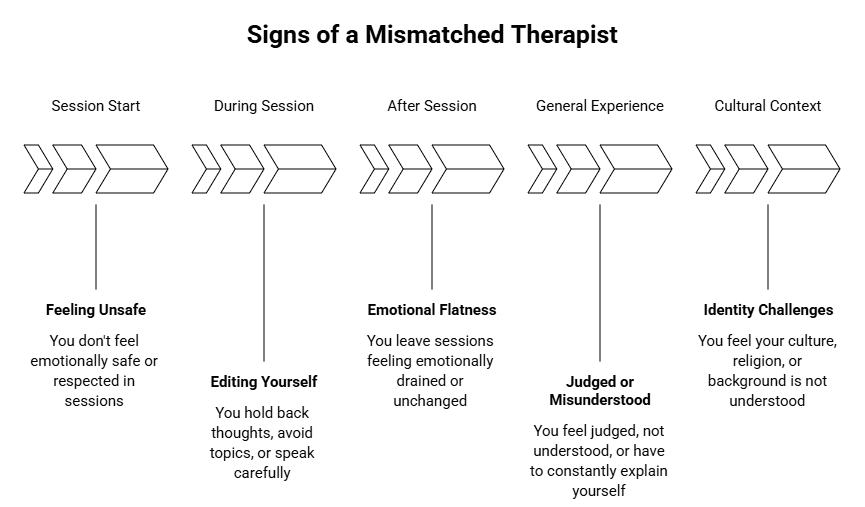
Many people stay in therapy while quietly editing themselves the entire time.
They hold things back. Avoid certain topics. Speak carefully. Minimise emotions. Or spend sessions trying to explain their background before they can even begin talking about what they’re feeling.
Clients often describe experiences like:
Feeling judged instead of understood,
Leaving sessions emotionally flat,
Feeling heard but not truly understood,
Or feeling like they had to constantly explain their culture, religion, family dynamics, caste, class background, or identity.
This matters deeply in India, where emotional experiences are often shaped by:
Family expectations,
Marriage pressure,
Workplace stress,
Religion,
Gender roles,
And boundaries with parents.
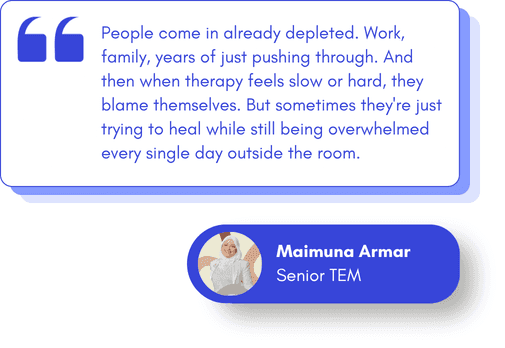
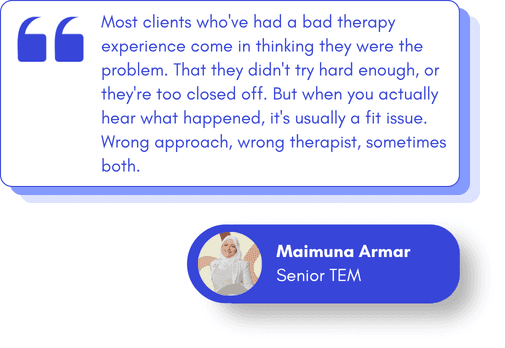
As Elfina’s Senior TEM Maimuna Armar recalls, some clients spend their first few sessions explaining their religion, family structure, or cultural context before they can even begin talking about themselves emotionally.
That emotional translation work can become exhausting.
At Elfina, therapist matching doesn’t focus only on diagnosis. It also considers:
Communication style,
Life stage,
Presenting concern,
Cultural comfort,
And therapist specialisation.
Because feeling emotionally understood is not a small detail in therapy. It’s often part of the foundation.
What If Therapy Actually Made You Feel Worse?
Yes. Therapy can sometimes feel harmful when sessions become emotionally overwhelming, invalidating, unsafe, or mismatched to the level of trauma or complexity a person is carrying.
This is one of the hardest therapy experiences to talk about openly.
Because many people assume:
“If therapy made me feel worse, I probably just wasn’t trying hard enough.”
But that’s not always true.
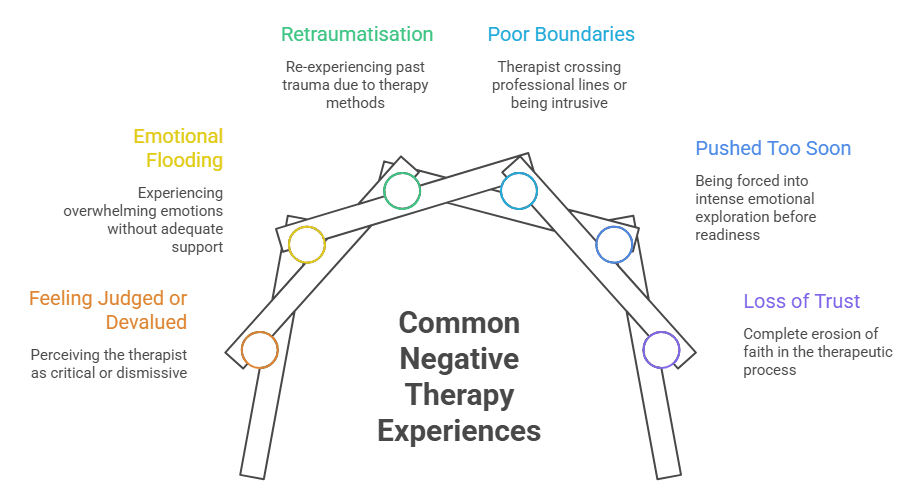
Research on negative therapy experiences highlights patterns such as:
Feeling judged or devalued,
Feeling emotionally flooded without enough support,
Feeling retraumatised,
Poor boundaries,
Feeling pushed into emotionally intense territory before feeling ready,
Or losing trust in therapy altogether.
In some cases, therapists may simply not be adequately trained for the type of trauma, neurodivergence, or emotional complexity the client is bringing into the room.
For example:
Trauma work done too quickly can feel destabilising,
Emotionally intense sessions without proper grounding can leave clients overwhelmed,
And clients from marginalised or culturally layered backgrounds may feel repeatedly misunderstood instead of supported.
Therapy is not supposed to feel emotionally comfortable all the time. Difficult conversations are part of the process.
But there’s a difference between ‘meaningful emotional discomfort’ and ‘consistently feeling emotionally unsafe, unseen, or destabilised’.
That distinction matters.
If you pulled away from therapy because something felt deeply wrong or emotionally unsafe, that does not automatically make you “resistant” or “difficult”.
Sometimes your nervous system was trying to protect you.
When we experience something that feels threatening, overwhelming, or painfully familiar, the brain and body often react before we have fully made sense of what is happening. That response is not always a sign that you were avoiding the work. Sometimes it is a sign that something in the process did not feel safe enough yet.
Could the Therapy Style Itself Have Been Wrong?
Absolutely. Different mental health struggles often respond better to different therapy approaches.
Sometimes therapy feels ineffective not because the person is “untreatable”, but because the approach doesn’t match the actual problem.
A few common examples:
OCD being treated through generic talk therapy
ADHD being mistaken for anxiety, or vice versa
Burnout being treated like a motivation issue
Different struggles often need different kinds of work.
This is one reason Elfina places significant emphasis on therapist experience, formulation skills, and specialist expertise during its vetting process, not just qualifications on paper.
For example:
Anxiety may respond well to CBT, ACT, or exposure-based approaches
Trauma may need trauma-informed or body-based work
Emotional dysregulation may benefit from DBT
Long-standing relationship patterns may respond better to attachment-focused or psychodynamic approaches
This matters because therapy styles are not interchangeable.
Someone struggling with obsessive thoughts may need structured behavioural work. Someone carrying complex trauma may first need emotional safety and nervous-system stabilisation before deeper exploration even becomes possible.
And sometimes people stay in the wrong kind of therapy for months simply because they assume:
“This is what therapy is supposed to feel like.”
Bad fit does not automatically mean bad therapy.
Sometimes the treatment simply wasn’t targeting the right mechanism.
Could Something Practical Have Quietly Worked Against You?
Yes. Therapy often becomes harder when real life makes consistency, privacy, or emotional bandwidth difficult.
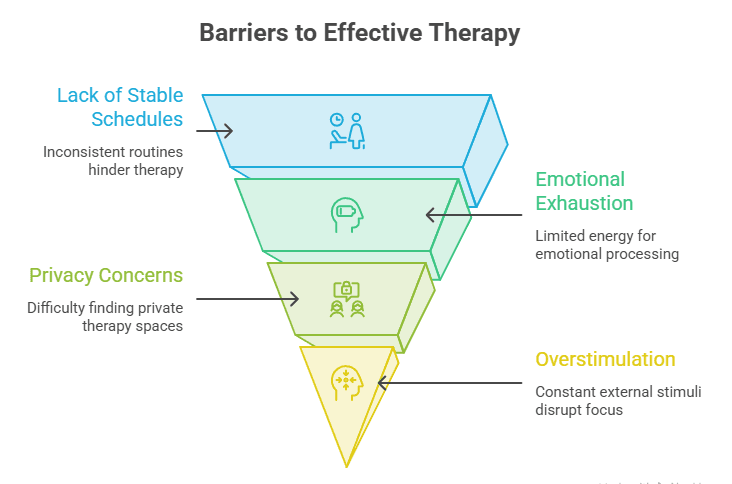
A lot of therapy advice assumes people have:
Stable schedules,
Emotional energy,
Privacy,
And enough mental space to process difficult emotions regularly.
Many people don’t.
Especially in urban India, therapy is often squeezed between:
Long work hours,
Caregiving responsibilities,
Exhausting commutes,
Family expectations,
And constant overstimulation.
Sometimes clients genuinely want help but are surviving week to week emotionally.
Privacy is another issue people rarely talk about enough.
Elfina therapists have worked with clients taking sessions from:
Office meeting rooms,
Parked cars,
Or Stairwells
simply because they didn’t have a private space to talk openly. That affects therapy more than people realise.
When someone is constantly worried about being overheard, interrupted, or emotionally exposed, it becomes much harder to:
Fully open up,
Process emotions honestly,
Or build a deeper therapeutic relationship.
And over time, that can start looking like “therapy isn’t working”, when the real issue is that the person never had enough safety or bandwidth to fully engage with it.
Sometimes practical barriers quietly shape the entire therapy experience. And sometimes the problem being treated isn’t even the full picture yet.
Could Therapy Have Been Treating Only Part of the Problem?
Yes. Therapy can feel ineffective when the diagnosis, formulation, or underlying issue is incomplete.
Mental health symptoms often overlap.
What looks like anxiety on the surface may actually be:
ADHD,
Burnout,
Trauma,
Sleep deprivation,
Chronic stress,
Or something else underneath.
This is one reason mental health can be difficult to assess. Concerns like anxiety, ADHD, trauma, attachment difficulties, burnout, and certain personality patterns can sometimes look surprisingly similar on the surface, even when the underlying causes are very different.
Some examples readers may recognise:
ADHD appearing as anxiety
Bipolar disorder appearing as depression, ADHD, or burnout
ADHD and bipolar disorder overlapping in ways that are easy to miss
Trauma appearing as defensiveness, emotional reactivity, or chronic anger
Autism appearing as social anxiety
Burnout appearing as procrastination, emotional numbness, or “laziness”
This is one reason some people spend years in therapy feeling confused about why nothing fully changes.
If you’ve ever felt like your anxiety never fully responded to treatment, it’s worth reading about how ADHD is commonly misidentified and what the right support actually looks like.
The therapy may not be wrong. But the formulation may be incomplete.
In India, many people first seek help through:
Family doctors,
Self-diagnosis online,
Advice from family or friends,
Or mental health content on social media,
before eventually reaching specialised care. That can delay proper assessment and make certain patterns harder to spot early.
Especially in working professionals, concerns like:
Adult ADHD,
High-functioning depression,
Trauma,
Emotional burnout,
Or neurodivergence
often go unnoticed for years because the person is still technically “functioning”.
Sometimes the person has spent so long coping that even they don’t realise how much they’re struggling.
Good therapy is not just about listening carefully.
It’s also about asking: “Are we treating the right problem?”
Could Your Body Have Been Affecting Your Mind?
Yes. Physical health issues, hormonal changes, sleep problems, and other biological factors can quietly maintain anxiety, depression, fatigue, or emotional dysregulation, even when the therapy itself is good.
Sometimes people assume:
“If I understand my emotions better, I should automatically feel better.”
But mental health does not exist separately from the body.
Things like:
Thyroid disorders,
Sleep disorders,
Chronic pain,
Chronic illnesses,
Progressive medical or neurological conditions,
Hormonal shifts,
Persistent inflammation,
Or long-term fatigue
can significantly affect mood, concentration, emotional regulation, and energy.
Hormonal changes are especially overlooked.
Experiences like PMS or PMDD, postpartum changes, perimenopause, menopause, or chronic hormonal imbalance can sometimes show up emotionally as:
Anxiety,
Irritability,
Low mood,
Emotional overwhelm,
Depression.
And many people spend months trying to “fix themselves psychologically” without realising their body may also be part of the picture.
This doesn’t mean the distress is “just physical”. It means emotional health and physical health constantly affect each other.
Good therapy often works best when the person is looked at more holistically rather than emotionally in isolation.
Can Therapy Work if Life Outside the Therapy Room Still Feels Unsafe?
Sometimes, yes. But progress becomes much harder when daily life keeps reactivating stress, burnout, fear, or emotional exhaustion.
Therapy does not happen in a vacuum.
Someone may spend one hour every week processing emotions in therapy...and then spend the remaining 167 hours inside:
A toxic workplace,
An emotionally unsafe relationship,
Financial instability,
Chronic caregiving stress,
Burnout,
Or a home where they cannot fully relax.
That changes the work.
In these situations, therapy may initially focus less on deep emotional exploration and more on coping, stabilisation, emotional regulation, assertiveness, boundaries, or simply helping someone function again.
This is especially relevant in urban India.
Recent Indian survey data found that more than half of urban Indians experienced stress severe enough to affect daily functioning. Workplace research by McKinsey also found Indian employees reporting some of the highest burnout levels globally.
If workplace stress is part of what you’re carrying, this guide on how work pressure affects mental health is worth a read.
There’s also growing Indian research linking chronic urban stressors, including pollution and environmental overload, with higher rates of anxiety and depression.
Sometimes people feel frustrated that therapy is “not going deep enough”.
But if someone is emotionally exhausted, constantly overstimulated, or still actively surviving difficult environments, deeper work may not be the first priority yet.
Sometimes the first goal is simply:
Helping the nervous system feel safer,
Helping the person regain stability,
Helping them build enough support to eventually move out of survival mode.
Therapy can help people survive difficult environments more safely. But therapy alone cannot always overpower an environment that keeps causing harm.
So What Should You Do if Therapy Didn’t Work?
The goal usually isn’t to give up on healing. It’s to understand what didn’t work and adjust the support accordingly.
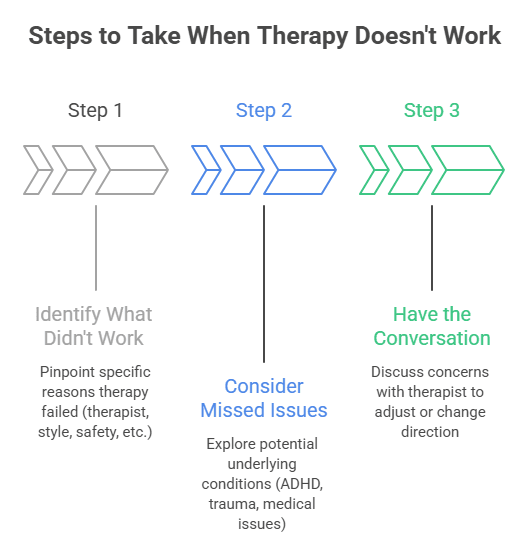
A bad therapy experience can make people want to shut the entire idea down. That makes sense.
But before deciding: “therapy doesn’t work for me”, it's worth slowing down and asking a few more specific questions.
Step 1: Name what actually didn’t work
Was it:
The therapist?
The therapy style?
The emotional safety?
The diagnosis?
The pace?
The practical setup?
A lot of people leave therapy with a vague feeling that “something felt off”. Getting more specific can help clarify what needs to change next time.
Step 2: Ask whether something may have been missed
Could it have been:
ADHD?
Trauma?
Bipolar disorder?
Burnout?
A medical issue?
Neurodivergence?
Sometimes therapy feels ineffective because the treatment was addressing the surface symptom, not the deeper pattern underneath it.
Step 3: Have the conversation, if it feels safe
Responsible therapists do not expect therapy to work perfectly all the time.
Good therapists typically review progress, revisit goals, repair misunderstandings, and adjust the approach when things are not improving.
Sometimes a difficult conversation inside therapy can genuinely improve the work. And sometimes it clarifies that a different direction may be needed.
Also Read:
Therapy Didn’t Fail Because You’re Bad at Healing
A difficult therapy experience can change the way people see themselves.
Some start believing:
They’re too complicated,
Too emotionally shut down,
Too self-aware,
Too damaged,
Or simply “not fixable”
But therapy not working does not automatically mean you were the problem.
Sometimes:
The fit wasn’t right,
The approach didn’t match the issue,
The diagnosis was incomplete,
Life outside therapy was overwhelming,
Or the process never felt emotionally safe enough to begin with.
And sometimes timing matters too. A person who could not fully engage with therapy two years ago may respond very differently later with more stability, better support, the right therapist, or a clearer understanding of what they actually need.
What failed may not have been therapy itself.
It may have been the fit, the formulation, the timing, or the kind of support being offered.
And those things can change.
A different therapist is not a step backward. Sometimes it’s simply a more informed next step.
Frequently Asked Questions (FAQs)
Can therapy fail even if I’m trying my best?
Yes. Therapy outcomes depend on many factors, including therapist fit, emotional safety, diagnosis, life stress, and the type of therapy being used, not just effort alone.
How many sessions should I try before switching therapists?
There’s no fixed number, but many therapists suggest giving it a few sessions unless something feels clearly unsafe, invalidating, or deeply uncomfortable from the start.
Can therapy actually make you feel worse?
Sometimes, yes. Difficult emotions can surface during therapy, but consistently feeling emotionally unsafe, judged, retraumatised, or destabilised may signal a poor therapeutic fit or an approach mismatch.
Is online therapy in India really effective?
Yes, online therapy can be effective for many people when there is strong therapist-client fit, consistency, privacy, and emotional safety. But practical barriers like interruptions or lack of private space can still affect the experience.
For a deeper look at what the research actually says, read Is Online Therapy as Effective as In-Person?.
How do I know if I need a different therapist or a different diagnosis?
If therapy feels stuck for a long time, it may help to reassess both. Sometimes the issue is therapist fit. Other times, concerns like ADHD, trauma, burnout, bipolar disorder, or medical conditions may not have been fully identified yet.
What if I felt judged in therapy?
Feeling occasionally challenged is different from feeling repeatedly judged, dismissed, or emotionally unsafe. If therapy consistently leaves you feeling smaller, ashamed, or misunderstood, it may be worth reconsidering the fit.
What if I was never officially diagnosed? Can therapy still work for me?
Yes. Many people begin therapy without a formal diagnosis. Good therapists often use the early sessions to understand patterns, symptoms, history, and context before deciding what framework fits best.
Should I try therapy again after a bad experience?
For many people, yes, though it’s understandable to feel hesitant. A negative experience with one therapist or one approach does not automatically mean all therapy will feel the same.
How do I find a therapist who understands Indian work and family stress?
Look for therapists who understand family dynamics, workplace burnout, cultural expectations, boundaries, and the realities of urban Indian life.
Feeling culturally understood can make a major difference in how safe and open therapy feels.
And if all of this still feels overwhelming, you don’t have to figure it out alone. Elfina’s therapist matching process is designed to help you find someone who actually fits you, not just someone who’s available.
References
[1] Swift, J. K., & Greenberg, R. P. (2012). Premature discontinuation in adult psychotherapy: A meta-analysis. Journal of Consulting and Clinical Psychology, 80(4), 547–559. https://doi.org/10.1037/a0028226
[2] Lambert, M. J. (Ed.). (2013). Bergin and Garfield's handbook of psychotherapy and behavior change. John Wiley & Sons.
[3] DeRubeis RJ, Hollon SD, Amsterdam JD, et al. Cognitive Therapy vs Medications in the Treatment of Moderate to Severe Depression. Arch Gen Psychiatry. 2005;62(4):409–416. https://doi.org/10.1001/archpsyc.62.4.409
[4] Vybíral, Z., Ogles, B. M., Řiháček, T., Urbancová, B., & Gocieková, V. (2024). Negative experiences in psychotherapy from clients’ perspective: A qualitative meta-analysis. Psychotherapy Research, 34(3), 279–292. https://doi.org/10.1080/10503307.2023.2226813
[5] Cooper, M., & Norcross, J. C. (2016). A brief, multidimensional measure of clients' therapy preferences: The Cooper-Norcross Inventory of Preferences (C-NIP). International journal of clinical and health psychology : IJCHP, 16(1), 87–98. https://doi.org/10.1016/j.ijchp.2015.08.003
[6] Humer, E., Schramm, E., Klein, J. P., Härter, M., Hautzinger, M., Pieh, C., & Probst, T. (2021). Effects of alliance ruptures and repairs on outcomes. Psychotherapy research : journal of the Society for Psychotherapy Research, 31(8), 977–987. https://doi.org/10.1080/10503307.2021.1874070
[7] Brassey, J., Herbig, B., Jeffery, B., & Ungerman, D. (2023, November 2). Reframing employee health: Moving beyond burnout to holistic health. McKinsey Health Institute.
[8] Kundu, P., Krishnan, A., Ghosh, S., Rao, G. N., Gururaj, G., Benegal, V., Varghese, M., & Dey, S. (2026). Differential association between ambient PM2.5 constituents and depression and anxiety among Indian adults. iScience, 29(2), 114837. https://doi.org/10.1016/j.isci.2026.114837

Why Therapy Didn't Work for You (And Why It's Not Your Fault)
|
12
min read
|
Tanvi

A therapist-backed guide to understanding why therapy sometimes fails, what may have gone wrong, and what to do differently next time
We Understand The Feeling
The session is over.
The therapist smiles and says, “Same time next week?”
You nod. Maybe even smile back. But on the way home, something feels off.
Maybe you thought you were supposed to feel lighter after therapy. Clearer. More understood.
Instead, you feel unsettled.
Maybe emotionally heavier than when you walked in.
You replay the session in your head:
Why did I say that?
Did I explain myself properly?
Was opening all of this up a mistake?
Some people spend the evening overthinking the conversation. Some cry unexpectedly. Some emotionally shut down after finally talking about things they’ve held in for years.
And then the thought quietly appears:
“Maybe therapy works for other people. Maybe I’m just bad at this.”
If therapy didn’t work for you, that does not automatically mean you failed therapy.
Sometimes therapy breaks down because:
The therapist wasn’t the right fit,
The approach didn’t match the problem,
The diagnosis wasn’t complete,
Life outside therapy was overwhelming,
Or the process never felt emotionally safe enough to begin with.
And despite how isolating it can feel, this experience is much more common than most people realise.
Is It Normal for Therapy Not to Work?
Yes. A meaningful number of people either leave therapy early, don’t improve significantly, or continue struggling despite receiving evidence-based treatment.
Therapy is often talked about online as though it works in a dramatic, linear way. Real therapy is rarely that simple.
Research involving nearly 84,000 psychotherapy patients found that almost 1 in 5 people leave therapy before treatment is complete. Other psychotherapy research suggests that around 35–40% of clients may not show clear improvement, even in structured treatment settings. And in one major depression study, many participants still met criteria for depression after treatment ended.
That doesn’t mean therapy is useless.
It means therapy outcomes are influenced by many things:
Therapist fit,
Emotional safety,
Timing,
Diagnosis,
Life stress,
And the type of therapy being used.

In India, things can become even more layered.
Many urban professionals begin therapy after years of:
Workplace burnout,
Family pressure,
Emotional suppression,
Untreated anxiety,
Or simply trying to “manage” on their own.
By the time therapy starts, the emotional patterns are often deeply ingrained. The work may require stronger structure, deeper formulation, or more specialised support than the client initially realises.
At the same time, many first-time clients don’t yet know what kind of therapist they actually need. Decisions are often shaped by:
Availability,
Cost,
Referrals,
Or convenience.
And expectations play a role too.
A lot of people expect therapy to feel profound immediately. They expect the first session to bring clarity, relief, or emotional release.
So when therapy feels slow, awkward, emotionally tiring, or simply ordinary, they assume something is wrong.
But therapy often progresses more quietly than people expect.
Sometimes progress looks like:
Sleeping slightly better,
Reacting less intensely,
Understanding your patterns more clearly,
Setting one boundary,
Or feeling a little less overwhelmed than before.
If you’re unsure whether slow progress is normal, here’s an honest look at how long therapy takes for common issues.
➡️ Key takeaway: If your first few therapy sessions didn’t feel life-changing, that doesn’t automatically mean therapy isn’t working.
Did Therapy Fail Because You “Didn’t Try Hard Enough”?

Usually, no. Many clients blame themselves for failed therapy even when therapist behaviour, treatment mismatch, or unsafe dynamics played a major role.
When therapy doesn’t help, many people turn the frustration inward.
They think:
Maybe I wasn’t open enough.
Maybe I didn’t do the work properly.
Maybe I’m too difficult.
Maybe I’m resistant.
Maybe I’m beyond help.
For people living with depression, perfectionism, chronic self-criticism, or years of emotional survival mode, self-blame can feel automatic.
Not because it’s accurate. Because it’s familiar.
If someone has spent years coping alone, minimising their own pain, or adapting to emotionally difficult environments, it makes sense that they would also blame themselves when therapy doesn’t work immediately.
Even healthy change can feel uncomfortable at first.
Sometimes healing feels unfamiliar enough that the mind interprets it as unsafe.

Research on negative therapy experiences found that many clients blamed themselves even when therapists were:
Emotionally unavailable,
Dismissive,
Culturally mismatched,
Or working outside their strongest area of expertise.
That can look like:
A trauma survivor working with someone trained mainly in stress management,
An adult ADHD client working with someone unfamiliar with neurodivergence,
Or a relationship-focused client working with someone focused only on symptom reduction.
In those situations, the issue may not be that the client “failed therapy”. The support itself may never have fully matched what the person needed.
Which raises an important question:
Before assuming you were the problem, was the fit ever right to begin with?
Could the Fit Have Been Wrong From the Start?
Very often, yes. Therapy tends to work best when the therapist, the approach, and the practical setup actually fit the person receiving care.
A lot of people don’t leave therapy because they “weren’t ready”.
They leave because something never fully clicked.
Sometimes the conversations felt emotionally flat. Sometimes the structure felt wrong. Sometimes they kept showing up, but never really felt safe enough to open up honestly.
Good therapy is not just about finding a therapist.
It’s about finding the right fit across multiple levels.
What Needs to Fit | What It Really Means |
Therapist fit | Do I feel safe, understood, respected? |
Treatment fit | Is this the right therapy approach, structure, and style for what I’m struggling with? |
Real-life fit | Can this realistically work with my schedule, energy, and responsibilities? |
Research shows that when therapy is matched to client preferences, outcomes often improve significantly.
That includes things like:
Therapist communication style,
Emotional directness,
Session structure,
Pacing,
And how collaborative the process feels.
In India, therapy decisions are also often shaped by trust and convenience.
People commonly begin therapy through:
A friend’s recommendation,
Someone their colleague liked,
A therapist they found quickly online,
Or whoever was immediately available.
That’s understandable. But therapy is highly individual. A therapist who helped one person may not necessarily be the right fit for someone else with a completely different emotional history, personality, or concern.
And sometimes, the mismatch begins before therapy even properly starts.
Could Your Therapist Have Been the Wrong Match?
Yes. One of the strongest predictors of therapy success is whether you feel emotionally safe, understood, and genuinely connected with your therapist.

This doesn’t mean your therapist has to be perfect or exactly like you.
But it does mean you should be able to gradually feel:
Emotionally safe,
Respected,
Understood,
And comfortable being honest.
Many people stay in therapy while quietly editing themselves the entire time.
They hold things back. Avoid certain topics. Speak carefully. Minimise emotions. Or spend sessions trying to explain their background before they can even begin talking about what they’re feeling.
Clients often describe experiences like:
Feeling judged instead of understood,
Leaving sessions emotionally flat,
Feeling heard but not truly understood,
Or feeling like they had to constantly explain their culture, religion, family dynamics, caste, class background, or identity.
This matters deeply in India, where emotional experiences are often shaped by:
Family expectations,
Marriage pressure,
Workplace stress,
Religion,
Gender roles,
And boundaries with parents.
As Elfina’s Senior TEM Maimuna Armar recalls, some clients spend their first few sessions explaining their religion, family structure, or cultural context before they can even begin talking about themselves emotionally.
That emotional translation work can become exhausting.
At Elfina, therapist matching doesn’t focus only on diagnosis. It also considers:
Communication style,
Life stage,
Presenting concern,
Cultural comfort,
And therapist specialisation.
Because feeling emotionally understood is not a small detail in therapy. It’s often part of the foundation.
What If Therapy Actually Made You Feel Worse?
Yes. Therapy can sometimes feel harmful when sessions become emotionally overwhelming, invalidating, unsafe, or mismatched to the level of trauma or complexity a person is carrying.

This is one of the hardest therapy experiences to talk about openly.
Because many people assume:
“If therapy made me feel worse, I probably just wasn’t trying hard enough.”
But that’s not always true.
Research on negative therapy experiences highlights patterns such as:
Feeling judged or devalued,
Feeling emotionally flooded without enough support,
Feeling retraumatised,
Poor boundaries,
Feeling pushed into emotionally intense territory before feeling ready,
Or losing trust in therapy altogether.
In some cases, therapists may simply not be adequately trained for the type of trauma, neurodivergence, or emotional complexity the client is bringing into the room.
For example:
Trauma work done too quickly can feel destabilising,
Emotionally intense sessions without proper grounding can leave clients overwhelmed,
And clients from marginalised or culturally layered backgrounds may feel repeatedly misunderstood instead of supported.
Therapy is not supposed to feel emotionally comfortable all the time. Difficult conversations are part of the process.
But there’s a difference between ‘meaningful emotional discomfort’ and ‘consistently feeling emotionally unsafe, unseen, or destabilised’.
That distinction matters.
If you pulled away from therapy because something felt deeply wrong or emotionally unsafe, that does not automatically make you “resistant” or “difficult”.
Sometimes your nervous system was trying to protect you.
When we experience something that feels threatening, overwhelming, or painfully familiar, the brain and body often react before we have fully made sense of what is happening. That response is not always a sign that you were avoiding the work. Sometimes it is a sign that something in the process did not feel safe enough yet.
Could the Therapy Style Itself Have Been Wrong?
Absolutely. Different mental health struggles often respond better to different therapy approaches.
Sometimes therapy feels ineffective not because the person is “untreatable”, but because the approach doesn’t match the actual problem.
A few common examples:
OCD being treated through generic talk therapy
ADHD being mistaken for anxiety, or vice versa
Burnout being treated like a motivation issue
Different struggles often need different kinds of work.
This is one reason Elfina places significant emphasis on therapist experience, formulation skills, and specialist expertise during its vetting process, not just qualifications on paper.
For example:
Anxiety may respond well to CBT, ACT, or exposure-based approaches
Trauma may need trauma-informed or body-based work
Emotional dysregulation may benefit from DBT
Long-standing relationship patterns may respond better to attachment-focused or psychodynamic approaches
This matters because therapy styles are not interchangeable.
Someone struggling with obsessive thoughts may need structured behavioural work. Someone carrying complex trauma may first need emotional safety and nervous-system stabilisation before deeper exploration even becomes possible.
And sometimes people stay in the wrong kind of therapy for months simply because they assume:
“This is what therapy is supposed to feel like.”
Bad fit does not automatically mean bad therapy.
Sometimes the treatment simply wasn’t targeting the right mechanism.
Could Something Practical Have Quietly Worked Against You?
Yes. Therapy often becomes harder when real life makes consistency, privacy, or emotional bandwidth difficult.

A lot of therapy advice assumes people have:
Stable schedules,
Emotional energy,
Privacy,
And enough mental space to process difficult emotions regularly.
Many people don’t.
Especially in urban India, therapy is often squeezed between:
Long work hours,
Caregiving responsibilities,
Exhausting commutes,
Family expectations,
And constant overstimulation.
Sometimes clients genuinely want help but are surviving week to week emotionally.
Privacy is another issue people rarely talk about enough.
Elfina therapists have worked with clients taking sessions from:
Office meeting rooms,
Parked cars,
Or Stairwells
simply because they didn’t have a private space to talk openly. That affects therapy more than people realise.
When someone is constantly worried about being overheard, interrupted, or emotionally exposed, it becomes much harder to:
Fully open up,
Process emotions honestly,
Or build a deeper therapeutic relationship.
And over time, that can start looking like “therapy isn’t working”, when the real issue is that the person never had enough safety or bandwidth to fully engage with it.
Sometimes practical barriers quietly shape the entire therapy experience. And sometimes the problem being treated isn’t even the full picture yet.
Could Therapy Have Been Treating Only Part of the Problem?
Yes. Therapy can feel ineffective when the diagnosis, formulation, or underlying issue is incomplete.
Mental health symptoms often overlap.
What looks like anxiety on the surface may actually be:
ADHD,
Burnout,
Trauma,
Sleep deprivation,
Chronic stress,
Or something else underneath.
This is one reason mental health can be difficult to assess. Concerns like anxiety, ADHD, trauma, attachment difficulties, burnout, and certain personality patterns can sometimes look surprisingly similar on the surface, even when the underlying causes are very different.
Some examples readers may recognise:
ADHD appearing as anxiety
Bipolar disorder appearing as depression, ADHD, or burnout
ADHD and bipolar disorder overlapping in ways that are easy to miss
Trauma appearing as defensiveness, emotional reactivity, or chronic anger
Autism appearing as social anxiety
Burnout appearing as procrastination, emotional numbness, or “laziness”
This is one reason some people spend years in therapy feeling confused about why nothing fully changes.
If you’ve ever felt like your anxiety never fully responded to treatment, it’s worth reading about how ADHD is commonly misidentified and what the right support actually looks like.
The therapy may not be wrong. But the formulation may be incomplete.
In India, many people first seek help through:
Family doctors,
Self-diagnosis online,
Advice from family or friends,
Or mental health content on social media,
before eventually reaching specialised care. That can delay proper assessment and make certain patterns harder to spot early.
Especially in working professionals, concerns like:
Adult ADHD,
High-functioning depression,
Trauma,
Emotional burnout,
Or neurodivergence
often go unnoticed for years because the person is still technically “functioning”.
Sometimes the person has spent so long coping that even they don’t realise how much they’re struggling.

Good therapy is not just about listening carefully.
It’s also about asking: “Are we treating the right problem?”
Could Your Body Have Been Affecting Your Mind?
Yes. Physical health issues, hormonal changes, sleep problems, and other biological factors can quietly maintain anxiety, depression, fatigue, or emotional dysregulation, even when the therapy itself is good.
Sometimes people assume:
“If I understand my emotions better, I should automatically feel better.”
But mental health does not exist separately from the body.
Things like:
Thyroid disorders,
Sleep disorders,
Chronic pain,
Chronic illnesses,
Progressive medical or neurological conditions,
Hormonal shifts,
Persistent inflammation,
Or long-term fatigue
can significantly affect mood, concentration, emotional regulation, and energy.
Hormonal changes are especially overlooked.
Experiences like PMS or PMDD, postpartum changes, perimenopause, menopause, or chronic hormonal imbalance can sometimes show up emotionally as:
Anxiety,
Irritability,
Low mood,
Emotional overwhelm,
Depression.
And many people spend months trying to “fix themselves psychologically” without realising their body may also be part of the picture.
This doesn’t mean the distress is “just physical”. It means emotional health and physical health constantly affect each other.
Good therapy often works best when the person is looked at more holistically rather than emotionally in isolation.
Can Therapy Work if Life Outside the Therapy Room Still Feels Unsafe?
Sometimes, yes. But progress becomes much harder when daily life keeps reactivating stress, burnout, fear, or emotional exhaustion.
Therapy does not happen in a vacuum.
Someone may spend one hour every week processing emotions in therapy...and then spend the remaining 167 hours inside:
A toxic workplace,
An emotionally unsafe relationship,
Financial instability,
Chronic caregiving stress,
Burnout,
Or a home where they cannot fully relax.
That changes the work.
In these situations, therapy may initially focus less on deep emotional exploration and more on coping, stabilisation, emotional regulation, assertiveness, boundaries, or simply helping someone function again.
This is especially relevant in urban India.
Recent Indian survey data found that more than half of urban Indians experienced stress severe enough to affect daily functioning. Workplace research by McKinsey also found Indian employees reporting some of the highest burnout levels globally.
If workplace stress is part of what you’re carrying, this guide on how work pressure affects mental health is worth a read.
There’s also growing Indian research linking chronic urban stressors, including pollution and environmental overload, with higher rates of anxiety and depression.
Sometimes people feel frustrated that therapy is “not going deep enough”.
But if someone is emotionally exhausted, constantly overstimulated, or still actively surviving difficult environments, deeper work may not be the first priority yet.
Sometimes the first goal is simply:
Helping the nervous system feel safer,
Helping the person regain stability,
Helping them build enough support to eventually move out of survival mode.
Therapy can help people survive difficult environments more safely. But therapy alone cannot always overpower an environment that keeps causing harm.
So What Should You Do if Therapy Didn’t Work?
The goal usually isn’t to give up on healing. It’s to understand what didn’t work and adjust the support accordingly.

A bad therapy experience can make people want to shut the entire idea down. That makes sense.
But before deciding: “therapy doesn’t work for me”, it's worth slowing down and asking a few more specific questions.
Step 1: Name what actually didn’t work
Was it:
The therapist?
The therapy style?
The emotional safety?
The diagnosis?
The pace?
The practical setup?
A lot of people leave therapy with a vague feeling that “something felt off”. Getting more specific can help clarify what needs to change next time.
Step 2: Ask whether something may have been missed
Could it have been:
ADHD?
Trauma?
Bipolar disorder?
Burnout?
A medical issue?
Neurodivergence?
Sometimes therapy feels ineffective because the treatment was addressing the surface symptom, not the deeper pattern underneath it.
Step 3: Have the conversation, if it feels safe
Responsible therapists do not expect therapy to work perfectly all the time.
Good therapists typically review progress, revisit goals, repair misunderstandings, and adjust the approach when things are not improving.
Sometimes a difficult conversation inside therapy can genuinely improve the work. And sometimes it clarifies that a different direction may be needed.
Also Read:
Therapy Didn’t Fail Because You’re Bad at Healing
A difficult therapy experience can change the way people see themselves.
Some start believing:
They’re too complicated,
Too emotionally shut down,
Too self-aware,
Too damaged,
Or simply “not fixable”
But therapy not working does not automatically mean you were the problem.
Sometimes:
The fit wasn’t right,
The approach didn’t match the issue,
The diagnosis was incomplete,
Life outside therapy was overwhelming,
Or the process never felt emotionally safe enough to begin with.
And sometimes timing matters too. A person who could not fully engage with therapy two years ago may respond very differently later with more stability, better support, the right therapist, or a clearer understanding of what they actually need.
What failed may not have been therapy itself.
It may have been the fit, the formulation, the timing, or the kind of support being offered.
And those things can change.
A different therapist is not a step backward. Sometimes it’s simply a more informed next step.
Frequently Asked Questions (FAQs)
Can therapy fail even if I’m trying my best?
Yes. Therapy outcomes depend on many factors, including therapist fit, emotional safety, diagnosis, life stress, and the type of therapy being used, not just effort alone.
How many sessions should I try before switching therapists?
There’s no fixed number, but many therapists suggest giving it a few sessions unless something feels clearly unsafe, invalidating, or deeply uncomfortable from the start.
Can therapy actually make you feel worse?
Sometimes, yes. Difficult emotions can surface during therapy, but consistently feeling emotionally unsafe, judged, retraumatised, or destabilised may signal a poor therapeutic fit or an approach mismatch.
Is online therapy in India really effective?
Yes, online therapy can be effective for many people when there is strong therapist-client fit, consistency, privacy, and emotional safety. But practical barriers like interruptions or lack of private space can still affect the experience.
For a deeper look at what the research actually says, read Is Online Therapy as Effective as In-Person?.
How do I know if I need a different therapist or a different diagnosis?
If therapy feels stuck for a long time, it may help to reassess both. Sometimes the issue is therapist fit. Other times, concerns like ADHD, trauma, burnout, bipolar disorder, or medical conditions may not have been fully identified yet.
What if I felt judged in therapy?
Feeling occasionally challenged is different from feeling repeatedly judged, dismissed, or emotionally unsafe. If therapy consistently leaves you feeling smaller, ashamed, or misunderstood, it may be worth reconsidering the fit.
What if I was never officially diagnosed? Can therapy still work for me?
Yes. Many people begin therapy without a formal diagnosis. Good therapists often use the early sessions to understand patterns, symptoms, history, and context before deciding what framework fits best.
Should I try therapy again after a bad experience?
For many people, yes, though it’s understandable to feel hesitant. A negative experience with one therapist or one approach does not automatically mean all therapy will feel the same.
How do I find a therapist who understands Indian work and family stress?
Look for therapists who understand family dynamics, workplace burnout, cultural expectations, boundaries, and the realities of urban Indian life.
Feeling culturally understood can make a major difference in how safe and open therapy feels.
And if all of this still feels overwhelming, you don’t have to figure it out alone. Elfina’s therapist matching process is designed to help you find someone who actually fits you, not just someone who’s available.
References
[1] Swift, J. K., & Greenberg, R. P. (2012). Premature discontinuation in adult psychotherapy: A meta-analysis. Journal of Consulting and Clinical Psychology, 80(4), 547–559. https://doi.org/10.1037/a0028226
[2] Lambert, M. J. (Ed.). (2013). Bergin and Garfield's handbook of psychotherapy and behavior change. John Wiley & Sons.
[3] DeRubeis RJ, Hollon SD, Amsterdam JD, et al. Cognitive Therapy vs Medications in the Treatment of Moderate to Severe Depression. Arch Gen Psychiatry. 2005;62(4):409–416. https://doi.org/10.1001/archpsyc.62.4.409
[4] Vybíral, Z., Ogles, B. M., Řiháček, T., Urbancová, B., & Gocieková, V. (2024). Negative experiences in psychotherapy from clients’ perspective: A qualitative meta-analysis. Psychotherapy Research, 34(3), 279–292. https://doi.org/10.1080/10503307.2023.2226813
[5] Cooper, M., & Norcross, J. C. (2016). A brief, multidimensional measure of clients' therapy preferences: The Cooper-Norcross Inventory of Preferences (C-NIP). International journal of clinical and health psychology : IJCHP, 16(1), 87–98. https://doi.org/10.1016/j.ijchp.2015.08.003
[6] Humer, E., Schramm, E., Klein, J. P., Härter, M., Hautzinger, M., Pieh, C., & Probst, T. (2021). Effects of alliance ruptures and repairs on outcomes. Psychotherapy research : journal of the Society for Psychotherapy Research, 31(8), 977–987. https://doi.org/10.1080/10503307.2021.1874070
[7] Brassey, J., Herbig, B., Jeffery, B., & Ungerman, D. (2023, November 2). Reframing employee health: Moving beyond burnout to holistic health. McKinsey Health Institute.
[8] Kundu, P., Krishnan, A., Ghosh, S., Rao, G. N., Gururaj, G., Benegal, V., Varghese, M., & Dey, S. (2026). Differential association between ambient PM2.5 constituents and depression and anxiety among Indian adults. iScience, 29(2), 114837. https://doi.org/10.1016/j.isci.2026.114837
Other blogs
Frequently Asked Questions
What types of therapy do you offer?
Can I meet my therapist in-person?
How do you match me with a therapist?
How much does therapy cost?
Do you offer free trials?
Finding The Right Fit, Made Easy

© Mindaro Health Technologies. All rights reserved
Finding the right fit, made easy.
FAQs
What types of therapy do you offer?
Can I meet my therapist in-person?
How do you match me with a therapist?
How much does therapy cost?
Do you offer free trials?