Elfina Health vs Amaha: Which Mental Health Platform Fits You?
|
5
min read
|
Tanvi


Deciding to start therapy can take weeks, months, or even years of consideration. Once you've made that decision, another question often appears almost immediately: where should I begin?
If you've been researching online therapy platforms in India, chances are you've come across both Elfina Health and Amaha. Both are credible mental health platforms. Both connect people with qualified professionals. And both are trying to make mental healthcare easier to access.
So how do you choose between them?
The answer isn't necessarily about which platform is "better". It's about understanding what each platform is designed to do and which approach feels like a better fit for your needs.
In this guide, we'll compare Elfina Health and Amaha, explore how the experience differs on each platform, and help you decide where you may feel most supported.
Elfina Health vs Amaha in One Minute
If you're looking for the short answer, it comes down to this:
Elfina Health may be the better choice if your priority is finding the right therapist and having guidance throughout your therapy journey.
Amaha may be the better choice if you already know you're looking for services beyond therapy, such as psychiatry, assessments, or clinic-based care.
Here's a quick comparison:
Aspect | Elfina Health | Amaha |
Primary Focus | Finding the right therapist | Bringing different types of mental health support into one place |
Getting Started | Guided matching call | App, website, or clinic-based entry |
Choosing a Therapist | Personalised recommendations | Browse from a list of available therapists |
Support Throughout the Journey | TEM-led guidance and follow-up | Platform resources and service options |
Session Fees | Vary based on therapist experience and expertise | Vary based on therapist and service type |
Best For | People prioritising therapist fit | People seeking support beyond therapy alone |
While both platforms aim to improve access to mental healthcare, they approach that goal in very different ways. Understanding those differences starts with looking at what they have in common.
What Both Platforms Get Right
Before comparing how Elfina Health and Amaha differ, it's worth acknowledging something important: both platforms are built around professional mental healthcare.
Both connect people with qualified mental health professionals and emphasise evidence-based approaches to support. The question here is not whether one platform is legitimate and the other isn't. It's whether one approach may suit your needs better than the other.
There's another reason this matters.
Research has consistently shown that a strong therapeutic alliance, the relationship between a client and therapist, is one of the most important predictors of positive therapy outcomes. In other words, the quality of that relationship often matters more than the platform itself. According to psychotherapy research, feeling understood, supported, and able to work collaboratively with your therapist plays a significant role in how helpful therapy ultimately feels (Opland & Torrico, 2024).
If you're wondering how much therapist fit actually shapes your outcomes, Why Therapy Didn't Work for You (And Why It’s Not Your Fault) explores this in depth.
That idea becomes an important lens for understanding the rest of this comparison because, while both platforms provide access to mental health support, they take very different approaches to helping people find it.
Two Different Ways of Approaching Mental Health Care
At first glance, Elfina Health and Amaha may seem quite similar. Both offer access to mental health professionals and both aim to make support easier to find. The biggest difference lies in what each platform is trying to solve.
Elfina's Approach: Helping People Find the Right Therapist
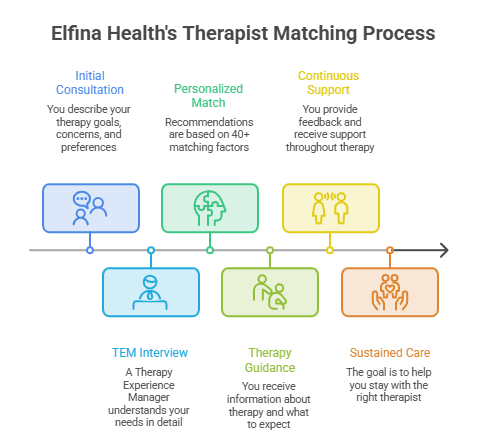
Elfina Health is built around a simple idea: finding the right therapist shouldn't feel like guesswork.
Many people start therapy after spending hours scrolling through profiles, reading bios, and trying to decide who might be a good fit. Even then, there's often uncertainty about whether the therapist's approach, communication style, or experience will actually match what they're looking for.
Instead of asking people to figure this out on their own, Elfina focuses on therapist matching. Every client begins with a guided matching call where their goals, concerns, preferences, and practical needs are explored before a therapist is recommended.
This process is supported by Therapy Experience Managers (TEMs), who act as a bridge between the client and the platform. Their role extends beyond the initial match, helping clients navigate therapy, set expectations, and access support if challenges arise later on.
What makes this different is that TEMs are therapists themselves, not coordinators or intake staff. Their clinical training helps them look beyond surface-level preferences and understand the kind of therapeutic relationship that is most likely to work. Think of it like the difference between walking into a gym and being handed a list of trainers versus speaking with someone who knows each trainer well, takes the time to understand your history and goals, and can recommend the right fit. The guidance comes from genuine clinical insight, not just a directory.
What stands out about Elfina Health's approach is that these elements are designed to work together. The matching process, therapist recommendations, expectation setting, and ongoing support are all part of the same journey rather than separate features. The goal is not simply to help someone start therapy, but to help them stay engaged with it over time.
Elfina’s network also includes clinical psychologists who can conduct formal assessments when appropriate.
Rather than trying to provide every type of mental health service, Elfina Health focuses on helping people find a therapist they feel comfortable staying with.
Amaha's Approach: Bringing Different Types of Support Into One Place
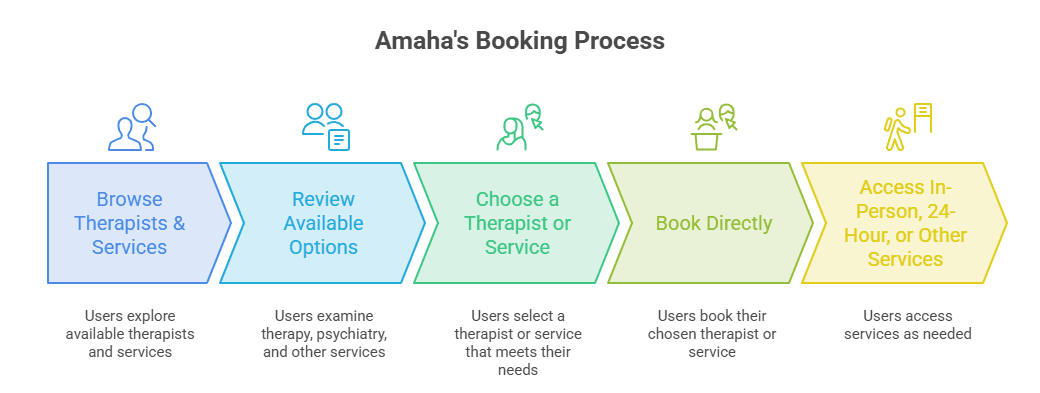
Amaha takes a different approach.
Alongside therapy, it offers services such as psychiatry, assessments, self-guided resources, and clinic-based care. The goal is to provide multiple ways for people to access mental health support depending on what they're looking for.
Amaha also offers 24-hour mental health support services and has expanded into inpatient mental healthcare. While these services may not be relevant for everyone seeking therapy, they can be valuable for people with more specialised support needs.
For someone who already knows they may need services beyond therapy, having these options available through the same platform can be valuable.
Also, Amaha's entry point is self-directed: users browse available therapists with basic filters and make their own selection.
The simplest way to think about the difference is this:
➡️ Elfina Health focuses on helping people find and stay with the right therapist. Amaha focuses on providing access to a broad range of mental health services. How you find your therapist within that is largely up to you.
That difference becomes even clearer when you look at what starting therapy actually feels like on each platform.
What Starting Therapy Actually Feels Like
Comparison pages often focus on features. But for most people, the experience of getting started matters far more.
Starting Therapy with Elfina Health
The journey at Elfina Health typically begins with a matching call rather than a therapist directory.
During this conversation, a Therapy Experience Manager takes time to understand why someone is seeking therapy, what they're hoping to work on, their preferences around communication style, and any previous therapy experiences they've had.
Based on this information, a therapist recommendation is made. Rather than relying solely on profile browsing, Elfina Health's matching process considers multiple factors, helping make therapist selection feel more informed and transparent.
The goal is to reduce the trial-and-error that often comes with choosing a therapist independently. Publicly shared data from Elfina Health also suggests that a large majority of clients are successfully matched with a suitable therapist on their first recommendation.
The experience itself is largely web-based and centred around the therapy journey, with tools that help support progress and engagement over time. Elfina Health also has a web app where clients and therapists can track therapy goals, add reflections, and access AI-generated session summaries with the client's consent.
Starting Therapy with Amaha
Amaha offers several entry points into care.
People can explore the platform through its website, app, therapy services, psychiatry offerings, or clinic-based support depending on what they need. When it comes to choosing a therapist, users browse available therapists or refer to the brochure and make their own selection from there.
This creates flexibility for people who already have a clear idea of the kind of support they want.
For many people, however, the hardest part of starting therapy is not attending the first session. It's figuring out who to trust with it.
And that raises another important question: what happens if the therapist you start with doesn't feel like the right fit?
What Happens If Therapy Doesn't Feel Right?
One of the most common fears people have about therapy is investing time, money, and emotional energy into a therapist who doesn't feel like the right match.
The reality is that therapy fit matters, and sometimes adjustments are needed.
Therapist Switching and Feedback
Both Elfina Health and Amaha recognise that not every therapeutic relationship will work perfectly from the start.
If therapy feels stuck, expectations aren't aligned, or a different therapeutic style is needed, people may choose to explore another therapist.
The difference lies less in whether switching is possible and more in how support is provided throughout that process.
Elfina includes a dedicated process for therapist transitions when needed. Amaha does not currently offer a built-in therapist switching option, so users generally need to reach out to customer support separately if they wish to change therapists.
The Role of Therapy Experience Managers
One of the more distinctive aspects of Elfina Health's model is the involvement of Therapy Experience Managers beyond the initial onboarding stage.
Rather than disappearing after a therapist is matched, TEMs remain available to help clients navigate different parts of the therapy journey.
Because they work closely with therapists throughout the hiring process and beyond, they develop a nuanced understanding of each therapist's style, strengths, and approach. This allows them to provide more informed support when questions, concerns, or challenges arise during therapy.
This can include:
Setting realistic expectations about therapy
Providing psychoeducation around the therapeutic process
Gathering structured feedback after sessions to understand how things are going
Talking to both the client and therapist when something needs attention, forming a balanced view of the relationship
Supporting therapist transitions when needed
Helping clients navigate challenges that arise during therapy
Providing a safe space to articulate something that feels difficult to bring directly to a therapist yet
For many people, this kind of support can be especially valuable during the early stages of therapy. Questions about whether therapy is "working", how long progress should take, or whether difficult emotions are normal often come up along the way. Having someone available to provide context, answer questions, and gather feedback can make the process feel less overwhelming.
In practice, this means therapist matching is not treated as a one-time event. It's viewed as an ongoing process that may require support, adjustment, and conversation along the way.
And that naturally leads to a bigger question: why does therapist fit matter so much in the first place?
Why Therapy Fit Matters More Than Most People Realise
Throughout this comparison, one theme keeps resurfacing: finding the right therapist.
That's because therapy isn't simply about finding a qualified professional. It's also about finding someone you feel comfortable opening up to, working with, and returning to week after week.
The Clinical Importance of Feeling Understood
Therapy is built on a relationship.
Research has consistently found that a strong therapeutic alliance, the sense of trust, collaboration, and connection between a client and therapist, is one of the most important predictors of positive therapy outcomes. People are generally more likely to engage in the process, discuss difficult topics honestly, and stay committed to therapy when they feel understood and supported by their therapist.
This doesn't mean there is only one "perfect" therapist for every person. But it does suggest that therapist fit deserves serious consideration rather than being treated as an afterthought.
For a closer look at how long it typically takes for therapy to feel like it's working, read How Long Does Therapy Actually Take to Work? Honest Timelines for Common Issues.
How Elfina Health Tries to Improve Therapist Fit
This is the challenge Elfina Health has chosen to focus on.
Rather than offering a large directory and leaving people to figure things out on their own, Elfina uses guided matching to recommend therapists based on a person's goals, preferences, and circumstances.
The matching call exists for exactly this reason - because finding the right therapist goes beyond qualifications and expertise. It's also about human connection, communication style, and the kind of relationship a person is likely to feel safe in. That requires a conversation, not a filter.
The platform maintains a curated therapist network and applies rigorous quality standards during therapist selection. But what makes this compounding over time is how TEM knowledge evolves. TEMs continuously update their understanding of every therapist on the network - through structured client feedback, data-driven insights, and patterns that emerge across pairings over time. They can identify concerns early, gather feedback before something becomes a problem, and support therapist transitions when needed. The result is a model of care that is constantly learning and improving, not static.
Publicly shared retention and matching data suggest that this approach helps many clients find a therapist they feel comfortable continuing with. While no platform can guarantee a perfect match, Elfina Health has clearly built much of its model around improving the chances of finding one.
When Amaha May Be the Better Choice
A balanced comparison should also acknowledge that there are situations where Amaha may be the more suitable option.
If you already know you're looking for services beyond therapy alone, Amaha's approach may align better with your needs.
This might include people who:
Prefer accessing psychiatry and therapy through the same platform
Prefer clinic-based care
Want access to multiple types of mental health support in one place
For these situations, having different support pathways available in one place can be helpful.
Comparing more than two platforms? See our guide to the best online therapy platforms in India.
It's also worth noting that therapy platforms don't always operate in isolation. For example, when clients at Elfina Health require support beyond therapy, such as psychiatry or specialised assessments, they can be referred to trusted clinicians based on their needs. The team maintains clear records of these referrals and follows up to help ensure continuity of care.
The right choice ultimately depends less on which platform offers more and more on what you're actually looking for at this stage of your mental health journey.
So Which Platform Should You Choose?
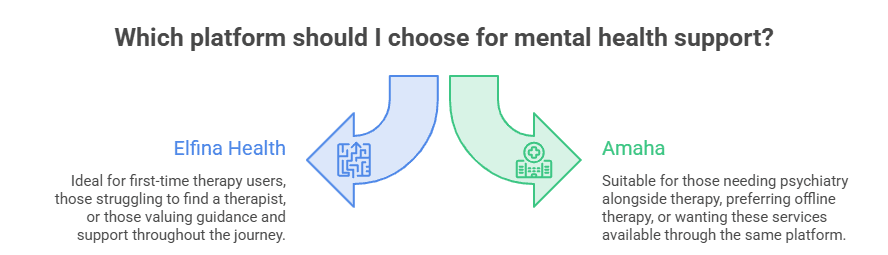
After comparing both platforms, the decision becomes a little clearer.
Choose Elfina Health If...
Elfina Health may be a good fit if:
You're starting therapy for the first time and feel overwhelmed by the process
You've tried therapy before but struggled to find the right therapist
You value guidance throughout the process rather than a more self-directed approach
You want support not just during therapy sessions, but throughout the wider therapy journey
Finding a therapist who feels like the right fit is your top priority
Choose Amaha If...
Amaha may be a good fit if:
You already know you need psychiatry alongside therapy
You're specifically looking for clinic-based services
You prefer having different forms of mental health support available through the same provider
Your primary goal extends beyond finding a therapist alone
If You're Still Unsure
If you're still deciding, it may help to ask yourself a simple question:
Are you primarily trying to access mental health services, or are you primarily trying to find a therapist who feels right for you?
Your answer will often point you in the right direction.
For people who feel uncertain about choosing a therapist, a guided matching conversation can also provide clarity before committing to therapy itself.
Ultimately, the best therapy platform is not necessarily the biggest one. It's the one that helps you find support you'll actually stay with.
Also Read:
Is Online Therapy as Effective as In-Person? What Research Says
ADHD Self-Test: Take the ASRS 1.1 Quiz & Understand Your Symptoms
Frequently Asked Questions
Is Elfina Health better than Amaha?
Neither platform is universally "better". The right choice depends on what you're looking for. If your priority is finding a therapist who feels like the right fit and having guidance throughout that process, Elfina Health may be a better match. If you're specifically looking for services such as 24/7 support or inpatient care alongside therapy, Amaha may be more suitable.
What's the difference between Elfina Health and Amaha?
The biggest difference is how each platform approaches mental healthcare. Elfina Health is built around therapist matching and long-term therapy engagement, while Amaha brings together multiple forms of mental health support under the same umbrella. As a result, the experience of getting started, choosing a therapist, and navigating care can feel quite different on each platform.
Does it actually matter which therapist I choose, or will any trained therapist do?
Yes, therapist fit matters. Research has consistently found that the quality of the relationship between a client and therapist is one of the strongest predictors of positive therapy outcomes. While qualifications are important, feeling understood, comfortable, and able to build trust with your therapist can significantly influence your experience in therapy.
Which platform is better for first-time therapy seekers?
Many first-time therapy seekers may find Elfina Health's guided matching approach helpful because it reduces the pressure of choosing a therapist independently. Amaha can also be a good option, particularly for people who already know what type of support they're looking for or want access to services beyond therapy.
Can I switch therapists on Elfina Health or Amaha?
Elfina Health provides a structured process for therapist transitions if the initial fit doesn't feel right. Amaha does not currently offer a built-in therapist switching option, so users generally need to contact customer support separately if they wish to explore a change. As platform features can evolve over time, it's always worth checking the latest support documentation or contacting the platform directly for the most up-to-date information.
How much does therapy cost on Elfina Health vs Amaha?
Therapy fees vary on both platforms depending on the therapist's experience, qualifications, and area of expertise. Amaha's pricing may also vary based on the type of service being accessed. Because fees can change over time, it's best to check each platform directly for the most up-to-date pricing information.
Does Elfina Health have an app?
Yes. Elfina Health has a web app where clients and therapists can track therapy goals, add reflections, and access AI-generated session summaries with the client's consent. This sits alongside the guided matching process and TEM support as part of one connected therapy experience.
Looking for specific mental health apps? Read The 7 Best Mental Health Apps of 2026 – According to a Therapist.

Elfina Health vs Amaha: Which Mental Health Platform Fits You?
|
5
min read
|
Tanvi

Deciding to start therapy can take weeks, months, or even years of consideration. Once you've made that decision, another question often appears almost immediately: where should I begin?
If you've been researching online therapy platforms in India, chances are you've come across both Elfina Health and Amaha. Both are credible mental health platforms. Both connect people with qualified professionals. And both are trying to make mental healthcare easier to access.
So how do you choose between them?
The answer isn't necessarily about which platform is "better". It's about understanding what each platform is designed to do and which approach feels like a better fit for your needs.
In this guide, we'll compare Elfina Health and Amaha, explore how the experience differs on each platform, and help you decide where you may feel most supported.
Elfina Health vs Amaha in One Minute
If you're looking for the short answer, it comes down to this:
Elfina Health may be the better choice if your priority is finding the right therapist and having guidance throughout your therapy journey.
Amaha may be the better choice if you already know you're looking for services beyond therapy, such as psychiatry, assessments, or clinic-based care.
Here's a quick comparison:
Aspect | Elfina Health | Amaha |
Primary Focus | Finding the right therapist | Bringing different types of mental health support into one place |
Getting Started | Guided matching call | App, website, or clinic-based entry |
Choosing a Therapist | Personalised recommendations | Browse from a list of available therapists |
Support Throughout the Journey | TEM-led guidance and follow-up | Platform resources and service options |
Session Fees | Vary based on therapist experience and expertise | Vary based on therapist and service type |
Best For | People prioritising therapist fit | People seeking support beyond therapy alone |
While both platforms aim to improve access to mental healthcare, they approach that goal in very different ways. Understanding those differences starts with looking at what they have in common.
What Both Platforms Get Right
Before comparing how Elfina Health and Amaha differ, it's worth acknowledging something important: both platforms are built around professional mental healthcare.
Both connect people with qualified mental health professionals and emphasise evidence-based approaches to support. The question here is not whether one platform is legitimate and the other isn't. It's whether one approach may suit your needs better than the other.
There's another reason this matters.
Research has consistently shown that a strong therapeutic alliance, the relationship between a client and therapist, is one of the most important predictors of positive therapy outcomes. In other words, the quality of that relationship often matters more than the platform itself. According to psychotherapy research, feeling understood, supported, and able to work collaboratively with your therapist plays a significant role in how helpful therapy ultimately feels (Opland & Torrico, 2024).
If you're wondering how much therapist fit actually shapes your outcomes, Why Therapy Didn't Work for You (And Why It’s Not Your Fault) explores this in depth.
That idea becomes an important lens for understanding the rest of this comparison because, while both platforms provide access to mental health support, they take very different approaches to helping people find it.
Two Different Ways of Approaching Mental Health Care
At first glance, Elfina Health and Amaha may seem quite similar. Both offer access to mental health professionals and both aim to make support easier to find. The biggest difference lies in what each platform is trying to solve.
Elfina's Approach: Helping People Find the Right Therapist

Elfina Health is built around a simple idea: finding the right therapist shouldn't feel like guesswork.
Many people start therapy after spending hours scrolling through profiles, reading bios, and trying to decide who might be a good fit. Even then, there's often uncertainty about whether the therapist's approach, communication style, or experience will actually match what they're looking for.
Instead of asking people to figure this out on their own, Elfina focuses on therapist matching. Every client begins with a guided matching call where their goals, concerns, preferences, and practical needs are explored before a therapist is recommended.
This process is supported by Therapy Experience Managers (TEMs), who act as a bridge between the client and the platform. Their role extends beyond the initial match, helping clients navigate therapy, set expectations, and access support if challenges arise later on.
What makes this different is that TEMs are therapists themselves, not coordinators or intake staff. Their clinical training helps them look beyond surface-level preferences and understand the kind of therapeutic relationship that is most likely to work. Think of it like the difference between walking into a gym and being handed a list of trainers versus speaking with someone who knows each trainer well, takes the time to understand your history and goals, and can recommend the right fit. The guidance comes from genuine clinical insight, not just a directory.
What stands out about Elfina Health's approach is that these elements are designed to work together. The matching process, therapist recommendations, expectation setting, and ongoing support are all part of the same journey rather than separate features. The goal is not simply to help someone start therapy, but to help them stay engaged with it over time.
Elfina’s network also includes clinical psychologists who can conduct formal assessments when appropriate.
Rather than trying to provide every type of mental health service, Elfina Health focuses on helping people find a therapist they feel comfortable staying with.
Amaha's Approach: Bringing Different Types of Support Into One Place

Amaha takes a different approach.
Alongside therapy, it offers services such as psychiatry, assessments, self-guided resources, and clinic-based care. The goal is to provide multiple ways for people to access mental health support depending on what they're looking for.
Amaha also offers 24-hour mental health support services and has expanded into inpatient mental healthcare. While these services may not be relevant for everyone seeking therapy, they can be valuable for people with more specialised support needs.
For someone who already knows they may need services beyond therapy, having these options available through the same platform can be valuable.
Also, Amaha's entry point is self-directed: users browse available therapists with basic filters and make their own selection.
The simplest way to think about the difference is this:
➡️ Elfina Health focuses on helping people find and stay with the right therapist. Amaha focuses on providing access to a broad range of mental health services. How you find your therapist within that is largely up to you.
That difference becomes even clearer when you look at what starting therapy actually feels like on each platform.
What Starting Therapy Actually Feels Like
Comparison pages often focus on features. But for most people, the experience of getting started matters far more.
Starting Therapy with Elfina Health
The journey at Elfina Health typically begins with a matching call rather than a therapist directory.
During this conversation, a Therapy Experience Manager takes time to understand why someone is seeking therapy, what they're hoping to work on, their preferences around communication style, and any previous therapy experiences they've had.
Based on this information, a therapist recommendation is made. Rather than relying solely on profile browsing, Elfina Health's matching process considers multiple factors, helping make therapist selection feel more informed and transparent.
The goal is to reduce the trial-and-error that often comes with choosing a therapist independently. Publicly shared data from Elfina Health also suggests that a large majority of clients are successfully matched with a suitable therapist on their first recommendation.
The experience itself is largely web-based and centred around the therapy journey, with tools that help support progress and engagement over time. Elfina Health also has a web app where clients and therapists can track therapy goals, add reflections, and access AI-generated session summaries with the client's consent.
Starting Therapy with Amaha
Amaha offers several entry points into care.
People can explore the platform through its website, app, therapy services, psychiatry offerings, or clinic-based support depending on what they need. When it comes to choosing a therapist, users browse available therapists or refer to the brochure and make their own selection from there.
This creates flexibility for people who already have a clear idea of the kind of support they want.
For many people, however, the hardest part of starting therapy is not attending the first session. It's figuring out who to trust with it.
And that raises another important question: what happens if the therapist you start with doesn't feel like the right fit?
What Happens If Therapy Doesn't Feel Right?
One of the most common fears people have about therapy is investing time, money, and emotional energy into a therapist who doesn't feel like the right match.
The reality is that therapy fit matters, and sometimes adjustments are needed.
Therapist Switching and Feedback
Both Elfina Health and Amaha recognise that not every therapeutic relationship will work perfectly from the start.
If therapy feels stuck, expectations aren't aligned, or a different therapeutic style is needed, people may choose to explore another therapist.
The difference lies less in whether switching is possible and more in how support is provided throughout that process.
Elfina includes a dedicated process for therapist transitions when needed. Amaha does not currently offer a built-in therapist switching option, so users generally need to reach out to customer support separately if they wish to change therapists.
The Role of Therapy Experience Managers
One of the more distinctive aspects of Elfina Health's model is the involvement of Therapy Experience Managers beyond the initial onboarding stage.
Rather than disappearing after a therapist is matched, TEMs remain available to help clients navigate different parts of the therapy journey.
Because they work closely with therapists throughout the hiring process and beyond, they develop a nuanced understanding of each therapist's style, strengths, and approach. This allows them to provide more informed support when questions, concerns, or challenges arise during therapy.
This can include:
Setting realistic expectations about therapy
Providing psychoeducation around the therapeutic process
Gathering structured feedback after sessions to understand how things are going
Talking to both the client and therapist when something needs attention, forming a balanced view of the relationship
Supporting therapist transitions when needed
Helping clients navigate challenges that arise during therapy
Providing a safe space to articulate something that feels difficult to bring directly to a therapist yet
For many people, this kind of support can be especially valuable during the early stages of therapy. Questions about whether therapy is "working", how long progress should take, or whether difficult emotions are normal often come up along the way. Having someone available to provide context, answer questions, and gather feedback can make the process feel less overwhelming.
In practice, this means therapist matching is not treated as a one-time event. It's viewed as an ongoing process that may require support, adjustment, and conversation along the way.
And that naturally leads to a bigger question: why does therapist fit matter so much in the first place?
Why Therapy Fit Matters More Than Most People Realise
Throughout this comparison, one theme keeps resurfacing: finding the right therapist.
That's because therapy isn't simply about finding a qualified professional. It's also about finding someone you feel comfortable opening up to, working with, and returning to week after week.
The Clinical Importance of Feeling Understood
Therapy is built on a relationship.
Research has consistently found that a strong therapeutic alliance, the sense of trust, collaboration, and connection between a client and therapist, is one of the most important predictors of positive therapy outcomes. People are generally more likely to engage in the process, discuss difficult topics honestly, and stay committed to therapy when they feel understood and supported by their therapist.
This doesn't mean there is only one "perfect" therapist for every person. But it does suggest that therapist fit deserves serious consideration rather than being treated as an afterthought.
For a closer look at how long it typically takes for therapy to feel like it's working, read How Long Does Therapy Actually Take to Work? Honest Timelines for Common Issues.
How Elfina Health Tries to Improve Therapist Fit
This is the challenge Elfina Health has chosen to focus on.
Rather than offering a large directory and leaving people to figure things out on their own, Elfina uses guided matching to recommend therapists based on a person's goals, preferences, and circumstances.
The matching call exists for exactly this reason - because finding the right therapist goes beyond qualifications and expertise. It's also about human connection, communication style, and the kind of relationship a person is likely to feel safe in. That requires a conversation, not a filter.
The platform maintains a curated therapist network and applies rigorous quality standards during therapist selection. But what makes this compounding over time is how TEM knowledge evolves. TEMs continuously update their understanding of every therapist on the network - through structured client feedback, data-driven insights, and patterns that emerge across pairings over time. They can identify concerns early, gather feedback before something becomes a problem, and support therapist transitions when needed. The result is a model of care that is constantly learning and improving, not static.
Publicly shared retention and matching data suggest that this approach helps many clients find a therapist they feel comfortable continuing with. While no platform can guarantee a perfect match, Elfina Health has clearly built much of its model around improving the chances of finding one.
When Amaha May Be the Better Choice
A balanced comparison should also acknowledge that there are situations where Amaha may be the more suitable option.
If you already know you're looking for services beyond therapy alone, Amaha's approach may align better with your needs.
This might include people who:
Prefer accessing psychiatry and therapy through the same platform
Prefer clinic-based care
Want access to multiple types of mental health support in one place
For these situations, having different support pathways available in one place can be helpful.
Comparing more than two platforms? See our guide to the best online therapy platforms in India.
It's also worth noting that therapy platforms don't always operate in isolation. For example, when clients at Elfina Health require support beyond therapy, such as psychiatry or specialised assessments, they can be referred to trusted clinicians based on their needs. The team maintains clear records of these referrals and follows up to help ensure continuity of care.
The right choice ultimately depends less on which platform offers more and more on what you're actually looking for at this stage of your mental health journey.
So Which Platform Should You Choose?

After comparing both platforms, the decision becomes a little clearer.
Choose Elfina Health If...
Elfina Health may be a good fit if:
You're starting therapy for the first time and feel overwhelmed by the process
You've tried therapy before but struggled to find the right therapist
You value guidance throughout the process rather than a more self-directed approach
You want support not just during therapy sessions, but throughout the wider therapy journey
Finding a therapist who feels like the right fit is your top priority
Choose Amaha If...
Amaha may be a good fit if:
You already know you need psychiatry alongside therapy
You're specifically looking for clinic-based services
You prefer having different forms of mental health support available through the same provider
Your primary goal extends beyond finding a therapist alone
If You're Still Unsure
If you're still deciding, it may help to ask yourself a simple question:
Are you primarily trying to access mental health services, or are you primarily trying to find a therapist who feels right for you?
Your answer will often point you in the right direction.
For people who feel uncertain about choosing a therapist, a guided matching conversation can also provide clarity before committing to therapy itself.
Ultimately, the best therapy platform is not necessarily the biggest one. It's the one that helps you find support you'll actually stay with.
Also Read:
Is Online Therapy as Effective as In-Person? What Research Says
ADHD Self-Test: Take the ASRS 1.1 Quiz & Understand Your Symptoms
Frequently Asked Questions
Is Elfina Health better than Amaha?
Neither platform is universally "better". The right choice depends on what you're looking for. If your priority is finding a therapist who feels like the right fit and having guidance throughout that process, Elfina Health may be a better match. If you're specifically looking for services such as 24/7 support or inpatient care alongside therapy, Amaha may be more suitable.
What's the difference between Elfina Health and Amaha?
The biggest difference is how each platform approaches mental healthcare. Elfina Health is built around therapist matching and long-term therapy engagement, while Amaha brings together multiple forms of mental health support under the same umbrella. As a result, the experience of getting started, choosing a therapist, and navigating care can feel quite different on each platform.
Does it actually matter which therapist I choose, or will any trained therapist do?
Yes, therapist fit matters. Research has consistently found that the quality of the relationship between a client and therapist is one of the strongest predictors of positive therapy outcomes. While qualifications are important, feeling understood, comfortable, and able to build trust with your therapist can significantly influence your experience in therapy.
Which platform is better for first-time therapy seekers?
Many first-time therapy seekers may find Elfina Health's guided matching approach helpful because it reduces the pressure of choosing a therapist independently. Amaha can also be a good option, particularly for people who already know what type of support they're looking for or want access to services beyond therapy.
Can I switch therapists on Elfina Health or Amaha?
Elfina Health provides a structured process for therapist transitions if the initial fit doesn't feel right. Amaha does not currently offer a built-in therapist switching option, so users generally need to contact customer support separately if they wish to explore a change. As platform features can evolve over time, it's always worth checking the latest support documentation or contacting the platform directly for the most up-to-date information.
How much does therapy cost on Elfina Health vs Amaha?
Therapy fees vary on both platforms depending on the therapist's experience, qualifications, and area of expertise. Amaha's pricing may also vary based on the type of service being accessed. Because fees can change over time, it's best to check each platform directly for the most up-to-date pricing information.
Does Elfina Health have an app?
Yes. Elfina Health has a web app where clients and therapists can track therapy goals, add reflections, and access AI-generated session summaries with the client's consent. This sits alongside the guided matching process and TEM support as part of one connected therapy experience.
Looking for specific mental health apps? Read The 7 Best Mental Health Apps of 2026 – According to a Therapist.
Other blogs
Frequently Asked Questions
What types of therapy do you offer?
Can I meet my therapist in-person?
How do you match me with a therapist?
How much does therapy cost?
Do you offer free trials?
Finding The Right Fit, Made Easy

© Mindaro Health Technologies. All rights reserved
Finding the right fit, made easy.
FAQs
What types of therapy do you offer?
Can I meet my therapist in-person?
How do you match me with a therapist?
How much does therapy cost?
Do you offer free trials?