Couples Therapy in India: How It Works, Signs & Benefits
|
12
min read
|
Tanvi


Introduction: “Nothing is wrong. But something isn’t right either.”
Two people sitting next to each other after a long day. There are fewer arguments than before, but there’s also less warmth.
Conversations have become practical. Efficient. Almost transactional. You talk about what needs to get done, not about how you’re feeling or what’s been building quietly over time.
And somewhere in the background, a thought appears: “Is this just what relationships become?”
Most couples don’t reach a point where everything feels broken.
Instead, things start to feel slightly off. A little more distant. A little less easy than before.
➡️ Not enough to panic. But enough to notice.
This is often where couples therapy becomes relevant. Not as a last resort, but as a way to understand what changed; and why the relationship no longer feels the way it once did.
Because when something feels strained in a relationship, it rarely stays contained. Over time, it can affect how you feel day to day, how you handle stress, and how supported or understood you feel at home.
What is couples therapy, really? (And is it the same as couples counselling?)
Couples therapy is a structured, evidence-based process where two people work with a trained therapist to understand and change patterns in their relationship.
At a basic level, it is a space to talk openly and understand each other better. But most couples who come in have already tried that. They’ve had conversations, explained their side, and still find themselves going in circles.
That’s because couples therapy is not just about resolving individual issues or improving communication in a general sense.
What it actually focuses on
At its core, couples therapy looks at:
➡️ The patterns that keep repeating between partners
Not just what the disagreement is about, but how it keeps unfolding.
For example, a conversation may start small, escalate quickly, and end with both people feeling misunderstood. The topic may change each time, but the experience remains similar.
Over time, it’s not the issue itself that creates strain. It’s the pattern.
Why both partners are part of the process
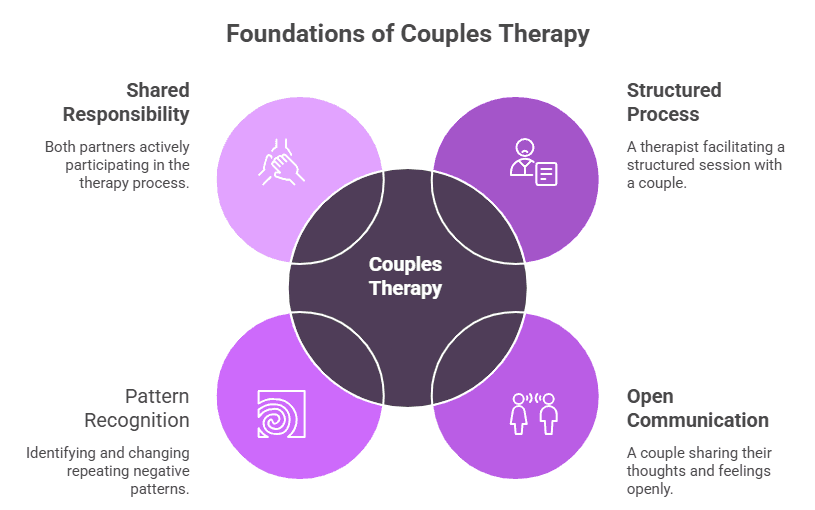
According to the American Psychological Association, couples therapy involves working with both partners together to address problems within and between them that affect the relationship.
This matters because, in most cases, the difficulty is not located in one person alone.
➡️ It exists in the interaction between both people.
What to expect from the therapist
Couples therapy is not about deciding who is right.
The therapist is not there to take sides or settle arguments. Instead, the focus is on understanding how both partners are contributing to the dynamic, often in ways that are not immediately obvious.
That shift - from blame to understanding - is where meaningful change begins.
Couples counselling vs couples therapy
In practice, the terms are often used interchangeably, especially in India.
Some people use “counselling” to refer to shorter, issue-focused work, and “therapy” for deeper, pattern-focused work. But in real situations, this distinction tends to blur.
Some couples come in with a specific concern. Others realise that the issue is part of a larger pattern. In many cases, what begins as a short-term concern opens into deeper exploration over time.
What does couples therapy actually work on? (It’s not the fights you think)
Couples therapy focuses on patterns of interaction, not just individual issues or isolated conflicts.
Across different approaches, one idea shows up consistently:
➡️ Relationship difficulties are maintained by repeating interaction cycles
Each partner’s response influences the other, and over time, these responses begin to reinforce each other.
What this looks like in real life
A common pattern many couples find themselves in:
One partner pushes for connection, clarity, or a response
The other withdraws, shuts down, or avoids
Over time, the pattern intensifies.
The more one person pushes, the more the other withdraws. And the more one withdraws, the more the other feels the need to push.
Both partners end up feeling:
Unheard
Misunderstood
And stuck in the same loop
Why this pattern is hard to break
These cycles don’t happen once. They become familiar, automatic ways of responding.
Each person’s reaction makes sense from their point of view. But together, those reactions keep the pattern going.
➡️ Without realising it, both partners begin to reinforce the very dynamic they’re trying to change.
What the conflict is really about
On the surface, arguments may seem to be about:
Time
Chores
Responsiveness
Priorities
But underneath, something more personal is often happening:
One partner feels unimportant
The other feels criticised
➡️ The topic is just the entry point. The pattern is what sustains the conflict.
What sits beneath the reactions
What shows up externally is often anger or frustration.
But beneath that, there is usually:
A fear of rejection
A sense of emotional distance
A need to feel valued or reassured
This is where therapy does its real work.
Not just resolving the immediate disagreement, but helping both partners understand and change the pattern that keeps bringing them back to the same place.
Does couples therapy actually work? (What research says - and what this means in India)
Couples therapy is one of the most effective ways to improve relationship satisfaction and emotional connection.
This is consistently supported by research.
A meta-analysis by Roddy, Doss, and colleagues (2020), covering 50+ studies, found large improvements in relationship satisfaction among couples who received therapy, while those who did not showed little meaningful change
Reviews of the field, including work by Lebow and colleagues (2022), describe couples therapy as a well-established, evidence-based approach for reducing relationship distress and improving relationship quality.
What this means in practice
Couples therapy is not just about talking through problems.
It helps couples:
Recognise repeating patterns
Understand each other’s emotional responses
Respond differently in moments that usually escalate
Over time, this changes how the relationship feels; not just during conflict, but day to day.
The impact goes beyond the relationship
Distressed relationships are strongly linked to:
Substance use
Physical health issues
They also affect the emotional environment at home, including children’s wellbeing (Bernet et al., 2016).
➡️ Improving the relationship often improves overall mental health as well.
What this means in the Indian context
There is limited India-specific research in this area.
But the patterns seen in global research are widely reflected in urban Indian relationships:
High work stress
Emotional strain
Limited space for open conversations
The context may differ, but the underlying dynamics are similar.
Which is why these approaches remain relevant here.
When should you consider couples therapy?
Couples therapy is most helpful when patterns begin repeating, not just when things reach a breaking point.
Many couples wait.
They consider therapy when:
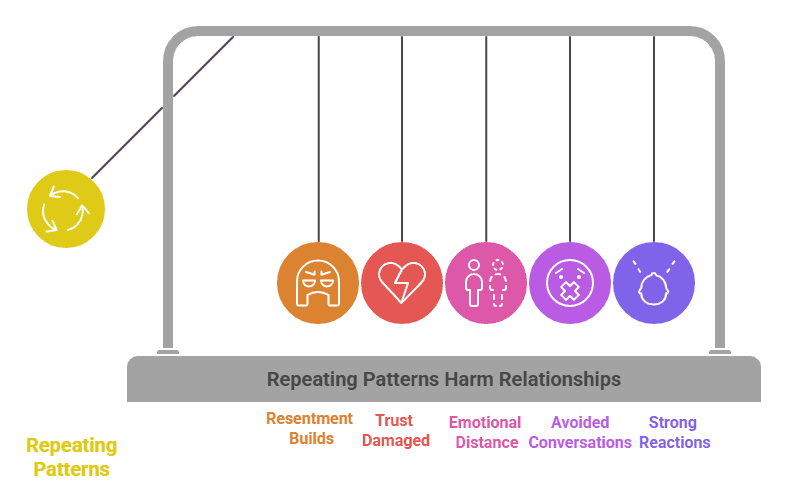
Resentment has built up
Trust has been damaged
Or separation feels close
By that point, the pattern is usually well established.
Early signs that something is repeating
The same arguments come up again and again
Emotional distance begins to grow
Conversations feel effortful or get avoided
Small issues trigger strong reactions
These are not isolated problems. They point to a repeating pattern.
Why earlier tends to work better
Relationship difficulties are rarely about one moment.
They are about patterns that:
Repeat
Reinforce themselves
Become harder to shift over time
➡️ The longer a pattern runs, the more automatic it becomes.
A more useful question
Instead of asking: “Is this serious enough for therapy?”
It can be more helpful to ask:
➡️ “Are we stuck in something that keeps repeating, and don’t know how to change it?”
Also Read:
Trauma-Informed Therapy: Techniques, Triggers & Finding the Right Therapist
Work Pressure Is Affecting Your Mental Health - Let's Fix That
What if your partner isn’t ready for therapy?
It is still possible to begin individually, even if couples therapy is the goal.
Relationships function as systems. When one person changes how they respond, the overall pattern can begin to shift.
Even small changes in:
Communication
Emotional regulation
Reactions during conflict
can influence the dynamic.
Curious about how individual therapy fits into relationship challenges? This piece on how individual therapy can strengthen relationships is worth a read.
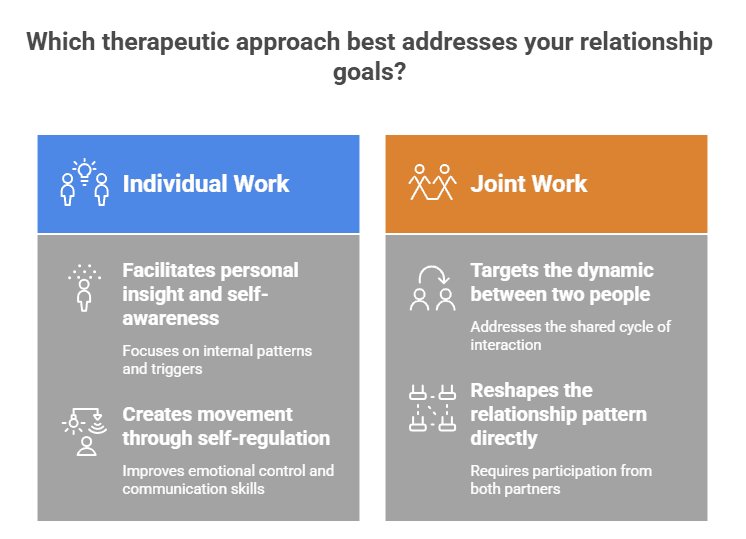
What individual work can help with
Gaining clarity about what’s happening
Recognising your own patterns and triggers
Improving emotional regulation
Communicating more effectively
What it cannot fully replace
At the same time, deeper change usually happens when both partners are involved.
Because:
The pattern exists between both people
And both are part of how it continues
Individual work can create movement. Joint work helps reshape the pattern more directly.
What happens in couples therapy? (And what it actually feels like)
Couples therapy is a guided process where conversations are slowed down so both partners can understand and begin to change their patterns.
What early sessions focus on
Early sessions are about building clarity.
This usually involves:
Understanding the relationship history
Identifying recurring patterns
Observing how both partners communicate in real time
Clarifying shared (or different) goals
The focus is not on fixing things immediately, but on seeing what is actually happening.
How the work develops
As therapy progresses:
Patterns become easier to recognise
Emotions are expressed more clearly
Reactions are understood differently
What once felt like:
Blame
Criticism
Defensiveness
is gradually reframed as:
➡️ underlying needs, fears, or emotional responses
How therapists approach the work
Most modern couples therapy is integrative.
As described in recent reviews (Lebow et al., 2022), therapists draw from multiple approaches rather than following a single model rigidly.
This may include:
Helping partners identify and express emotions
Exploring how past experiences shape current reactions
Teaching communication and conflict resolution skills
Reframing the problem as a shared cycle, not one person’s fault
What it often feels like
Therapy can feel uncomfortable at first.
It may feel:
Emotionally intense
Confronting
Or overwhelming at times
This is especially true when:
Long-standing patterns are being discussed
Unresolved conflict surfaces
Deeper emotional layers are explored
At the same time, many couples experience:
Relief when things begin to make sense
Clarity about what has been happening
A different way of seeing each other
➡️ That discomfort is often part of the process, not a sign that something is going wrong.
Types of couples therapy (and which one might fit your situation)
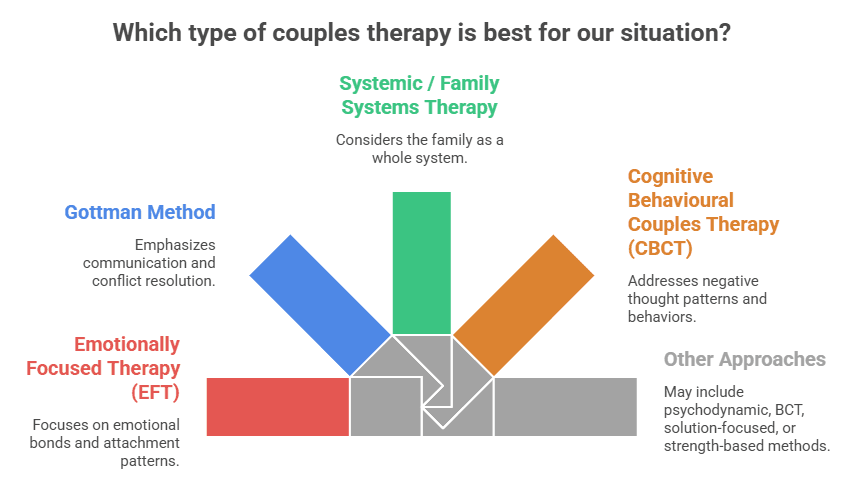
Different approaches to couples therapy focus on different aspects of relationships, and in practice, most therapists use a combination based on what you need.
There isn’t one single “type” that works for everyone.
Different approaches focus on:
Emotions
Communication patterns
Thoughts and behaviours
Or the broader context of the relationship
What matters is understanding what each one is trying to change.
Emotionally Focused Therapy (EFT)
Best suited for emotional disconnection and attachment-related issues.
EFT focuses on helping partners:
Move out of defensive reactions
Express vulnerability more openly
Feel emotionally safer with each other
It is based on attachment theory and has strong research support.
Meta-analyses show medium to large improvements in relationship satisfaction, with gains often maintained over time.
Gottman Method
Often helpful in high-conflict relationships.
The Gottman Method is built on decades of observational research with couples. It focuses on:
Improving communication
Repairing conflict more effectively
Strengthening the “friendship” in the relationship
The idea is not to eliminate conflict, but to make it less damaging and more manageable.
Systemic / Family Systems Therapy
This approach looks at the relationship as part of a larger system, not in isolation.
It focuses on:
Family dynamics
Roles within the relationship
Long-standing relational patterns
Ideas from approaches like Bowenian family systems theory help explain how:
Family history
Emotional habits
Intergenerational patterns
continue to shape present-day relationships.
Understanding these broader systems is central to working with relationship patterns effectively.
Cognitive Behavioural Couples Therapy (CBCT)
Useful when patterns are strongly driven by thoughts and behaviours.
CBCT focuses on:
How partners interpret each other’s actions
How those interpretations shape reactions
And how behaviour reinforces conflict
It is also commonly used when one partner is dealing with:
Anxiety
Depression
and the relationship is being affected as a result.
CBCT and related approaches are considered well-established treatments for relationship distress in evidence reviews.
If you're unsure whether anxiety or depression might be playing a role, our guide to CBT therapy breaks down how this approach works and who it tends to help most.
Other approaches you may come across
Some therapists may also draw from:
Psychodynamic approaches → explore deeper fears, motivations, and past relational patterns
Behavioural Couples Therapy (BCT) → focuses on reinforcing positive behaviours and interactions
Solution-focused therapy → useful for short-term, specific concerns
Strength-based approaches (e.g. Ellen Wachtel) → focus on what is already working and build from there
What this means in practice
Most therapists do not follow a single model rigidly.
As we discussed before, modern couples therapy is integrative and flexible, combining ideas from different approaches depending on the couple’s needs.
Couples therapy in India: Why finding the right therapist is harder than it should be
In India, the challenge is not just accessing therapy, but finding therapists trained specifically in couples work.
The training gap
Couples therapy requires specialised training.
But in India, there are very few formal training pathways in couple or family therapy. Most programmes focus on individual therapy, with limited in-depth training in systemic or couples-based approaches.
This means that:
➡️ Many therapists offering couples therapy may not have structured training in approaches like EFT, Gottman, or systemic family therapy.
Why this matters
Couples therapy is not the same as individual therapy with two people present.
It requires the ability to:
Hold space for two people at once
Manage conflict safely in real time
Track interaction patterns as they unfold
Stay neutral without reinforcing blame
Research and clinical reviews emphasise that working with reciprocal interaction cycles is central to effective couples therapy, a skill that comes from specific training, not just general practice.
Cultural context adds another layer
In India, relationships often exist within a broader system.
This can include:
Family involvement
Cultural expectations
Gender roles
These factors shape:
How conflict is expressed
What is spoken about openly
And what is avoided
Which makes the therapist’s understanding of context even more important.
How to tell if couples therapy is helping
Progress in couples therapy is not always obvious in the beginning.
It is often:
Gradual
Non-linear
And relational
In many cases, things may feel more intense before they start to feel better.
What early progress actually looks like
Early signs are often subtle:
Arguments become slightly less repetitive or less intense
One or both partners pause before reacting
There is a sense of being better understood
Patterns start becoming visible (“this is our usual cycle again”)
In well-conducted couples therapy, the first shift is often not resolution.
It is understanding. And over time, that understanding is what allows change to happen.
Why the right therapist matters
Because of how this process works, the therapist plays a central role.
A well-trained therapist helps:
Identify patterns accurately
Guide difficult conversations safely
Adjust the approach based on what the couple needs
➡️ Without that, therapy can feel confusing, ineffective, or even frustrating.
How Elfina approaches couples therapy differently
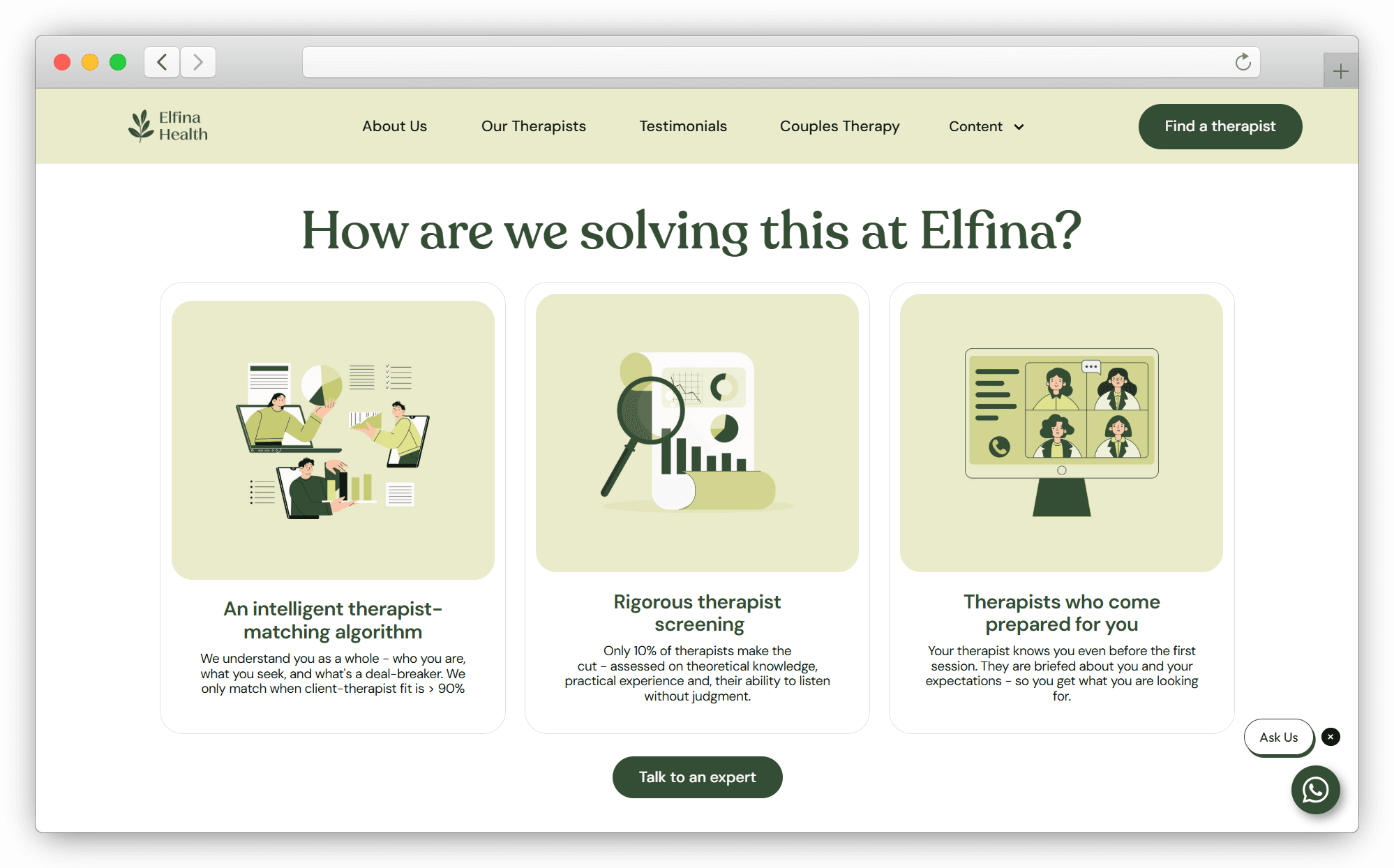
One of the biggest challenges with couples therapy in India is not just access - it’s consistency. The experience can vary widely depending on the therapist and how well the couple is matched.
Elfina’s approach focuses on reducing that uncertainty:
1. Trained couples therapists
Couples therapy requires a different skill set than individual therapy: holding space for two people, managing conflict safely, and tracking patterns in real time.
At Elfina, therapists are trained in approaches like EFT, Gottman, and systemic therapy, so the work goes beyond advice and focuses on deeper relational patterns.
2. Understanding both partners first
Each partner is spoken to individually before therapy begins, creating space to share openly without pressure.
This matters because both partners often experience the same relationship very differently; and not everything comes out in joint conversations.
3. Assessing readiness for therapy
Not every couple is equally ready to begin therapy at the same time, and that can shape how effective the process is.
We use structured tools like the Readiness for Psychotherapy Index (RPI) to understand openness to change, so expectations are more aligned from the start.
4. Understanding the relationship more objectively
Sometimes it helps to step back and look at the relationship beyond just conversation.
We use measures like the Couples Satisfaction Index (CSI) to map areas of strain and satisfaction, alongside what the therapist observes in sessions.
5. Ongoing feedback and flexibility
Couples therapy isn’t a fixed process. What works early on may need to shift as things unfold.
If something isn’t working, whether it’s the pace, approach, or fit, it can be adjusted so therapy stays aligned with both partners.
6. Built for all kinds of couples
Couples therapy isn’t limited to marriage. It can be just as relevant earlier in a relationship.
Elfina works with dating couples, live-in partners, and those preparing for marriage, focusing on the relationship itself, not the label.
The goal is not just to start therapy, but to ensure it’s thoughtful, well-matched, and meaningful for both partners.
FAQs: Real questions people ask about couples therapy
Is couples therapy only for serious problems?
No. Couples therapy is often most effective before problems become severe. Many couples come in when they notice repeating patterns or growing distance, not just during major crises.
When is the right time to start couples therapy?
The right time is usually when something keeps repeating and doesn’t resolve on its own. You don’t need to wait until things feel “bad enough” - earlier intervention often makes change easier.
Can couples therapy fix a relationship?
Therapy can help couples understand patterns, improve communication, and rebuild connection. Whether the relationship continues or not, it usually leads to more clarity and healthier decision-making.
Can couples therapy make things worse or lead to a breakup?
Therapy can feel more intense at first because difficult patterns are being addressed directly. In some cases, it may bring clarity that the relationship is not working. But even then, it helps people move forward in a more thoughtful and less reactive way.
Can couples therapy help with issues like infidelity or trust?
Yes. Couples therapy often works with issues like infidelity, trust breakdown, and emotional distance. The process usually involves understanding what happened, addressing underlying patterns, and gradually rebuilding trust.
If one partner has depression or anxiety, can couples therapy still help?
Yes. When individual mental health concerns affect the relationship, couples therapy can help both partners understand the impact and respond more effectively. In some cases, it is combined with individual therapy.
Is online couples therapy effective?
Research suggests that online therapy can be as effective as in-person therapy for many concerns, including relationship issues. For many couples, it also improves consistency by making sessions easier to attend.
Can we go for couples therapy if we’re not married?
Yes. Couples therapy is not limited to married couples.
It can be helpful at any stage of a relationship, including:
Dating
Live-in relationships
Long-term partnerships
Even when you’re trying to decide whether to continue the relationship
The focus is not on the label of the relationship, but on how the two of you relate to each other.
In many cases, starting earlier can actually be more useful. It helps identify patterns before they become deeply ingrained.
References
[1] Lebow, J., & Snyder, D. K. (2022). Couple therapy in the 2020s: Current status and emerging developments. Family process, 61(4), 1359–1385. https://doi.org/10.1111/famp.12824
[2] Roddy, M. K., Walsh, L. M., Rothman, K., Hatch, S. G., & Doss, B. D. (2020). Meta-analysis of couple therapy: Effects across outcomes, designs, timeframes, and other moderators. Journal of consulting and clinical psychology, 88(7), 583–596. https://doi.org/10.1037/ccp0000514
[3] Lebow, J., & Snyder, D. K. (2022). Couple therapy in the 2020s: Current status and emerging developments. Family process, 61(4), 1359–1385. https://doi.org/10.1111/famp.12824
[4] Bernet, W., Wamboldt, M. Z., & Narrow, W. E. (2016). Child affected by parental relationship distress. Journal of the American Academy of Child & Adolescent Psychiatry, 55(7), 571–579. https://doi.org/10.1016/j.jaac.2016.04.018
[5] Beasley, C. C., & Ager, R. (2019). Emotionally Focused Couples Therapy: A Systematic Review of Its Effectiveness over the past 19 Years. Journal of evidence-based social work (2019), 16(2), 144–159. https://doi.org/10.1080/23761407.2018.1563013
[6] Furrow, J.L., Johnson, S.M., Bradley, B., Brubacher, L., Palmer, G., Rheem, K., & Woolley, S. (2005). Becoming an Emotionally Focused Couple Therapist: The Workbook (1st ed.). Routledge. https://doi.org/10.4324/9780203955161

Couples Therapy in India: How It Works, Signs & Benefits
|
12
min read
|
Tanvi

Introduction: “Nothing is wrong. But something isn’t right either.”
Two people sitting next to each other after a long day. There are fewer arguments than before, but there’s also less warmth.
Conversations have become practical. Efficient. Almost transactional. You talk about what needs to get done, not about how you’re feeling or what’s been building quietly over time.
And somewhere in the background, a thought appears: “Is this just what relationships become?”
Most couples don’t reach a point where everything feels broken.
Instead, things start to feel slightly off. A little more distant. A little less easy than before.
➡️ Not enough to panic. But enough to notice.
This is often where couples therapy becomes relevant. Not as a last resort, but as a way to understand what changed; and why the relationship no longer feels the way it once did.
Because when something feels strained in a relationship, it rarely stays contained. Over time, it can affect how you feel day to day, how you handle stress, and how supported or understood you feel at home.
What is couples therapy, really? (And is it the same as couples counselling?)
Couples therapy is a structured, evidence-based process where two people work with a trained therapist to understand and change patterns in their relationship.
At a basic level, it is a space to talk openly and understand each other better. But most couples who come in have already tried that. They’ve had conversations, explained their side, and still find themselves going in circles.
That’s because couples therapy is not just about resolving individual issues or improving communication in a general sense.
What it actually focuses on
At its core, couples therapy looks at:
➡️ The patterns that keep repeating between partners
Not just what the disagreement is about, but how it keeps unfolding.
For example, a conversation may start small, escalate quickly, and end with both people feeling misunderstood. The topic may change each time, but the experience remains similar.
Over time, it’s not the issue itself that creates strain. It’s the pattern.
Why both partners are part of the process

According to the American Psychological Association, couples therapy involves working with both partners together to address problems within and between them that affect the relationship.
This matters because, in most cases, the difficulty is not located in one person alone.
➡️ It exists in the interaction between both people.
What to expect from the therapist
Couples therapy is not about deciding who is right.
The therapist is not there to take sides or settle arguments. Instead, the focus is on understanding how both partners are contributing to the dynamic, often in ways that are not immediately obvious.
That shift - from blame to understanding - is where meaningful change begins.
Couples counselling vs couples therapy
In practice, the terms are often used interchangeably, especially in India.
Some people use “counselling” to refer to shorter, issue-focused work, and “therapy” for deeper, pattern-focused work. But in real situations, this distinction tends to blur.
Some couples come in with a specific concern. Others realise that the issue is part of a larger pattern. In many cases, what begins as a short-term concern opens into deeper exploration over time.
What does couples therapy actually work on? (It’s not the fights you think)
Couples therapy focuses on patterns of interaction, not just individual issues or isolated conflicts.
Across different approaches, one idea shows up consistently:
➡️ Relationship difficulties are maintained by repeating interaction cycles
Each partner’s response influences the other, and over time, these responses begin to reinforce each other.
What this looks like in real life
A common pattern many couples find themselves in:
One partner pushes for connection, clarity, or a response
The other withdraws, shuts down, or avoids
Over time, the pattern intensifies.
The more one person pushes, the more the other withdraws. And the more one withdraws, the more the other feels the need to push.
Both partners end up feeling:
Unheard
Misunderstood
And stuck in the same loop
Why this pattern is hard to break
These cycles don’t happen once. They become familiar, automatic ways of responding.
Each person’s reaction makes sense from their point of view. But together, those reactions keep the pattern going.
➡️ Without realising it, both partners begin to reinforce the very dynamic they’re trying to change.
What the conflict is really about
On the surface, arguments may seem to be about:
Time
Chores
Responsiveness
Priorities
But underneath, something more personal is often happening:
One partner feels unimportant
The other feels criticised
➡️ The topic is just the entry point. The pattern is what sustains the conflict.
What sits beneath the reactions
What shows up externally is often anger or frustration.
But beneath that, there is usually:
A fear of rejection
A sense of emotional distance
A need to feel valued or reassured
This is where therapy does its real work.
Not just resolving the immediate disagreement, but helping both partners understand and change the pattern that keeps bringing them back to the same place.
Does couples therapy actually work? (What research says - and what this means in India)
Couples therapy is one of the most effective ways to improve relationship satisfaction and emotional connection.
This is consistently supported by research.
A meta-analysis by Roddy, Doss, and colleagues (2020), covering 50+ studies, found large improvements in relationship satisfaction among couples who received therapy, while those who did not showed little meaningful change
Reviews of the field, including work by Lebow and colleagues (2022), describe couples therapy as a well-established, evidence-based approach for reducing relationship distress and improving relationship quality.
What this means in practice
Couples therapy is not just about talking through problems.
It helps couples:
Recognise repeating patterns
Understand each other’s emotional responses
Respond differently in moments that usually escalate
Over time, this changes how the relationship feels; not just during conflict, but day to day.
The impact goes beyond the relationship
Distressed relationships are strongly linked to:
Substance use
Physical health issues
They also affect the emotional environment at home, including children’s wellbeing (Bernet et al., 2016).
➡️ Improving the relationship often improves overall mental health as well.
What this means in the Indian context
There is limited India-specific research in this area.
But the patterns seen in global research are widely reflected in urban Indian relationships:
High work stress
Emotional strain
Limited space for open conversations
The context may differ, but the underlying dynamics are similar.
Which is why these approaches remain relevant here.
When should you consider couples therapy?
Couples therapy is most helpful when patterns begin repeating, not just when things reach a breaking point.
Many couples wait.
They consider therapy when:
Resentment has built up
Trust has been damaged
Or separation feels close
By that point, the pattern is usually well established.
Early signs that something is repeating
The same arguments come up again and again
Emotional distance begins to grow
Conversations feel effortful or get avoided
Small issues trigger strong reactions
These are not isolated problems. They point to a repeating pattern.

Why earlier tends to work better
Relationship difficulties are rarely about one moment.
They are about patterns that:
Repeat
Reinforce themselves
Become harder to shift over time
➡️ The longer a pattern runs, the more automatic it becomes.
A more useful question
Instead of asking: “Is this serious enough for therapy?”
It can be more helpful to ask:
➡️ “Are we stuck in something that keeps repeating, and don’t know how to change it?”
Also Read:
Trauma-Informed Therapy: Techniques, Triggers & Finding the Right Therapist
Work Pressure Is Affecting Your Mental Health - Let's Fix That
What if your partner isn’t ready for therapy?
It is still possible to begin individually, even if couples therapy is the goal.
Relationships function as systems. When one person changes how they respond, the overall pattern can begin to shift.
Even small changes in:
Communication
Emotional regulation
Reactions during conflict
can influence the dynamic.
Curious about how individual therapy fits into relationship challenges? This piece on how individual therapy can strengthen relationships is worth a read.
What individual work can help with
Gaining clarity about what’s happening
Recognising your own patterns and triggers
Improving emotional regulation
Communicating more effectively
What it cannot fully replace
At the same time, deeper change usually happens when both partners are involved.
Because:
The pattern exists between both people
And both are part of how it continues
Individual work can create movement. Joint work helps reshape the pattern more directly.

What happens in couples therapy? (And what it actually feels like)
Couples therapy is a guided process where conversations are slowed down so both partners can understand and begin to change their patterns.
What early sessions focus on
Early sessions are about building clarity.
This usually involves:
Understanding the relationship history
Identifying recurring patterns
Observing how both partners communicate in real time
Clarifying shared (or different) goals
The focus is not on fixing things immediately, but on seeing what is actually happening.
How the work develops
As therapy progresses:
Patterns become easier to recognise
Emotions are expressed more clearly
Reactions are understood differently
What once felt like:
Blame
Criticism
Defensiveness
is gradually reframed as:
➡️ underlying needs, fears, or emotional responses
How therapists approach the work
Most modern couples therapy is integrative.
As described in recent reviews (Lebow et al., 2022), therapists draw from multiple approaches rather than following a single model rigidly.
This may include:
Helping partners identify and express emotions
Exploring how past experiences shape current reactions
Teaching communication and conflict resolution skills
Reframing the problem as a shared cycle, not one person’s fault
What it often feels like
Therapy can feel uncomfortable at first.
It may feel:
Emotionally intense
Confronting
Or overwhelming at times
This is especially true when:
Long-standing patterns are being discussed
Unresolved conflict surfaces
Deeper emotional layers are explored
At the same time, many couples experience:
Relief when things begin to make sense
Clarity about what has been happening
A different way of seeing each other
➡️ That discomfort is often part of the process, not a sign that something is going wrong.
Types of couples therapy (and which one might fit your situation)
Different approaches to couples therapy focus on different aspects of relationships, and in practice, most therapists use a combination based on what you need.
There isn’t one single “type” that works for everyone.
Different approaches focus on:
Emotions
Communication patterns
Thoughts and behaviours
Or the broader context of the relationship
What matters is understanding what each one is trying to change.

Emotionally Focused Therapy (EFT)
Best suited for emotional disconnection and attachment-related issues.
EFT focuses on helping partners:
Move out of defensive reactions
Express vulnerability more openly
Feel emotionally safer with each other
It is based on attachment theory and has strong research support.
Meta-analyses show medium to large improvements in relationship satisfaction, with gains often maintained over time.
Gottman Method
Often helpful in high-conflict relationships.
The Gottman Method is built on decades of observational research with couples. It focuses on:
Improving communication
Repairing conflict more effectively
Strengthening the “friendship” in the relationship
The idea is not to eliminate conflict, but to make it less damaging and more manageable.
Systemic / Family Systems Therapy
This approach looks at the relationship as part of a larger system, not in isolation.
It focuses on:
Family dynamics
Roles within the relationship
Long-standing relational patterns
Ideas from approaches like Bowenian family systems theory help explain how:
Family history
Emotional habits
Intergenerational patterns
continue to shape present-day relationships.
Understanding these broader systems is central to working with relationship patterns effectively.
Cognitive Behavioural Couples Therapy (CBCT)
Useful when patterns are strongly driven by thoughts and behaviours.
CBCT focuses on:
How partners interpret each other’s actions
How those interpretations shape reactions
And how behaviour reinforces conflict
It is also commonly used when one partner is dealing with:
Anxiety
Depression
and the relationship is being affected as a result.
CBCT and related approaches are considered well-established treatments for relationship distress in evidence reviews.
If you're unsure whether anxiety or depression might be playing a role, our guide to CBT therapy breaks down how this approach works and who it tends to help most.
Other approaches you may come across
Some therapists may also draw from:
Psychodynamic approaches → explore deeper fears, motivations, and past relational patterns
Behavioural Couples Therapy (BCT) → focuses on reinforcing positive behaviours and interactions
Solution-focused therapy → useful for short-term, specific concerns
Strength-based approaches (e.g. Ellen Wachtel) → focus on what is already working and build from there
What this means in practice
Most therapists do not follow a single model rigidly.
As we discussed before, modern couples therapy is integrative and flexible, combining ideas from different approaches depending on the couple’s needs.
Couples therapy in India: Why finding the right therapist is harder than it should be
In India, the challenge is not just accessing therapy, but finding therapists trained specifically in couples work.
The training gap
Couples therapy requires specialised training.
But in India, there are very few formal training pathways in couple or family therapy. Most programmes focus on individual therapy, with limited in-depth training in systemic or couples-based approaches.
This means that:
➡️ Many therapists offering couples therapy may not have structured training in approaches like EFT, Gottman, or systemic family therapy.
Why this matters
Couples therapy is not the same as individual therapy with two people present.
It requires the ability to:
Hold space for two people at once
Manage conflict safely in real time
Track interaction patterns as they unfold
Stay neutral without reinforcing blame
Research and clinical reviews emphasise that working with reciprocal interaction cycles is central to effective couples therapy, a skill that comes from specific training, not just general practice.
Cultural context adds another layer
In India, relationships often exist within a broader system.
This can include:
Family involvement
Cultural expectations
Gender roles
These factors shape:
How conflict is expressed
What is spoken about openly
And what is avoided
Which makes the therapist’s understanding of context even more important.
How to tell if couples therapy is helping
Progress in couples therapy is not always obvious in the beginning.
It is often:
Gradual
Non-linear
And relational
In many cases, things may feel more intense before they start to feel better.
What early progress actually looks like
Early signs are often subtle:
Arguments become slightly less repetitive or less intense
One or both partners pause before reacting
There is a sense of being better understood
Patterns start becoming visible (“this is our usual cycle again”)
In well-conducted couples therapy, the first shift is often not resolution.
It is understanding. And over time, that understanding is what allows change to happen.
Why the right therapist matters
Because of how this process works, the therapist plays a central role.
A well-trained therapist helps:
Identify patterns accurately
Guide difficult conversations safely
Adjust the approach based on what the couple needs
➡️ Without that, therapy can feel confusing, ineffective, or even frustrating.
How Elfina approaches couples therapy differently

One of the biggest challenges with couples therapy in India is not just access - it’s consistency. The experience can vary widely depending on the therapist and how well the couple is matched.
Elfina’s approach focuses on reducing that uncertainty:
1. Trained couples therapists
Couples therapy requires a different skill set than individual therapy: holding space for two people, managing conflict safely, and tracking patterns in real time.
At Elfina, therapists are trained in approaches like EFT, Gottman, and systemic therapy, so the work goes beyond advice and focuses on deeper relational patterns.
2. Understanding both partners first
Each partner is spoken to individually before therapy begins, creating space to share openly without pressure.
This matters because both partners often experience the same relationship very differently; and not everything comes out in joint conversations.
3. Assessing readiness for therapy
Not every couple is equally ready to begin therapy at the same time, and that can shape how effective the process is.
We use structured tools like the Readiness for Psychotherapy Index (RPI) to understand openness to change, so expectations are more aligned from the start.
4. Understanding the relationship more objectively
Sometimes it helps to step back and look at the relationship beyond just conversation.
We use measures like the Couples Satisfaction Index (CSI) to map areas of strain and satisfaction, alongside what the therapist observes in sessions.
5. Ongoing feedback and flexibility
Couples therapy isn’t a fixed process. What works early on may need to shift as things unfold.
If something isn’t working, whether it’s the pace, approach, or fit, it can be adjusted so therapy stays aligned with both partners.
6. Built for all kinds of couples
Couples therapy isn’t limited to marriage. It can be just as relevant earlier in a relationship.
Elfina works with dating couples, live-in partners, and those preparing for marriage, focusing on the relationship itself, not the label.
The goal is not just to start therapy, but to ensure it’s thoughtful, well-matched, and meaningful for both partners.
FAQs: Real questions people ask about couples therapy
Is couples therapy only for serious problems?
No. Couples therapy is often most effective before problems become severe. Many couples come in when they notice repeating patterns or growing distance, not just during major crises.
When is the right time to start couples therapy?
The right time is usually when something keeps repeating and doesn’t resolve on its own. You don’t need to wait until things feel “bad enough” - earlier intervention often makes change easier.
Can couples therapy fix a relationship?
Therapy can help couples understand patterns, improve communication, and rebuild connection. Whether the relationship continues or not, it usually leads to more clarity and healthier decision-making.
Can couples therapy make things worse or lead to a breakup?
Therapy can feel more intense at first because difficult patterns are being addressed directly. In some cases, it may bring clarity that the relationship is not working. But even then, it helps people move forward in a more thoughtful and less reactive way.
Can couples therapy help with issues like infidelity or trust?
Yes. Couples therapy often works with issues like infidelity, trust breakdown, and emotional distance. The process usually involves understanding what happened, addressing underlying patterns, and gradually rebuilding trust.
If one partner has depression or anxiety, can couples therapy still help?
Yes. When individual mental health concerns affect the relationship, couples therapy can help both partners understand the impact and respond more effectively. In some cases, it is combined with individual therapy.
Is online couples therapy effective?
Research suggests that online therapy can be as effective as in-person therapy for many concerns, including relationship issues. For many couples, it also improves consistency by making sessions easier to attend.
Can we go for couples therapy if we’re not married?
Yes. Couples therapy is not limited to married couples.
It can be helpful at any stage of a relationship, including:
Dating
Live-in relationships
Long-term partnerships
Even when you’re trying to decide whether to continue the relationship
The focus is not on the label of the relationship, but on how the two of you relate to each other.
In many cases, starting earlier can actually be more useful. It helps identify patterns before they become deeply ingrained.
References
[1] Lebow, J., & Snyder, D. K. (2022). Couple therapy in the 2020s: Current status and emerging developments. Family process, 61(4), 1359–1385. https://doi.org/10.1111/famp.12824
[2] Roddy, M. K., Walsh, L. M., Rothman, K., Hatch, S. G., & Doss, B. D. (2020). Meta-analysis of couple therapy: Effects across outcomes, designs, timeframes, and other moderators. Journal of consulting and clinical psychology, 88(7), 583–596. https://doi.org/10.1037/ccp0000514
[3] Lebow, J., & Snyder, D. K. (2022). Couple therapy in the 2020s: Current status and emerging developments. Family process, 61(4), 1359–1385. https://doi.org/10.1111/famp.12824
[4] Bernet, W., Wamboldt, M. Z., & Narrow, W. E. (2016). Child affected by parental relationship distress. Journal of the American Academy of Child & Adolescent Psychiatry, 55(7), 571–579. https://doi.org/10.1016/j.jaac.2016.04.018
[5] Beasley, C. C., & Ager, R. (2019). Emotionally Focused Couples Therapy: A Systematic Review of Its Effectiveness over the past 19 Years. Journal of evidence-based social work (2019), 16(2), 144–159. https://doi.org/10.1080/23761407.2018.1563013
[6] Furrow, J.L., Johnson, S.M., Bradley, B., Brubacher, L., Palmer, G., Rheem, K., & Woolley, S. (2005). Becoming an Emotionally Focused Couple Therapist: The Workbook (1st ed.). Routledge. https://doi.org/10.4324/9780203955161
Other blogs
Frequently Asked Questions
What types of therapy do you offer?
Can I meet my therapist in-person?
How do you match me with a therapist?
How much does therapy cost?
Do you offer free trials?
Finding The Right Fit, Made Easy

© Mindaro Health Technologies. All rights reserved
Finding the right fit, made easy.
FAQs
What types of therapy do you offer?
Can I meet my therapist in-person?
How do you match me with a therapist?
How much does therapy cost?
Do you offer free trials?