Anxiety in India: Symptoms, Causes, Treatment & Help
|
14
min read
|
Tanvi


Opening: The Kind of Anxiety We Don’t Talk About
Lying in bed, exhausted but somehow unable to switch off.
Your body is tired, but your mind is still working overtime. You replay something you said in a meeting. You wonder if that message sounded rude. You think about tomorrow’s deadlines, next month’s finances, your parents’ health, the future in general. Your heart is beating a little faster than usual, but not enough to feel alarming. There’s a tightness in your chest you can’t fully explain.
So you tell yourself what many people do:
“It’s just stress.”
Maybe you check your unread emails one more time. Maybe you open WhatsApp, then close it. Maybe you go over the same conversation again, trying to figure out if you missed something.
The strange part is how common this experience has become.
Almost everyone around you seems to carry some version of it. For some, it shows up as overthinking. For others, it shows up in the body, as a racing heart, shallow breathing, stomach discomfort, headaches, or a constant sense of unease.
And yet, many people never call it anxiety.
They call it being responsible. Being ambitious. Being busy. Being someone who cares.
But when worry becomes your normal state, it can be hard to notice that something deeper is happening.
This matters because anxiety is common, it is treatable, and it is not a personal weakness.
Understanding it is often the first turning point.
So What Is Anxiety, Really? (And When Is It More Than Just Stress?)
Anxiety, at its core, is the mind and body preparing for something that might go wrong.
It is a future-focused response. It tries to protect you by helping you stay alert, think ahead, notice risk, and avoid danger. In small doses, that system can be useful. It can help you prepare for an interview, study for an exam, or react quickly in an uncertain situation.
So anxiety itself is not the enemy. It is a normal human survival system.
What often creates confusion is that fear, stress, and anxiety are related, but not the same thing.
Fear usually responds to a threat happening right now. A car swerves suddenly. You hear a loud noise behind you.
Stress is often a response to current pressure, like deadlines, conflict, exams, or financial strain.
Anxiety is more about anticipation. It asks, What if something goes wrong?
The American Psychiatric Association describes anxiety as the anticipation of future threat, often linked with physical tension and cautious or avoidant behaviour.
It becomes a problem when that system does not switch off, even when there is no immediate danger.
Clinically (DSM-5), anxiety disorders are identified when anxiety becomes excessive, persistent, and begins interfering with daily functioning. In many cases, symptoms continue for months rather than passing with the stressful event itself.
That distinction matters.
It is not only about how intense anxiety feels in one moment. It is about whether it stays, whether it keeps returning, and whether it starts shaping your choices, relationships, sleep, confidence, or ability to function.
In India, this line often gets blurred. Constant worry and overthinking are frequently normalised. Many of us grow up seeing people who are always tense, always busy, always thinking ahead.
Being stressed can look like being hardworking. Being restless can look like being productive. Slowing down can even look irresponsible.
So persistent anxiety often goes unnoticed for much longer than it should.
If this feels familiar, it is not surprising. Anxiety is far more common than many people realise.
Why It Feels Like Everyone Is Anxious Right Now
If anxiety feels unusually common today, that is because in many ways, it is.
Globally, anxiety disorders affect hundreds of millions of people. The World Health Organization has estimated around 359 million people worldwide live with anxiety disorders, yet only a minority receive treatment.
In India, the picture is significant too. Research reviews have found substantial rates of anxiety-related conditions, with some studies showing higher prevalence in urban settings. Among young adults in Jaipur, one study found more than half screened positive for anxiety symptoms.
So if it feels like everyone around you is struggling in some form, you are not imagining it.
But statistics only tell part of the story. The more useful question is: why now?
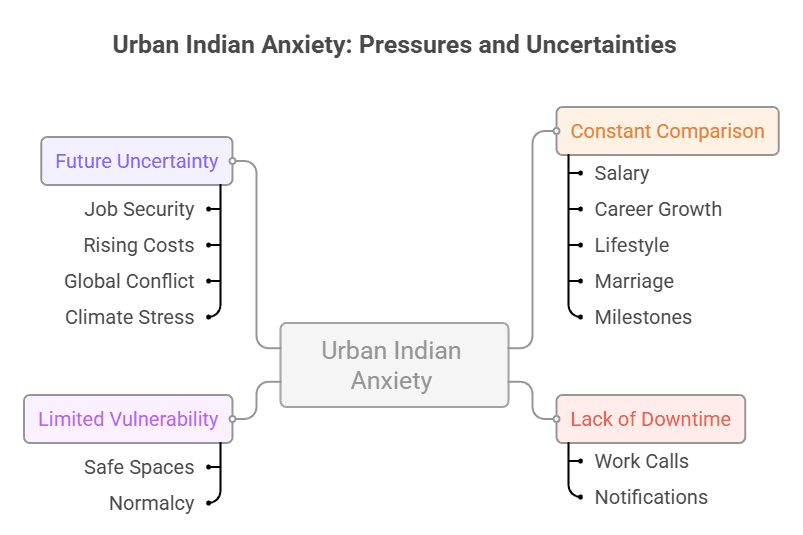
For many urban Indians, anxiety is being fuelled by multiple pressures at once:
Constant comparison around salary, career growth, lifestyle, marriage, or milestones
Very little true downtime, because work follows us through phones and notifications
Pressure to keep progressing, even when stability feels uncertain
Fewer spaces where vulnerability feels safe or normal
There is also a newer layer many young adults describe: a growing sense of uncertainty about the future.
People worry about job security, rising costs, global conflict, climate stress, and whether life will become more stable or more fragile. We are exposed to these concerns daily, often without any real control over them.
That can create a background feeling of: Something feels unstable, and I’m supposed to function normally anyway.
This is why anxiety can feel deeply personal while also being shaped by the world around us.
And anxiety does not always arrive dramatically. Most of the time, it is quieter than people expect.
For many people, it slowly becomes a baseline, something you get used to rather than question. Which is exactly why it can be difficult to recognise as a problem until it starts affecting your life more clearly.
Also Read:
Chronic Procrastination: What It Really Is, Why It Hurts, and How to Heal
Overcoming Imposter Syndrome: What It Is, Why It Happens & How Therapy Helps
What Anxiety Actually Feels Like (And Why It’s So Convincing)
One reason anxiety is so difficult to recognise is that it rarely feels like “a disorder”.
It usually feels like reality.
It feels like being careful. Being responsible. Thinking ahead. Staying prepared. It can feel like common sense, even when it is quietly draining you.
That is because anxiety does not only affect your thoughts. It also changes how your body feels and what you begin doing differently.
How Anxiety Changes Your Thoughts
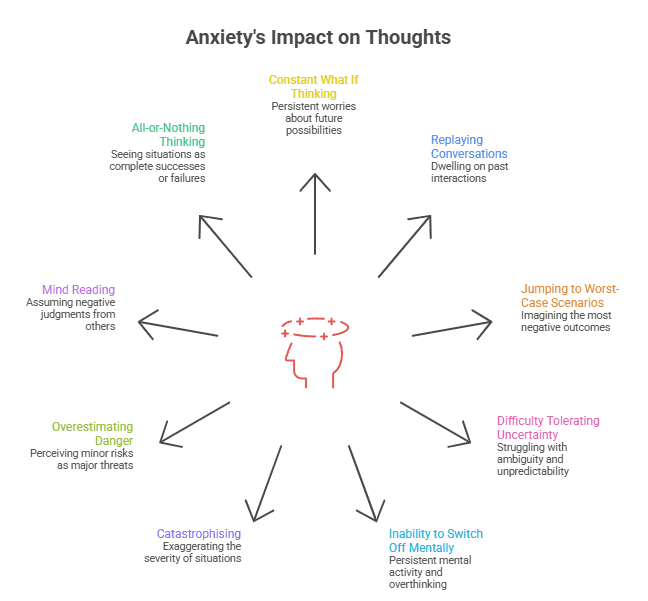
Many people notice anxiety first in the mind:
Constant what if thinking
Replaying conversations long after they ended
Jumping to the worst-case scenario
Difficulty tolerating uncertainty
Feeling unable to “switch off” mentally
Over time, anxiety can distort thinking patterns in predictable ways.
For example:
Catastrophising: imagining the worst possible scenario.
Your manager says, “Can we talk tomorrow?” and your mind immediately jumps to “Did I do something wrong?”Overestimating danger: treating small risks like major threats.
One awkward moment in a meeting starts feeling like something people will remember for weeks.Mind reading: assuming others are judging you negatively.
A friend replies with just “okay”, and you start wondering if they’re upset with you.All-or-nothing thinking: seeing situations as total success or total failure
One mistake during a presentation makes the whole day feel ruined.
These patterns often happen automatically. They do not feel irrational in the moment. They feel true.
That is why anxiety can be so convincing.
How Anxiety Feels in the Body
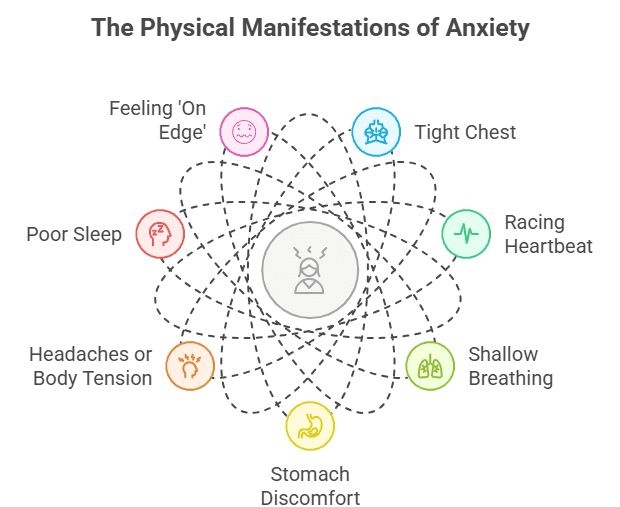
For many people, especially in India, anxiety first looks physical rather than emotional.
It can show up as:
Tight chest
Racing heartbeat
Shallow breathing
Stomach discomfort
Headaches or body tension
Poor sleep
Feeling “on edge” for no clear reason
Because anxiety can feel so physical, many people understandably assume something is wrong with their heart, digestion, hormones, or general health.
Sometimes medical evaluation is important. But when tests repeatedly come back normal, anxiety is often part of the picture.
How Anxiety Changes Behaviour
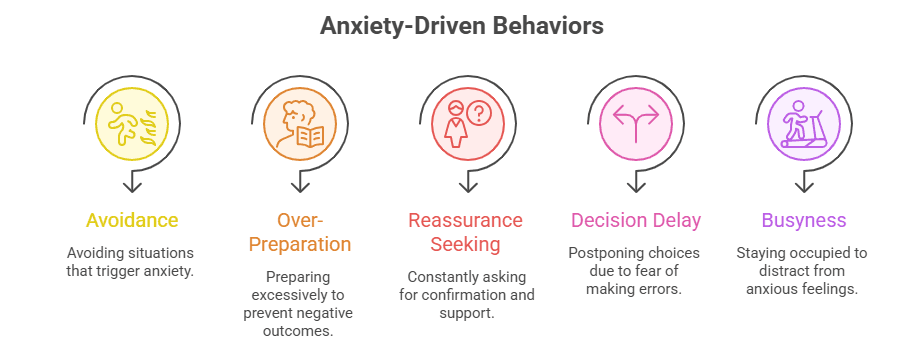
Anxiety also influences behaviour in quieter ways:
Avoiding situations that feel uncomfortable
Over-preparing so nothing can go wrong
Constantly seeking reassurance
Delaying decisions out of fear of mistakes
Staying busy to avoid feeling anxious
These behaviours can bring relief in the short term.
And that is exactly why they become powerful.
Why Anxiety Keeps Coming Back
Imagine you avoid a difficult phone call. Your anxiety drops immediately.
Your brain learns: Avoidance helped. That must have been dangerous.
This is part of a psychological process called avoidance learning, a form of conditioning where the brain learns that avoiding discomfort feels safer than facing it. The relief reinforces the behaviour, so your brain repeats it next time.
Over time:
Avoidance becomes automatic
Fear feels more believable
Confidence shrinks
Anxiety grows stronger
Psychologists often call this avoidance behaviour, and while it can bring short-term relief, it prevents the brain from learning that the situation may actually be manageable. The problem is that they prevent the brain from learning the situation may actually be manageable.
Sometimes people also use safety behaviours such as over-preparing, staying close to exits, or constantly seeking reassurance. These may feel protective in the moment, but they can also keep anxiety going.
What’s Happening Biologically?
When the brain senses threat, it activates the body’s stress response.
Adrenaline increases. Heart rate rises. Muscles tense. Cortisol helps the body stay alert (Source).
This response is useful during real danger. But when it is activated too often, the body can start living in a constant state of readiness.
That can feel exhausting.
Once we understand how anxiety works, the next question becomes clearer: why is it showing up so much right now, especially in India?
Why Are So Many Indians Feeling Anxious Right Now?
Anxiety rarely comes from one cause.
It usually builds from multiple layers: biology, past experiences, current stress, culture, and environment. In India, many of those layers can stack together at the same time.
1. Your Brain’s Threat System May Be Overworking
The brain naturally tries to detect danger and keep you safe.
Brain messengers called neurotransmitters, such as serotonin and GABA help regulate mood and anxiety, while areas like the amygdala help detect threat. When anxiety is high, this alarm system can become overactive.
In simple terms: Your brain is doing its job. Just a little too aggressively.
2. Past Experiences Shape What Feels Unsafe
What you have lived through matters.
Experiences like:
Childhood pressure
Criticism
Unpredictability at home
Repeated stress
Past embarrassment or failure
Trauma or loss
can train the brain to stay more alert later in life.
Sometimes people call themselves “naturally anxious” when they are actually carrying learned patterns from earlier experiences.
3. The Indian Environment Can Intensify Anxiety
Many people in India move through years of continuous performance pressure.
School can feel highly competitive
College often brings uncertainty about careers, identity, and the future
Workplaces may involve constant evaluation and comparison
Family expectations can remain strong well into adulthood
And in many Indian families, success is rarely experienced in private. It is often visible, discussed, and compared.
People are asked where they work, how much they earn, when they will marry, whether they own a home, what comes next.
Many of us also grow up hearing phrases like “log kya kahenge” (what will people say?), or being quietly compared to someone who seems to be doing better.
Over time, this can create a constant awareness of how we are being seen, judged, and where we stand socially, even when nobody says it directly.
Urban life itself can keep the nervous system on edge. Long commutes, traffic, construction noise, crowded public spaces, rushing to meetings, worrying about being late, all of this can quietly keep the body in a more activated state than we realise.
4. Culture Shapes How Anxiety Is Handled
Many people grow up hearing messages like:
Don’t overthink
Be strong
Adjust
Everyone deals with this
These messages often come from resilience and care. But they can also make anxiety harder to recognise.
When anxiety is not named:
It is less likely to be discussed
People do not learn healthy coping skills
Struggle gets minimised
So people often create their own ways to cope:
Suppressing feelings
Distracting themselves constantly
Staying busy
Avoiding difficult situations
These can help in the short term, but they don’t actually reduce anxiety; they just keep it in the background. For a while, these coping strategies can make it feel like things are under control.
But many people eventually come to therapy when these patterns stop working, when staying busy no longer quiets the mind, avoiding things starts shrinking their world, or pushing feelings aside no longer feels possible.
What once felt like coping starts feeling like survival.
5. Anxiety Can Show Up Differently Across Gender
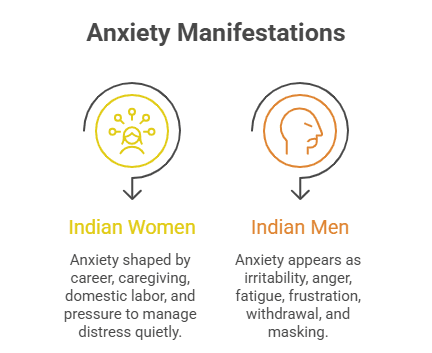
Research often finds anxiety disorders are more common in women, though anyone can experience anxiety.
For many Indian women, anxiety may be shaped by overlapping pressures:
Career performance
Caregiving responsibilities
Invisible domestic labour
Pressure to manage distress quietly
This can sometimes show up as constant worry, self-doubt, difficulty mentally switching off, or even physical symptoms like headaches, body pain, fatigue, or unexplained discomfort, especially when expressing emotional distress does not always feel safe or acceptable.
For many men, anxiety may be less openly named and more likely to appear as:
Irritability
Anger
Fatigue
Frustration
Withdrawal
Saying “I’m just stressed” instead of “I’m anxious”
This is not because men feel less anxiety. Often, they are simply taught to express it differently.
The Bigger Truth
Anxiety is not only about what is happening inside you.
It is also about what is happening around you.
And depending on how these pressures interact, anxiety can take different forms.
The Different Ways Anxiety Shows Up
Not all anxiety looks the same.
Some people worry constantly. Others fear social judgement. Some experience sudden panic. Others avoid one specific situation for years.
These experiences can fall into different anxiety disorders. Labels can be useful because they guide treatment, but your experience matters more than the label itself.
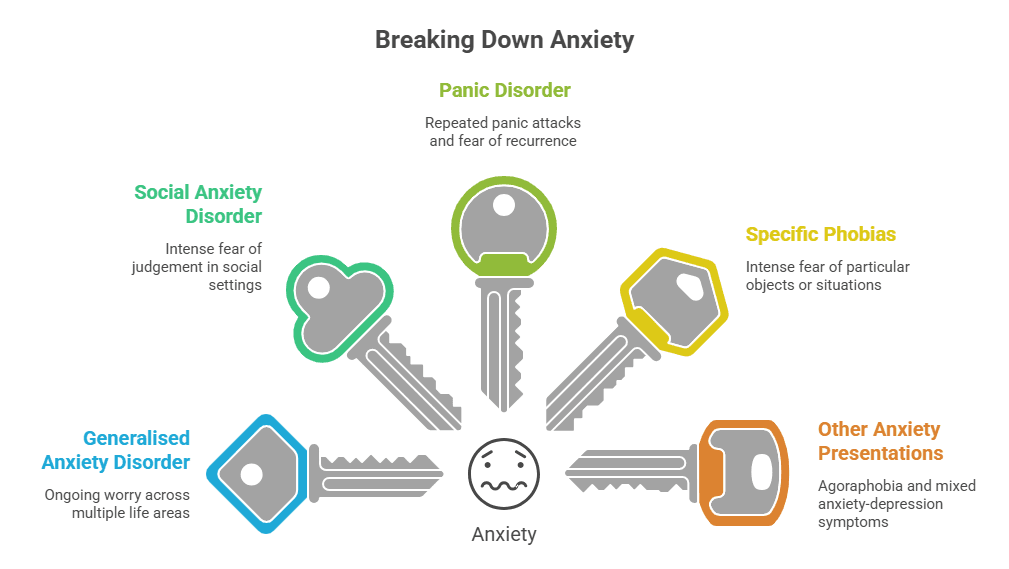
Generalised Anxiety Disorder (GAD)
This often looks like ongoing worry across multiple areas of life such as work, health, family, money, or the future.
The mind keeps searching for the next thing to solve.
It is often mistaken for:
“Just being a worrier”
Being highly responsible
Overthinking personality traits
Not sure whether what you're experiencing is GAD or just everyday stress? Take our anxiety quiz to get a clearer picture.
Social Anxiety Disorder
This involves intense fear of judgement, embarrassment, rejection, or looking foolish in front of others.
It may show up during:
Meetings
Presentations
Dating
Group settings
Speaking to authority figures
It is often mistaken for:
Introversion
Shyness
Low confidence
Panic Disorder
This involves repeated panic attacks or persistent fear of having another one.
Panic attacks can include:
Racing heart
Dizziness
Chest tightness
Breathlessness
Feeling like something terrible is happening
It is often mistaken for:
A heart problem
A medical emergency
“Going crazy”
Specific Phobias
This is intense fear linked to a particular object or situation, such as:
Flying
Needles
Dogs
Heights
Enclosed spaces
People usually know the fear feels excessive, but the body reacts strongly anyway.
Other Anxiety Presentations
Some people also struggle with:
Agoraphobia (fear of situations where escape feels difficult)
Mixed anxiety with depression or stress symptoms
Why This Matters
You do not need to diagnose yourself perfectly.
A clear diagnosis can help guide the right treatment. But you do not need to label yourself perfectly before asking for help. The goal is to notice patterns, understand what may be happening, and seek support if it is affecting your life.
So how do you know when anxiety has crossed that line?
When Should You Take Anxiety Seriously?
Many people do not ask for help because they think they need to be “bad enough” first.
They tell themselves:
Other people have it worse
I should be able to handle this
It’s just a stressful phase
Once work settles down, I’ll be fine
That hesitation is common. But the better question is usually not “Do I have anxiety?”
It is: “Is this starting to affect how I live?”
If anxiety is beginning to reduce your quality of life or disturb your normal functioning, it deserves attention.
That can look like:
Your mind rarely feeling at rest
Poor sleep, even when you are tired
Struggling to focus at work
Feeling more irritable or withdrawn
Avoiding calls, meetings, travel, or social plans
Overthinking small decisions for hours
Feeling exhausted by everyday life
Sometimes people continue functioning on the outside while struggling heavily on the inside. They are still meeting deadlines, replying to messages, showing up to work.
But everything feels harder than it should. That still counts.
Why Waiting Often Makes It Worse
Anxiety tends to grow through avoidance.
You skip one difficult situation and feel temporary relief. Then the next situation feels harder. Slowly, your world can become smaller without you fully noticing.
That is why “I’ll just wait for it to pass” does not always work when anxiety has become persistent.
How Anxiety Is Assessed
Getting help does not mean being labelled or judged.
Usually, a mental health professional starts by understanding:
What you have been feeling
How long it has been happening
What triggers it
How it is affecting daily life
Sometimes physical causes such as thyroid issues, sleep problems, or other health concerns may also need to be ruled out.
Simple screening tools like the GAD-7 can help measure anxiety symptoms, but they are not a diagnosis on their own.
A Helpful Rule of Thumb
If anxiety is repeatedly stealing your peace, energy, sleep, confidence, or freedom, it is worth taking seriously.
You do not need to wait until you are overwhelmed.
What Actually Helps (And What Doesn’t Work Long-Term)
If you are struggling with anxiety, the good news is this:
Anxiety does not have to keep running your life. With the right support, it can become far more manageable.
Many people improve significantly with the right support. But long-term relief usually comes from changing the pattern underneath anxiety, not only calming the symptoms in the moment.
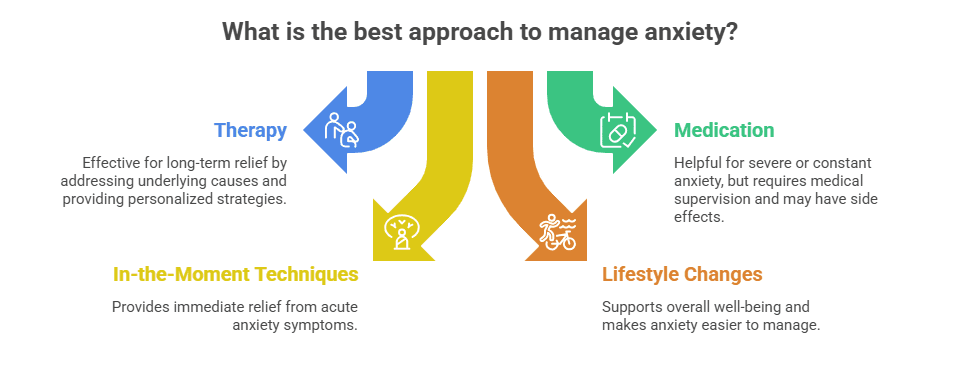
Therapy: The Most Effective Long-Term Option
Therapy is one of the most effective treatments for persistent anxiety because it helps you understand your anxiety, not just anxiety in general.
That matters more than it sounds.
Two people may both say, “I’m anxious,” but one may be driven by perfectionism, another by past criticism, another by health fears, another by chronic overwhelm.
Good therapy works with your specific story.
What Therapy Often Includes
Cognitive Behavioural Therapy (CBT) helps identify and change thought patterns that keep anxiety active.
For example:
Assuming the worst
Overestimating danger
Treating uncertainty like danger
Harsh self-judgement
Exposure-based therapy helps the brain gradually relearn safety by facing feared situations in a supported, manageable way.
Instead of avoidance teaching fear, new experiences teach confidence.
That is powerful.
Why Therapy Often Works Better Than Generic Advice
There are many helpful anxiety tips online. Breathing exercises, grounding tools, journaling prompts, meditation apps.
Some genuinely help.
But therapy adds something self-help often cannot:
Understanding your personal triggers
Noticing hidden patterns
Accountability and consistency
Emotional support
Strategies adapted to your life, personality, and cultural context
The same tool can feel very different when it is personalised.
Wondering which platform might be the right starting point? Here's how to find an online psychologist that fits your needs.
Medication: Helpful for Some People
Medication can be an important part of treatment, especially when anxiety is severe, constant, or affecting daily functioning.
Common options may include:
SSRIs (often used for longer-term treatment)
Beta-blockers (sometimes used for performance-related physical symptoms)
Some medications, such as benzodiazepines, may be used for short-term relief in certain situations. They can be helpful when prescribed carefully, but because they may cause side effects or dependency in some people, they are usually used with close medical supervision rather than as a long-term first option.
Medication decisions should always be made with a qualified doctor or psychiatrist.
For some people, medication may be needed only temporarily. For others, longer-term support may be part of what helps them function well.
What Helps in the Moment
If anxiety feels high right now, do not try to solve your whole life tonight.
Start smaller.
Try:
Slowing your breathing
Noticing five things you can see around you
Naming what you feel: “This is anxiety”
Postponing worry into a set “worry time” later (NHS recommended)
Stepping away from overstimulation for a few minutes
Sometimes immediate regulation comes before deeper healing.
Lifestyle Still Matters
Lifestyle changes are not a cure-all, but they can make anxiety easier to manage.
Helpful foundations include:
Consistent sleep
Regular movement
Reducing excess caffeine
Eating regularly
Building some recovery time into the week
The Honest Truth
Self-help can reduce anxiety.
But when anxiety becomes persistent, repetitive, or life-limiting, support often works faster and more deeply than trying to battle it alone.
Why Does Asking for Help Feel So Hard in India?
Many people notice something feels off long before they ask for help, poor sleep, constant overthinking, body tension, feeling on edge, but do not always recognise it as anxiety, or as something serious enough to deserve support.
The issue is not always awareness. Often, it is everything that comes after awareness.
“Maybe It’s Not Serious Enough”
A common barrier is minimising your own pain.
You might think:
Other people have bigger problems
I should be grateful
This is normal adult life
I’m just weak if I can’t cope
So people keep pushing through, even when they are tired, anxious, and quietly overwhelmed.
Stigma Still Exists
Mental health conversations have improved in India, especially in cities. But stigma has not disappeared.
Some people still worry:
What will my family think?
Will people see me differently?
Does needing therapy mean something is wrong with me?
Because of that, many people suffer privately while appearing fine publicly.
Access Can Feel Confusing
Even when someone wants help, the next steps can feel unclear.
Questions like these stop people:
Where do I start?
Should I see a therapist or psychiatrist?
What if I get the wrong person?
Is online therapy effective?
Will it be too expensive?
When you are already anxious, extra friction matters.
Many People Were Never Taught How to Ask for Help
Some people grew up in environments where emotional pain was handled through endurance, distraction, or silence.
You were expected to move on, be strong, stay busy.
So asking for support can feel unfamiliar, uncomfortable, or even selfish.
The Hidden Cost of Waiting
The longer anxiety is normalised, the more it can shape daily life:
Relationships become strained
Confidence drops
Health suffers
Joy becomes harder to access
And because this happens gradually, many people only seek help when they feel completely exhausted.
A Gentler Way to See It
Asking for help is not a sign that you failed to cope.
Often, it is the moment you stop carrying more than you were meant to carry alone.
Because of these barriers, even deciding to begin can feel overwhelming. Which is exactly why the next step matters: making help easier to access, understand, and trust.
How to Actually Find the Right Help
By the time many people decide to seek help, they are already tired.
Not always because anxiety is severe, but because they have spent months, sometimes years, trying to manage it alone. Pushing through. Normalising it. Hoping the next weekend, next holiday, next life phase will finally make things easier.
So when someone finally reaches the point of saying, I think I need support, the next challenge often appears immediately:
Where do I even begin?
That confusion is more common than most people realise.
Therapy Works, But Fit Matters
One of the biggest misunderstandings about therapy is assuming it either “works” or “doesn’t work” in a universal way.
In reality, fit matters a lot.
The right therapist should help you feel:
Understood rather than analysed
Safe rather than judged
Challenged, but not overwhelmed
Guided in a way that suits your personality and needs
Therapy is still a relationship. And like any relationship, the quality of the connection matters.
Research consistently shows that the therapeutic alliance, the sense of trust and collaboration between client and therapist, is one of the strongest predictors of positive outcomes.
What Good Fit Can Look Like
The right fit may involve:
A therapist experienced with anxiety
Someone whose style feels structured or exploratory, depending on what helps you
Sensitivity to cultural and family dynamics
Practical tools, emotional depth, or both
A pace that feels steady, not rushed
For one person, a direct and structured therapist may feel grounding. For another, warmth and reflective space may matter more.
There is no single ideal therapist. There is the therapist who is right for you.
Why Many People Give Up Too Early
A lot of people try therapy once, do not feel a connection, and quietly conclude:
Therapy isn’t for me
Talking won’t help
Nothing will change
Often, the issue was not therapy itself. It was mismatch.
That can happen with:
Communication style
Expectations
Goals not being clarified
Lack of cultural understanding
Simply not feeling comfortable enough to open up
This is important to remember, because one poor fit should not decide the future of your mental health support.
Why Online Therapy Has Helped So Many People
For many working professionals in India, online therapy has reduced barriers that once felt too heavy.
It can make support more accessible by removing:
Commute time
Location limits
Difficulty finding specialists nearby
Scheduling friction
Some of the visibility and stigma people worry about
For many people, privacy and convenience make it easier to start.
Where Elfina Fits In
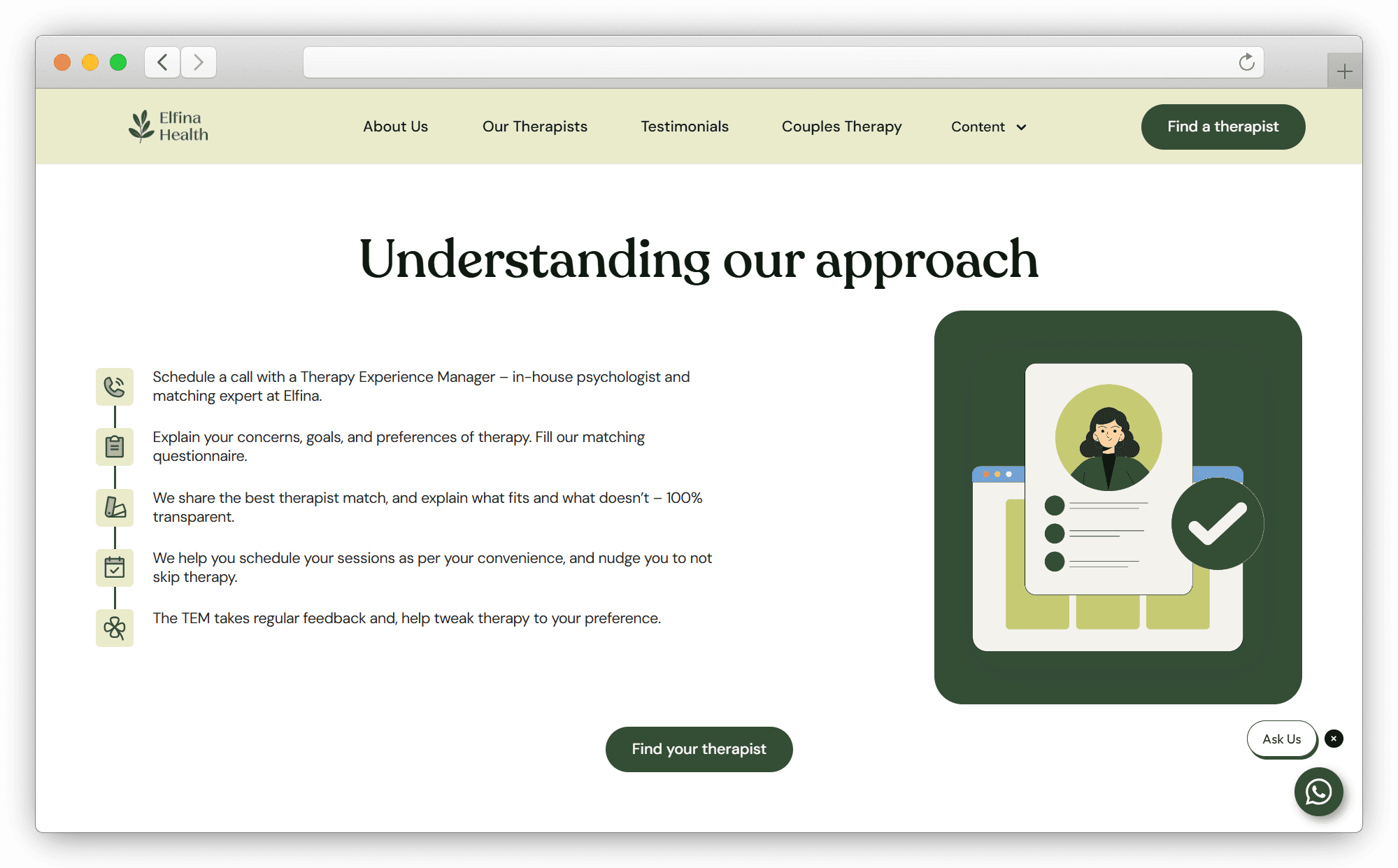
At Elfina Health, the focus is not just on offering therapy sessions. It is on helping people find a therapist who actually fits.
That includes thoughtful matching based on:
Your concerns
Preferences
Communication style
Goals
Life context
This reduces the exhausting trial-and-error that stops many people before they truly begin.
Because when someone is already anxious, the process of finding help should feel easier, not harder.
If You’re Unsure Where to Start
You do not need a perfect plan before reaching out.
You do not need to explain everything clearly.
You do not need to be “bad enough”.
Sometimes the bravest and most useful first step is simply saying:
Something feels off, and I don’t want to keep carrying it alone.
If something in this article felt familiar, that matters.
Maybe you recognised your own overthinking. Maybe you recognised the way anxiety lives in your body. Maybe you realised that what you called “stress” has quietly been shaping more of your life than you noticed.
None of that means you are broken. It means you are human, and your mind and body may be asking for support.
Anxiety is common. It is understandable. And it is treatable.
You do not have to wait until things become unbearable to take yourself seriously.
Sometimes healing begins much earlier than that, with understanding, honesty, and one small next step.
Frequently Asked Questions (FAQs) about Anxiety
Is anxiety common in India?
Yes. Anxiety is one of the most common mental health concerns in India, especially in urban settings where people often face work pressure, financial stress, family expectations, and constant comparison. Many people experience symptoms quietly without formal diagnosis.
What is the difference between stress and anxiety?
Stress is usually a response to a current pressure, such as deadlines or conflict. Anxiety is more future-focused and centres around what might go wrong. Stress often reduces when the situation passes, while anxiety may continue even when nothing immediate is wrong.
Can anxiety go away on its own?
Mild anxiety sometimes improves when stress reduces and routines stabilise. But persistent anxiety often continues without support. If it keeps affecting sleep, mood, work, or relationships, treatment can help significantly.
Can anxiety cause physical symptoms?
Yes. Anxiety can cause very real physical symptoms such as chest tightness, racing heart, stomach discomfort, headaches, dizziness, muscle tension, and sleep problems. The symptoms are real, even when anxiety is the cause.
Can anxiety be treated without medication?
Yes. Many people improve through therapy, lifestyle changes, and evidence-based coping strategies. Medication can be helpful in some cases, especially when symptoms are severe or long-lasting, but it is not the only option.
How long does anxiety treatment take?
It depends on the person, severity, and treatment type. Some people feel improvement within weeks, while deeper long-term work may take several months. Progress is often gradual rather than instant.
What is the difference between an anxiety attack, a panic attack, or something physical like a heart problem?
An “anxiety attack” usually builds gradually and may feel like intense worry, overthinking, tension, or feeling overwhelmed. It is a common term, but not an official clinical diagnosis.
A panic attack is more sudden and intense. It often peaks within minutes and can cause chest tightness, a racing heart, dizziness, breathlessness, or a strong sense that something is seriously wrong.
Physical conditions like heart problems can sometimes feel similar. If chest pain, breathlessness, or dizziness feels new, severe, or unusual for you, it is always safest to get medical help first.
Is online therapy effective for anxiety in India?
Yes. Online therapy can be highly effective for anxiety, especially when matched with the right therapist and evidence-based treatment methods such as CBT. For many people in India, it also makes access easier and more private.
References
[1] Substance Abuse and Mental Health Services Administration. Impact of the DSM-IV to DSM-5 Changes on the National Survey on Drug Use and Health [Internet]. Rockville (MD): Substance Abuse and Mental Health Services Administration (US); 2016 Jun. Table 3.15, DSM-IV to DSM-5 Generalized Anxiety Disorder Comparison. Available from: https://www.ncbi.nlm.nih.gov/books/NBK519704/table/ch3.t15/
[2] Reddy, V. M., & Chandrashekar, C. R. (1998). Prevalence of mental and behavioural disorders in India : a meta-analysis. Indian journal of psychiatry, 40(2), 149–157.
[3] Trivedi, J. K.; Gupta, Pawan Kumar. An overview of Indian research in anxiety disorders. Indian Journal of Psychiatry 52(Suppl1):p S210-S218, January 2010. | DOI: 10.4103/0019-5545.69234
[4] Gupta, Vidhi, Sonam Verma, Madhusudan Tiwari, and Devendra Singh Shekhawat. 2025. “A Study of the Prevalence of Stress, Anxiety and Depression in Young Adults in Jaipur, India”. Journal of Advances in Medicine and Medical Research 37 (6):315-20. https://doi.org/10.9734/jammr/2025/v37i65874.
[5] LeDoux, J. E., & Pine, D. S. (2016). Using neuroscience to help understand fear and anxiety: A two-system framework. American Journal of Psychiatry, 173(11). https://doi.org/10.1176/appi.ajp.2016.16030353

Anxiety in India: Symptoms, Causes, Treatment & Help
|
14
min read
|
Tanvi

Opening: The Kind of Anxiety We Don’t Talk About
Lying in bed, exhausted but somehow unable to switch off.
Your body is tired, but your mind is still working overtime. You replay something you said in a meeting. You wonder if that message sounded rude. You think about tomorrow’s deadlines, next month’s finances, your parents’ health, the future in general. Your heart is beating a little faster than usual, but not enough to feel alarming. There’s a tightness in your chest you can’t fully explain.
So you tell yourself what many people do:
“It’s just stress.”
Maybe you check your unread emails one more time. Maybe you open WhatsApp, then close it. Maybe you go over the same conversation again, trying to figure out if you missed something.
The strange part is how common this experience has become.
Almost everyone around you seems to carry some version of it. For some, it shows up as overthinking. For others, it shows up in the body, as a racing heart, shallow breathing, stomach discomfort, headaches, or a constant sense of unease.
And yet, many people never call it anxiety.
They call it being responsible. Being ambitious. Being busy. Being someone who cares.
But when worry becomes your normal state, it can be hard to notice that something deeper is happening.
This matters because anxiety is common, it is treatable, and it is not a personal weakness.
Understanding it is often the first turning point.
So What Is Anxiety, Really? (And When Is It More Than Just Stress?)
Anxiety, at its core, is the mind and body preparing for something that might go wrong.
It is a future-focused response. It tries to protect you by helping you stay alert, think ahead, notice risk, and avoid danger. In small doses, that system can be useful. It can help you prepare for an interview, study for an exam, or react quickly in an uncertain situation.
So anxiety itself is not the enemy. It is a normal human survival system.
What often creates confusion is that fear, stress, and anxiety are related, but not the same thing.
Fear usually responds to a threat happening right now. A car swerves suddenly. You hear a loud noise behind you.
Stress is often a response to current pressure, like deadlines, conflict, exams, or financial strain.
Anxiety is more about anticipation. It asks, What if something goes wrong?
The American Psychiatric Association describes anxiety as the anticipation of future threat, often linked with physical tension and cautious or avoidant behaviour.
It becomes a problem when that system does not switch off, even when there is no immediate danger.
Clinically (DSM-5), anxiety disorders are identified when anxiety becomes excessive, persistent, and begins interfering with daily functioning. In many cases, symptoms continue for months rather than passing with the stressful event itself.
That distinction matters.
It is not only about how intense anxiety feels in one moment. It is about whether it stays, whether it keeps returning, and whether it starts shaping your choices, relationships, sleep, confidence, or ability to function.
In India, this line often gets blurred. Constant worry and overthinking are frequently normalised. Many of us grow up seeing people who are always tense, always busy, always thinking ahead.
Being stressed can look like being hardworking. Being restless can look like being productive. Slowing down can even look irresponsible.
So persistent anxiety often goes unnoticed for much longer than it should.
If this feels familiar, it is not surprising. Anxiety is far more common than many people realise.
Why It Feels Like Everyone Is Anxious Right Now

If anxiety feels unusually common today, that is because in many ways, it is.
Globally, anxiety disorders affect hundreds of millions of people. The World Health Organization has estimated around 359 million people worldwide live with anxiety disorders, yet only a minority receive treatment.
In India, the picture is significant too. Research reviews have found substantial rates of anxiety-related conditions, with some studies showing higher prevalence in urban settings. Among young adults in Jaipur, one study found more than half screened positive for anxiety symptoms.
So if it feels like everyone around you is struggling in some form, you are not imagining it.
But statistics only tell part of the story. The more useful question is: why now?
For many urban Indians, anxiety is being fuelled by multiple pressures at once:
Constant comparison around salary, career growth, lifestyle, marriage, or milestones
Very little true downtime, because work follows us through phones and notifications
Pressure to keep progressing, even when stability feels uncertain
Fewer spaces where vulnerability feels safe or normal
There is also a newer layer many young adults describe: a growing sense of uncertainty about the future.
People worry about job security, rising costs, global conflict, climate stress, and whether life will become more stable or more fragile. We are exposed to these concerns daily, often without any real control over them.
That can create a background feeling of: Something feels unstable, and I’m supposed to function normally anyway.
This is why anxiety can feel deeply personal while also being shaped by the world around us.
And anxiety does not always arrive dramatically. Most of the time, it is quieter than people expect.
For many people, it slowly becomes a baseline, something you get used to rather than question. Which is exactly why it can be difficult to recognise as a problem until it starts affecting your life more clearly.
Also Read:
Chronic Procrastination: What It Really Is, Why It Hurts, and How to Heal
Overcoming Imposter Syndrome: What It Is, Why It Happens & How Therapy Helps
What Anxiety Actually Feels Like (And Why It’s So Convincing)
One reason anxiety is so difficult to recognise is that it rarely feels like “a disorder”.
It usually feels like reality.
It feels like being careful. Being responsible. Thinking ahead. Staying prepared. It can feel like common sense, even when it is quietly draining you.
That is because anxiety does not only affect your thoughts. It also changes how your body feels and what you begin doing differently.
How Anxiety Changes Your Thoughts

Many people notice anxiety first in the mind:
Constant what if thinking
Replaying conversations long after they ended
Jumping to the worst-case scenario
Difficulty tolerating uncertainty
Feeling unable to “switch off” mentally
Over time, anxiety can distort thinking patterns in predictable ways.
For example:
Catastrophising: imagining the worst possible scenario.
Your manager says, “Can we talk tomorrow?” and your mind immediately jumps to “Did I do something wrong?”Overestimating danger: treating small risks like major threats.
One awkward moment in a meeting starts feeling like something people will remember for weeks.Mind reading: assuming others are judging you negatively.
A friend replies with just “okay”, and you start wondering if they’re upset with you.All-or-nothing thinking: seeing situations as total success or total failure
One mistake during a presentation makes the whole day feel ruined.
These patterns often happen automatically. They do not feel irrational in the moment. They feel true.
That is why anxiety can be so convincing.
How Anxiety Feels in the Body

For many people, especially in India, anxiety first looks physical rather than emotional.
It can show up as:
Tight chest
Racing heartbeat
Shallow breathing
Stomach discomfort
Headaches or body tension
Poor sleep
Feeling “on edge” for no clear reason
Because anxiety can feel so physical, many people understandably assume something is wrong with their heart, digestion, hormones, or general health.
Sometimes medical evaluation is important. But when tests repeatedly come back normal, anxiety is often part of the picture.
How Anxiety Changes Behaviour

Anxiety also influences behaviour in quieter ways:
Avoiding situations that feel uncomfortable
Over-preparing so nothing can go wrong
Constantly seeking reassurance
Delaying decisions out of fear of mistakes
Staying busy to avoid feeling anxious
These behaviours can bring relief in the short term.
And that is exactly why they become powerful.
Why Anxiety Keeps Coming Back
Imagine you avoid a difficult phone call. Your anxiety drops immediately.
Your brain learns: Avoidance helped. That must have been dangerous.
This is part of a psychological process called avoidance learning, a form of conditioning where the brain learns that avoiding discomfort feels safer than facing it. The relief reinforces the behaviour, so your brain repeats it next time.
Over time:
Avoidance becomes automatic
Fear feels more believable
Confidence shrinks
Anxiety grows stronger
Psychologists often call this avoidance behaviour, and while it can bring short-term relief, it prevents the brain from learning that the situation may actually be manageable. The problem is that they prevent the brain from learning the situation may actually be manageable.
Sometimes people also use safety behaviours such as over-preparing, staying close to exits, or constantly seeking reassurance. These may feel protective in the moment, but they can also keep anxiety going.
What’s Happening Biologically?
When the brain senses threat, it activates the body’s stress response.
Adrenaline increases. Heart rate rises. Muscles tense. Cortisol helps the body stay alert (Source).
This response is useful during real danger. But when it is activated too often, the body can start living in a constant state of readiness.
That can feel exhausting.
Once we understand how anxiety works, the next question becomes clearer: why is it showing up so much right now, especially in India?
Why Are So Many Indians Feeling Anxious Right Now?
Anxiety rarely comes from one cause.
It usually builds from multiple layers: biology, past experiences, current stress, culture, and environment. In India, many of those layers can stack together at the same time.
1. Your Brain’s Threat System May Be Overworking
The brain naturally tries to detect danger and keep you safe.
Brain messengers called neurotransmitters, such as serotonin and GABA help regulate mood and anxiety, while areas like the amygdala help detect threat. When anxiety is high, this alarm system can become overactive.
In simple terms: Your brain is doing its job. Just a little too aggressively.
2. Past Experiences Shape What Feels Unsafe
What you have lived through matters.
Experiences like:
Childhood pressure
Criticism
Unpredictability at home
Repeated stress
Past embarrassment or failure
Trauma or loss
can train the brain to stay more alert later in life.
Sometimes people call themselves “naturally anxious” when they are actually carrying learned patterns from earlier experiences.
3. The Indian Environment Can Intensify Anxiety
Many people in India move through years of continuous performance pressure.
School can feel highly competitive
College often brings uncertainty about careers, identity, and the future
Workplaces may involve constant evaluation and comparison
Family expectations can remain strong well into adulthood
And in many Indian families, success is rarely experienced in private. It is often visible, discussed, and compared.
People are asked where they work, how much they earn, when they will marry, whether they own a home, what comes next.
Many of us also grow up hearing phrases like “log kya kahenge” (what will people say?), or being quietly compared to someone who seems to be doing better.
Over time, this can create a constant awareness of how we are being seen, judged, and where we stand socially, even when nobody says it directly.
Urban life itself can keep the nervous system on edge. Long commutes, traffic, construction noise, crowded public spaces, rushing to meetings, worrying about being late, all of this can quietly keep the body in a more activated state than we realise.
4. Culture Shapes How Anxiety Is Handled
Many people grow up hearing messages like:
Don’t overthink
Be strong
Adjust
Everyone deals with this
These messages often come from resilience and care. But they can also make anxiety harder to recognise.
When anxiety is not named:
It is less likely to be discussed
People do not learn healthy coping skills
Struggle gets minimised
So people often create their own ways to cope:
Suppressing feelings
Distracting themselves constantly
Staying busy
Avoiding difficult situations
These can help in the short term, but they don’t actually reduce anxiety; they just keep it in the background. For a while, these coping strategies can make it feel like things are under control.
But many people eventually come to therapy when these patterns stop working, when staying busy no longer quiets the mind, avoiding things starts shrinking their world, or pushing feelings aside no longer feels possible.
What once felt like coping starts feeling like survival.
5. Anxiety Can Show Up Differently Across Gender

Research often finds anxiety disorders are more common in women, though anyone can experience anxiety.
For many Indian women, anxiety may be shaped by overlapping pressures:
Career performance
Caregiving responsibilities
Invisible domestic labour
Pressure to manage distress quietly
This can sometimes show up as constant worry, self-doubt, difficulty mentally switching off, or even physical symptoms like headaches, body pain, fatigue, or unexplained discomfort, especially when expressing emotional distress does not always feel safe or acceptable.
For many men, anxiety may be less openly named and more likely to appear as:
Irritability
Anger
Fatigue
Frustration
Withdrawal
Saying “I’m just stressed” instead of “I’m anxious”
This is not because men feel less anxiety. Often, they are simply taught to express it differently.
The Bigger Truth
Anxiety is not only about what is happening inside you.
It is also about what is happening around you.
And depending on how these pressures interact, anxiety can take different forms.
The Different Ways Anxiety Shows Up
Not all anxiety looks the same.
Some people worry constantly. Others fear social judgement. Some experience sudden panic. Others avoid one specific situation for years.
These experiences can fall into different anxiety disorders. Labels can be useful because they guide treatment, but your experience matters more than the label itself.

Generalised Anxiety Disorder (GAD)
This often looks like ongoing worry across multiple areas of life such as work, health, family, money, or the future.
The mind keeps searching for the next thing to solve.
It is often mistaken for:
“Just being a worrier”
Being highly responsible
Overthinking personality traits
Not sure whether what you're experiencing is GAD or just everyday stress? Take our anxiety quiz to get a clearer picture.
Social Anxiety Disorder
This involves intense fear of judgement, embarrassment, rejection, or looking foolish in front of others.
It may show up during:
Meetings
Presentations
Dating
Group settings
Speaking to authority figures
It is often mistaken for:
Introversion
Shyness
Low confidence
Panic Disorder
This involves repeated panic attacks or persistent fear of having another one.
Panic attacks can include:
Racing heart
Dizziness
Chest tightness
Breathlessness
Feeling like something terrible is happening
It is often mistaken for:
A heart problem
A medical emergency
“Going crazy”
Specific Phobias
This is intense fear linked to a particular object or situation, such as:
Flying
Needles
Dogs
Heights
Enclosed spaces
People usually know the fear feels excessive, but the body reacts strongly anyway.
Other Anxiety Presentations
Some people also struggle with:
Agoraphobia (fear of situations where escape feels difficult)
Mixed anxiety with depression or stress symptoms
Why This Matters
You do not need to diagnose yourself perfectly.
A clear diagnosis can help guide the right treatment. But you do not need to label yourself perfectly before asking for help. The goal is to notice patterns, understand what may be happening, and seek support if it is affecting your life.
So how do you know when anxiety has crossed that line?
When Should You Take Anxiety Seriously?
Many people do not ask for help because they think they need to be “bad enough” first.
They tell themselves:
Other people have it worse
I should be able to handle this
It’s just a stressful phase
Once work settles down, I’ll be fine
That hesitation is common. But the better question is usually not “Do I have anxiety?”
It is: “Is this starting to affect how I live?”
If anxiety is beginning to reduce your quality of life or disturb your normal functioning, it deserves attention.
That can look like:
Your mind rarely feeling at rest
Poor sleep, even when you are tired
Struggling to focus at work
Feeling more irritable or withdrawn
Avoiding calls, meetings, travel, or social plans
Overthinking small decisions for hours
Feeling exhausted by everyday life
Sometimes people continue functioning on the outside while struggling heavily on the inside. They are still meeting deadlines, replying to messages, showing up to work.
But everything feels harder than it should. That still counts.
Why Waiting Often Makes It Worse
Anxiety tends to grow through avoidance.
You skip one difficult situation and feel temporary relief. Then the next situation feels harder. Slowly, your world can become smaller without you fully noticing.
That is why “I’ll just wait for it to pass” does not always work when anxiety has become persistent.
How Anxiety Is Assessed
Getting help does not mean being labelled or judged.
Usually, a mental health professional starts by understanding:
What you have been feeling
How long it has been happening
What triggers it
How it is affecting daily life
Sometimes physical causes such as thyroid issues, sleep problems, or other health concerns may also need to be ruled out.
Simple screening tools like the GAD-7 can help measure anxiety symptoms, but they are not a diagnosis on their own.
A Helpful Rule of Thumb
If anxiety is repeatedly stealing your peace, energy, sleep, confidence, or freedom, it is worth taking seriously.
You do not need to wait until you are overwhelmed.
What Actually Helps (And What Doesn’t Work Long-Term)

If you are struggling with anxiety, the good news is this:
Anxiety does not have to keep running your life. With the right support, it can become far more manageable.
Many people improve significantly with the right support. But long-term relief usually comes from changing the pattern underneath anxiety, not only calming the symptoms in the moment.
Therapy: The Most Effective Long-Term Option
Therapy is one of the most effective treatments for persistent anxiety because it helps you understand your anxiety, not just anxiety in general.
That matters more than it sounds.
Two people may both say, “I’m anxious,” but one may be driven by perfectionism, another by past criticism, another by health fears, another by chronic overwhelm.
Good therapy works with your specific story.
What Therapy Often Includes
Cognitive Behavioural Therapy (CBT) helps identify and change thought patterns that keep anxiety active.
For example:
Assuming the worst
Overestimating danger
Treating uncertainty like danger
Harsh self-judgement
Exposure-based therapy helps the brain gradually relearn safety by facing feared situations in a supported, manageable way.
Instead of avoidance teaching fear, new experiences teach confidence.
That is powerful.
Why Therapy Often Works Better Than Generic Advice
There are many helpful anxiety tips online. Breathing exercises, grounding tools, journaling prompts, meditation apps.
Some genuinely help.
But therapy adds something self-help often cannot:
Understanding your personal triggers
Noticing hidden patterns
Accountability and consistency
Emotional support
Strategies adapted to your life, personality, and cultural context
The same tool can feel very different when it is personalised.
Wondering which platform might be the right starting point? Here's how to find an online psychologist that fits your needs.
Medication: Helpful for Some People
Medication can be an important part of treatment, especially when anxiety is severe, constant, or affecting daily functioning.
Common options may include:
SSRIs (often used for longer-term treatment)
Beta-blockers (sometimes used for performance-related physical symptoms)
Some medications, such as benzodiazepines, may be used for short-term relief in certain situations. They can be helpful when prescribed carefully, but because they may cause side effects or dependency in some people, they are usually used with close medical supervision rather than as a long-term first option.
Medication decisions should always be made with a qualified doctor or psychiatrist.
For some people, medication may be needed only temporarily. For others, longer-term support may be part of what helps them function well.
What Helps in the Moment
If anxiety feels high right now, do not try to solve your whole life tonight.
Start smaller.
Try:
Slowing your breathing
Noticing five things you can see around you
Naming what you feel: “This is anxiety”
Postponing worry into a set “worry time” later (NHS recommended)
Stepping away from overstimulation for a few minutes
Sometimes immediate regulation comes before deeper healing.
Lifestyle Still Matters
Lifestyle changes are not a cure-all, but they can make anxiety easier to manage.
Helpful foundations include:
Consistent sleep
Regular movement
Reducing excess caffeine
Eating regularly
Building some recovery time into the week
The Honest Truth
Self-help can reduce anxiety.
But when anxiety becomes persistent, repetitive, or life-limiting, support often works faster and more deeply than trying to battle it alone.
Why Does Asking for Help Feel So Hard in India?
Many people notice something feels off long before they ask for help, poor sleep, constant overthinking, body tension, feeling on edge, but do not always recognise it as anxiety, or as something serious enough to deserve support.
The issue is not always awareness. Often, it is everything that comes after awareness.
“Maybe It’s Not Serious Enough”
A common barrier is minimising your own pain.
You might think:
Other people have bigger problems
I should be grateful
This is normal adult life
I’m just weak if I can’t cope
So people keep pushing through, even when they are tired, anxious, and quietly overwhelmed.
Stigma Still Exists
Mental health conversations have improved in India, especially in cities. But stigma has not disappeared.
Some people still worry:
What will my family think?
Will people see me differently?
Does needing therapy mean something is wrong with me?
Because of that, many people suffer privately while appearing fine publicly.
Access Can Feel Confusing
Even when someone wants help, the next steps can feel unclear.
Questions like these stop people:
Where do I start?
Should I see a therapist or psychiatrist?
What if I get the wrong person?
Is online therapy effective?
Will it be too expensive?
When you are already anxious, extra friction matters.
Many People Were Never Taught How to Ask for Help
Some people grew up in environments where emotional pain was handled through endurance, distraction, or silence.
You were expected to move on, be strong, stay busy.
So asking for support can feel unfamiliar, uncomfortable, or even selfish.
The Hidden Cost of Waiting
The longer anxiety is normalised, the more it can shape daily life:
Relationships become strained
Confidence drops
Health suffers
Joy becomes harder to access
And because this happens gradually, many people only seek help when they feel completely exhausted.
A Gentler Way to See It
Asking for help is not a sign that you failed to cope.
Often, it is the moment you stop carrying more than you were meant to carry alone.
Because of these barriers, even deciding to begin can feel overwhelming. Which is exactly why the next step matters: making help easier to access, understand, and trust.
How to Actually Find the Right Help
By the time many people decide to seek help, they are already tired.
Not always because anxiety is severe, but because they have spent months, sometimes years, trying to manage it alone. Pushing through. Normalising it. Hoping the next weekend, next holiday, next life phase will finally make things easier.
So when someone finally reaches the point of saying, I think I need support, the next challenge often appears immediately:
Where do I even begin?
That confusion is more common than most people realise.
Therapy Works, But Fit Matters
One of the biggest misunderstandings about therapy is assuming it either “works” or “doesn’t work” in a universal way.
In reality, fit matters a lot.
The right therapist should help you feel:
Understood rather than analysed
Safe rather than judged
Challenged, but not overwhelmed
Guided in a way that suits your personality and needs
Therapy is still a relationship. And like any relationship, the quality of the connection matters.
Research consistently shows that the therapeutic alliance, the sense of trust and collaboration between client and therapist, is one of the strongest predictors of positive outcomes.
What Good Fit Can Look Like
The right fit may involve:
A therapist experienced with anxiety
Someone whose style feels structured or exploratory, depending on what helps you
Sensitivity to cultural and family dynamics
Practical tools, emotional depth, or both
A pace that feels steady, not rushed
For one person, a direct and structured therapist may feel grounding. For another, warmth and reflective space may matter more.
There is no single ideal therapist. There is the therapist who is right for you.
Why Many People Give Up Too Early
A lot of people try therapy once, do not feel a connection, and quietly conclude:
Therapy isn’t for me
Talking won’t help
Nothing will change
Often, the issue was not therapy itself. It was mismatch.
That can happen with:
Communication style
Expectations
Goals not being clarified
Lack of cultural understanding
Simply not feeling comfortable enough to open up
This is important to remember, because one poor fit should not decide the future of your mental health support.
Why Online Therapy Has Helped So Many People
For many working professionals in India, online therapy has reduced barriers that once felt too heavy.
It can make support more accessible by removing:
Commute time
Location limits
Difficulty finding specialists nearby
Scheduling friction
Some of the visibility and stigma people worry about
For many people, privacy and convenience make it easier to start.
Where Elfina Fits In

At Elfina Health, the focus is not just on offering therapy sessions. It is on helping people find a therapist who actually fits.
That includes thoughtful matching based on:
Your concerns
Preferences
Communication style
Goals
Life context
This reduces the exhausting trial-and-error that stops many people before they truly begin.
Because when someone is already anxious, the process of finding help should feel easier, not harder.
If You’re Unsure Where to Start
You do not need a perfect plan before reaching out.
You do not need to explain everything clearly.
You do not need to be “bad enough”.
Sometimes the bravest and most useful first step is simply saying:
Something feels off, and I don’t want to keep carrying it alone.
If something in this article felt familiar, that matters.
Maybe you recognised your own overthinking. Maybe you recognised the way anxiety lives in your body. Maybe you realised that what you called “stress” has quietly been shaping more of your life than you noticed.
None of that means you are broken. It means you are human, and your mind and body may be asking for support.
Anxiety is common. It is understandable. And it is treatable.
You do not have to wait until things become unbearable to take yourself seriously.
Sometimes healing begins much earlier than that, with understanding, honesty, and one small next step.
Frequently Asked Questions (FAQs) about Anxiety
Is anxiety common in India?
Yes. Anxiety is one of the most common mental health concerns in India, especially in urban settings where people often face work pressure, financial stress, family expectations, and constant comparison. Many people experience symptoms quietly without formal diagnosis.
What is the difference between stress and anxiety?
Stress is usually a response to a current pressure, such as deadlines or conflict. Anxiety is more future-focused and centres around what might go wrong. Stress often reduces when the situation passes, while anxiety may continue even when nothing immediate is wrong.
Can anxiety go away on its own?
Mild anxiety sometimes improves when stress reduces and routines stabilise. But persistent anxiety often continues without support. If it keeps affecting sleep, mood, work, or relationships, treatment can help significantly.
Can anxiety cause physical symptoms?
Yes. Anxiety can cause very real physical symptoms such as chest tightness, racing heart, stomach discomfort, headaches, dizziness, muscle tension, and sleep problems. The symptoms are real, even when anxiety is the cause.
Can anxiety be treated without medication?
Yes. Many people improve through therapy, lifestyle changes, and evidence-based coping strategies. Medication can be helpful in some cases, especially when symptoms are severe or long-lasting, but it is not the only option.
How long does anxiety treatment take?
It depends on the person, severity, and treatment type. Some people feel improvement within weeks, while deeper long-term work may take several months. Progress is often gradual rather than instant.
What is the difference between an anxiety attack, a panic attack, or something physical like a heart problem?
An “anxiety attack” usually builds gradually and may feel like intense worry, overthinking, tension, or feeling overwhelmed. It is a common term, but not an official clinical diagnosis.
A panic attack is more sudden and intense. It often peaks within minutes and can cause chest tightness, a racing heart, dizziness, breathlessness, or a strong sense that something is seriously wrong.
Physical conditions like heart problems can sometimes feel similar. If chest pain, breathlessness, or dizziness feels new, severe, or unusual for you, it is always safest to get medical help first.
Is online therapy effective for anxiety in India?
Yes. Online therapy can be highly effective for anxiety, especially when matched with the right therapist and evidence-based treatment methods such as CBT. For many people in India, it also makes access easier and more private.
References
[1] Substance Abuse and Mental Health Services Administration. Impact of the DSM-IV to DSM-5 Changes on the National Survey on Drug Use and Health [Internet]. Rockville (MD): Substance Abuse and Mental Health Services Administration (US); 2016 Jun. Table 3.15, DSM-IV to DSM-5 Generalized Anxiety Disorder Comparison. Available from: https://www.ncbi.nlm.nih.gov/books/NBK519704/table/ch3.t15/
[2] Reddy, V. M., & Chandrashekar, C. R. (1998). Prevalence of mental and behavioural disorders in India : a meta-analysis. Indian journal of psychiatry, 40(2), 149–157.
[3] Trivedi, J. K.; Gupta, Pawan Kumar. An overview of Indian research in anxiety disorders. Indian Journal of Psychiatry 52(Suppl1):p S210-S218, January 2010. | DOI: 10.4103/0019-5545.69234
[4] Gupta, Vidhi, Sonam Verma, Madhusudan Tiwari, and Devendra Singh Shekhawat. 2025. “A Study of the Prevalence of Stress, Anxiety and Depression in Young Adults in Jaipur, India”. Journal of Advances in Medicine and Medical Research 37 (6):315-20. https://doi.org/10.9734/jammr/2025/v37i65874.
[5] LeDoux, J. E., & Pine, D. S. (2016). Using neuroscience to help understand fear and anxiety: A two-system framework. American Journal of Psychiatry, 173(11). https://doi.org/10.1176/appi.ajp.2016.16030353
Other blogs
Frequently Asked Questions
What types of therapy do you offer?
Can I meet my therapist in-person?
How do you match me with a therapist?
How much does therapy cost?
Do you offer free trials?
Finding The Right Fit, Made Easy

© Mindaro Health Technologies. All rights reserved
Finding the right fit, made easy.
FAQs
What types of therapy do you offer?
Can I meet my therapist in-person?
How do you match me with a therapist?
How much does therapy cost?
Do you offer free trials?