Therapist Matching Explained: Why Fit Matters in Therapy
|
8
min read
|
Tanvi


Why finding the right therapist can change your entire therapy experience
Introduction: Maybe Therapy Didn't Fail You. Maybe the Fit Wasn't Right.
Many people leave therapy believing it simply wasn't for them.
The therapist seemed qualified. The sessions were professional. Yet something never quite clicked. The conversations didn't feel particularly helpful, the connection never developed, and eventually therapy stopped.
For many people, getting to that first session already takes considerable effort. There may be months of hesitation, concerns about cost, uncertainty about what therapy involves, or pressure to "handle things yourself". When therapy doesn't feel right, it's easy to conclude that the entire process doesn't work.
But therapy is rarely that simple.
Research consistently shows that one of the strongest predictors of therapy outcomes is the relationship between therapist and client. In other words, who you work with can matter almost as much as the therapy itself.
That doesn't mean a therapist is ineffective if they aren't the right fit for you. A therapist who is excellent for one person may not be the right match for another.
This idea sits at the heart of therapist matching: the process of helping people find therapists whose expertise, style, and approach align with what they need.
But how much does fit actually matter, and can matching really improve therapy outcomes?
Why the Right Therapist Matters So Much
The relationship between a therapist and client is one of the strongest predictors of whether therapy will be helpful.
Psychologists often refer to this relationship as the therapeutic alliance. While the term sounds technical, the idea is straightforward: therapy works best when the therapist and the client are working together toward a shared goal.
Research has repeatedly found that strong therapeutic relationships are associated with better outcomes across different therapy approaches. In fact, the American Psychological Association notes that the quality of the therapeutic relationship can be just as important as the treatment method itself.
Curious about whether online therapy can deliver this same quality of relationship? Read: Is Online Therapy as Effective as In-Person? What the Research Actually Says.
So what does a strong therapeutic relationship actually look like?
Good Therapy Feels Like a Collaborative Process

At its core, a healthy therapeutic relationship includes three things:
Agreement on what you're working toward
Agreement on how you'll get there
A sense of trust between therapist and client
Good therapy shouldn't feel like something being done to you. It should feel like a collaborative process where both people are working toward the same goals.
That trust matters for a practical reason. Therapy often requires people to do difficult things: challenge long-standing beliefs, confront painful emotions, try new behaviours, or break patterns they've been stuck in for years. A strong relationship helps people stay engaged even when that work becomes uncomfortable.
Feeling Accepted Makes Change Possible
People rarely talk openly about the things that hurt most when they feel judged.
This is why emotional safety matters so much in therapy.
Psychologist Carl Rogers, one of the founders of humanistic therapy, believed that meaningful change becomes more possible when people feel genuinely accepted rather than criticised or judged. That idea continues to influence modern psychotherapy today.
When clients feel accepted and understood, they're often more willing to discuss fears, mistakes, shame, grief, or vulnerabilities they may not share anywhere else.
For some people, that safety becomes the foundation for deeper therapeutic work. For others, simply having a space where they feel genuinely heard can be therapeutic in its own right.
➡️ Key Takeaway: Therapy often becomes most effective when professional expertise is paired with a relationship that feels safe, collaborative, and genuinely understanding.
But not every therapist-client relationship develops this way. And when it doesn't, the impact can be significant.
The Cost of a Poor Therapist Match
A poor therapist match can make even good therapy feel ineffective.

One of the challenges with therapist mismatch is that people often don't recognise it for what it is.
Instead, they blame themselves.
They assume they're doing therapy incorrectly. They wonder whether they're expecting too much. Some conclude that therapy simply isn't for them.
The Emotional Cost
When therapy doesn't feel like a good fit, people often start holding parts of themselves back.
They may hesitate to discuss difficult topics, feel misunderstood, or leave sessions feeling disconnected from the process.
A poor fit can also create self-doubt. Many people compare their experience to stories from friends, social media, or popular culture, where therapy is often portrayed as an instant connection. When their own experience feels slower or more uncertain, they assume something is wrong.
In reality, trust often develops gradually. The issue isn't whether therapy feels comfortable immediately. It's whether a meaningful sense of understanding and collaboration begins to emerge over time.
This is one reason Elfina's matching call includes conversations about what clients can realistically expect from the early stages of therapy.
The Practical Cost
Therapy requires time, money, emotional energy, and vulnerability.
Repeating painful stories, attending sessions that don't feel useful, or starting over with a new therapist can be exhausting, especially when seeking help already felt difficult.
For many working professionals, a disappointing therapy experience doesn't just waste resources. It can delay getting the support they need.
Why So Many People Leave Therapy Early
Research suggests this challenge is common.
A large meta-analysis by Swift and Greenberg found that roughly one in five clients leave therapy before achieving the goals they initially came to work on.
Of course, people stop therapy for many different reasons. But the finding highlights an important reality: people often disengage from therapy emotionally before they disengage from it practically.
If a previous experience has left you wondering whether therapy is even for you, this might explain why it didn't work - and why it probably wasn't your fault.
It's also important to remember that a poor fit doesn't necessarily mean the therapist lacks skill or expertise. A therapist can be highly effective for some clients and still not be the right fit for others.
And that's exactly the problem therapist matching is designed to solve.
What Is Therapist Matching?
Therapist matching is the process of pairing clients with therapists based on factors that are likely to support trust, engagement, and effective therapy.
At first glance, therapist matching can sound like a technology feature or a fancy way of assigning therapists. In reality, it is an attempt to solve a very human problem.
Most people don't choose therapists the same way they choose healthcare providers. They aren't simply looking for someone qualified. They're looking for someone they can trust with deeply personal parts of their life.
That's where therapist matching comes in.
Rather than asking, "Which therapist is available?", therapist matching asks a different question:
"Which therapist is most likely to help this particular person?"
The answer often involves much more than symptoms alone.
A thoughtful matching process may consider:
The concerns bringing someone to therapy
Their goals and expectations
The therapist's areas of expertise
Communication and therapy style preferences
Personality and relational patterns
Cultural and personal considerations
Previous therapy experiences
Readiness for therapy
Not sure how long the process of finding the right fit might take? Here's an honest look at therapy timelines for common concerns.
Importantly, therapist matching is not about finding a perfect therapist.
No system can guarantee instant chemistry or predict exactly how a therapeutic relationship will develop.
Instead, the goal is to increase the likelihood of a strong working relationship from the beginning, reducing the frustration, uncertainty, and trial-and-error that many people experience when searching for a therapist on their own.
And increasingly, research suggests that this effort may be worth it.
What the Research Says About Therapist Matching
Research increasingly indicates that thoughtful therapist matching can improve both therapy outcomes and the likelihood that clients stay engaged in treatment.
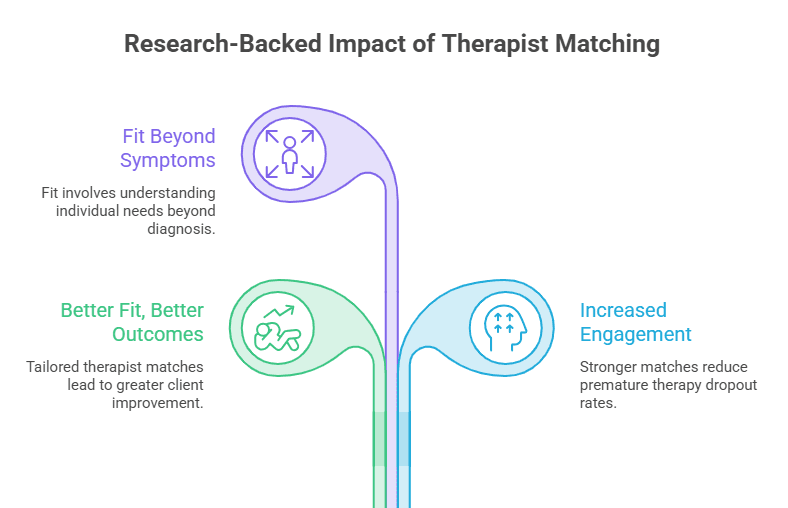
While therapist matching may feel intuitive, it isn't just a marketing idea. Researchers have spent decades trying to understand whether matching clients and therapists more thoughtfully can improve outcomes.
So far, the findings are encouraging.
Better Fit Can Lead to Better Outcomes
One of the strongest pieces of evidence comes from research led by psychologist Bruce Wampold's colleague Michael Constantino and colleagues at the University of Massachusetts.
In the study, clients were matched with therapists who had demonstrated strengths in helping people with concerns similar to their own. Compared to clients assigned through traditional methods, those who received a tailored match showed greater improvement.
What makes this finding particularly interesting is that the therapy itself didn't change.
The difference came from who was paired with whom.
In other words, the match mattered.
Matching May Help People Stay Engaged
Earlier, we discussed the finding from Swift and Greenberg's 2012 meta-analysis that roughly one in five clients leave therapy before completing treatment (achieving the goals they initially came to work on).
This matters because therapy only works when people stay engaged long enough to benefit from it.
When clients feel understood, trust their therapist, and believe the work is relevant to their lives, they're often more willing to continue through difficult phases of therapy rather than dropping out prematurely.
A stronger match cannot eliminate every reason people leave therapy, but it may remove one of the most common barriers: feeling disconnected from the person sitting across from you.
Fit Goes Beyond Symptoms
Perhaps the most important lesson from therapist matching research is that diagnosis is only part of the picture.
Two people may both struggle with anxiety and still need very different therapists.
One person may want practical strategies and structure. Another may want space to explore deeper emotional patterns. One may value a therapist who challenges them directly. Another may respond better to a gentler approach.
Relevant experience matters too.
A therapist who has spent several years working extensively with postpartum mental health challenges, pregnancy loss, or trauma may sometimes be a better fit than a therapist with more years of experience overall but less exposure to those specific concerns.
➡️ Key Takeaway: The best therapist is not always the most experienced therapist in general. It's often the therapist whose expertise, style, and experience align most closely with what a particular client needs.
Which raises an important question:
So what exactly separates a good therapist match from a poor one?
What Makes a Good Therapist Match?
A good therapist match considers both what a person is struggling with and how they prefer to engage in therapy.
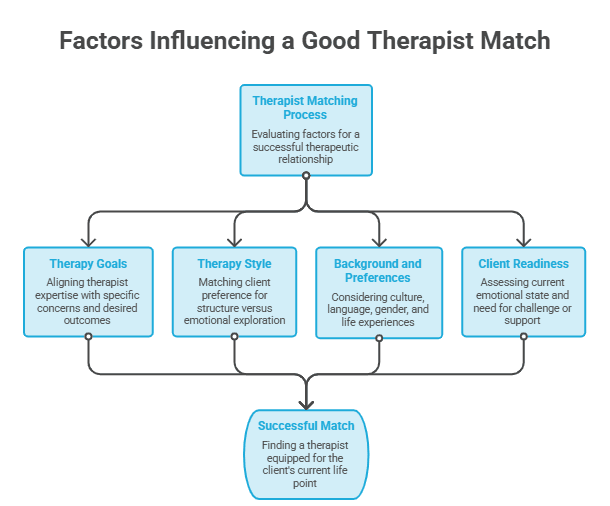
Many people assume therapist matching is mostly about diagnosis.
In reality, diagnosis is often just the starting point.
Your Therapy Goals Matter
Two people can seek therapy for completely different reasons, even if they share similar symptoms.
Someone experiencing anxiety may want help managing panic attacks before a major career transition. Another may want to understand long-standing patterns in relationships. A third may be struggling with burnout and looking for practical tools to regain balance.
The most helpful therapist for each of those people may not be the same.
Matching becomes even more important when someone is seeking support for a highly specific concern.
Experiences such as pregnancy loss, postpartum mental health challenges, infertility, trauma, compulsive pornography use, or complex relationship difficulties often benefit from therapists who have worked extensively with those issues before.
In these situations, relevant expertise can be just as important as interpersonal fit.
Therapy Style Matters Too
Imagine two therapists who are equally qualified.
One is highly structured, goal-oriented, and practical.
The other prefers reflection, exploration, and deeper emotional processing.
Neither approach is inherently better.
But one may feel significantly more helpful depending on what a client is looking for.
People often have different expectations about how therapy should work. Some want guidance and direction. Others want space to explore their thoughts and feelings. Some prefer a present-focused approach, while others want to understand how past experiences continue to shape their lives.
These preferences don't determine success on their own, but they can influence how comfortable and engaged someone feels in therapy.
At Elfina, frameworks such as the Cooper-Norcross preference model help inform these conversations during the matching process.
Background, Preferences, and Life Experience
Feeling understood is about more than diagnosis and therapy style.
Language preferences, cultural background, gender preferences, religious considerations, family dynamics, and life experiences can all influence how comfortable someone feels opening up.
This doesn't mean people need therapists who are identical to them. But it does mean that certain forms of understanding can help trust develop more quickly. Personality and attachment patterns may also influence how people connect, communicate, and engage in the therapeutic relationship, which is why they are often considered during the matching process.
But it does mean that certain forms of understanding can help trust develop more quickly.
Readiness Matters
Not everyone begins therapy from the same place.
Some people arrive motivated and ready for change.
Others feel uncertain, overwhelmed, sceptical, or emotionally exhausted.
A good match takes this into account.
Sometimes what someone needs most is challenge and accountability. At other times, they may need patience, reassurance, and a therapist who can meet them where they are.
The goal of matching isn't to find a perfect therapist.
It's to find a therapist who feels equipped to help a particular person at a particular point in their life.
And when that happens, therapy often feels very different.
How to Know You've Found the Right Therapist
The right therapist usually feels less like a perfect match and more like someone you gradually learn to trust, learn from, and speak honestly with.
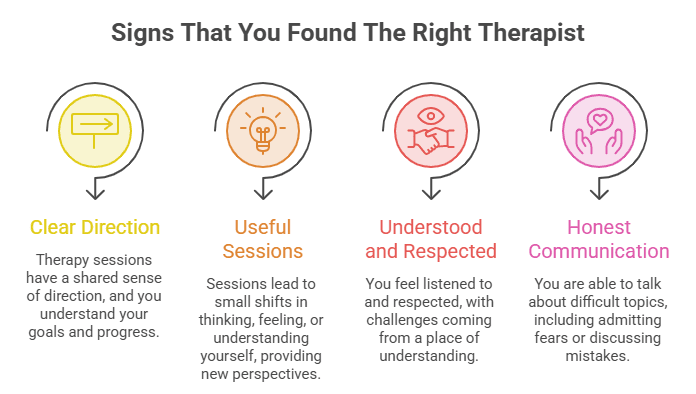
Many people start therapy expecting a moment of certainty.
A session where they immediately think, "This is the one".
Sometimes that happens. More often, it doesn't.
Like any meaningful relationship, trust in therapy usually develops over time. The goal isn't to find someone who understands everything about you within an hour. It's to find someone who consistently helps you feel understood, supported, and able to move forward.
So what does that actually look like?
You Know What You're Working Toward
Good therapy doesn't feel random.
Even when sessions explore different parts of your life, there is usually a shared sense of direction. You understand what you're working on, why certain conversations matter, and what progress might look like.
That doesn't mean every goal is perfectly defined from day one. Goals often evolve as therapy progresses. But there should be a feeling that both you and your therapist are moving in the same direction.
Sessions Feel Useful
Contrary to popular belief, not every therapy session feels profound.
Some sessions feel emotional. Others feel practical. Some may even feel ordinary.
What matters is the overall pattern.
Over time, you begin noticing small shifts in how you think, feel, respond, or understand yourself. You leave sessions with new perspectives, greater clarity, or a deeper understanding of what is keeping you stuck.
The value of therapy often comes from these gradual changes rather than dramatic breakthroughs.
You Feel Understood and Respected
One of the most powerful aspects of good therapy is the feeling that you don't have to constantly explain or defend your experience.
You feel listened to rather than judged.
Your therapist may challenge you at times, but the challenge comes from a place of understanding rather than criticism.
As trust develops, many people notice that they become more willing to discuss topics they initially avoided. That's often a sign that the therapeutic relationship is strengthening.
You Can Be Honest, Even When It's Difficult
Perhaps the clearest sign of a healthy therapeutic relationship is the ability to talk about things you'd rather avoid.
That might mean admitting fears you're embarrassed by.
Discussing mistakes you've never shared with anyone.
Or even telling your therapist that something in therapy isn't working for you.
Good therapy makes room for honesty, including uncomfortable honesty.
In fact, the ability to disagree, ask questions, express frustration, or share feedback is often a sign that trust has deepened rather than weakened. Working through those moments can strengthen the therapeutic relationship rather than damage it.
➡️ Key Takeaway: The right therapist does not make therapy easy. They make it feel safe enough to do difficult work.
Of course, finding this kind of relationship shouldn't depend entirely on luck. That's why thoughtful therapist matching has become such an important part of the therapy process.
How Therapist Matching Works at Elfina
Elfina combines therapist expertise, structured matching, and human judgment to help clients find therapists who are likely to be a strong fit from the beginning.

Finding the right therapist shouldn't depend entirely on scrolling through profiles and hoping for the best.
That's why Elfina approaches matching as a structured process rather than a simple assignment.
We Start by Understanding You
Every client begins with a matching call led by a Therapy Experience Manager (TEM). This isn't a quick intake conversation. The goal is to understand what brings you to therapy, your goals, past therapy experiences, preferences, relevant history, and what you're hoping to get from the process.
Clients can also ask questions and gain a clearer understanding of what therapy may look like before getting started.
We Match on More Than Just Symptoms
Two people can come to therapy with the same concern and need completely different therapists.
That's why Elfina considers more than 40 factors, including therapy preferences, communication style, cultural considerations, personality patterns, previous therapy experiences, and practical factors that may affect fit.
The focus isn't just on what you're struggling with, but who is most likely to help.
We Focus on Quality and Fit
Only around 10% of therapists who apply are accepted into Elfina's network. Matching recommendations are then made only when the process identifies a strong fit, with a target threshold of over 90%.
Matching Continues After the Recommendation
Before the first session, therapists receive a structured summary of the information gathered during the matching process, helping them begin with meaningful context rather than starting from scratch.
Feedback and support continue throughout the therapy journey because matching is not treated as a one-time event.
➡️ Elfina Takeaway: The goal of therapist matching isn't simply to recommend a therapist. It's to create the conditions for a strong therapeutic relationship from the very beginning.
Conclusion: Finding the Right Therapist Shouldn't Be Left to Chance
Many people leave therapy believing it wasn't right for them.
Sometimes that's true.
But often, what wasn't right was the fit.
A therapist who wasn't the right match for one person may still be an excellent therapist for someone else. Therapy is deeply personal, and the relationship between therapist and client shapes how safe people feel, how honest they can be, and how willing they are to stay engaged when the work becomes difficult.
That's why therapist matching matters.
Not because it guarantees a perfect experience, but because it recognises that therapy is more than a set of techniques. It's a human relationship. And like any important relationship, the fit matters.
If you're considering therapy, finding the right therapist shouldn't be left entirely to chance. A thoughtful matching process can make it easier to find someone who understands not only what you're going through, but also how you communicate, connect, and heal.
Frequently Asked Questions (FAQs) on Therapist Matching
What is therapist matching?
Therapist matching is the process of pairing clients with therapists based on factors such as their concerns, therapy goals, communication preferences, personality, and therapist expertise. The goal is to increase the likelihood of a strong therapeutic relationship, which can improve engagement and therapy outcomes.
Does therapist matching actually improve therapy outcomes?
Research suggests that thoughtful therapist matching can improve therapy outcomes and reduce the likelihood of clients dropping out of treatment early. When clients feel understood, supported, and aligned with their therapist's approach, they are often more likely to stay engaged and benefit from therapy.
What factors are used to match clients with therapists?
Therapist matching may consider factors such as presenting concerns, therapy goals, therapist specialisations, communication style preferences, cultural considerations, previous therapy experiences, personality patterns, and readiness for therapy. Different platforms use different matching methods.
How do I know if my therapist is the right fit?
A therapist is often a good fit when you feel understood, respected, and comfortable being honest with them. You should have a general sense of what you're working toward, feel that sessions are meaningful, and feel increasingly able to discuss difficult thoughts, emotions, or experiences over time.
Can I switch therapists if the fit doesn't feel right?
Yes. Switching therapists is a normal part of the therapy process and does not mean therapy has failed. If the therapeutic relationship does not feel productive or supportive after giving it reasonable time, exploring a different therapist may help you find a better fit.
Can I ask for a therapist with a specific background or gender?
Yes. Many people have preferences regarding a therapist's gender, language, cultural background, or experience with specific concerns. These preferences can be important for comfort, trust, and engagement, and many therapy platforms take them into account during the matching process.
Is therapist matching important for online therapy?
Yes. Therapist matching can be especially important in online therapy because clients often have access to a larger pool of therapists. A thoughtful matching process can help narrow those options and improve the chances of finding a therapist whose expertise and style align with your needs.
How does Elfina match clients with therapists?
Elfina combines clinical expertise, structured assessment, and human judgment to match clients with therapists. The process includes a detailed matching call, consideration of more than 40 matching variables, therapist quality screening, and ongoing support to help ensure a strong therapist-client fit.
References
[1] DeAngelis, T. (2019, November 1). CE corner: Better relationships with patients lead to better outcomes. Monitor on Psychology, 50(10). https://www.apa.org/monitor/2019/11/ce-corner-relationships
[2] Swift, J. K., & Greenberg, R. P. (2012). Premature discontinuation in adult psychotherapy: a meta-analysis. Journal of consulting and clinical psychology, 80(4), 547–559. https://doi.org/10.1037/a0028226
[3] University of Massachusetts Amherst. (2021, June 28). Evidence-based patient-psychotherapist matching improves mental health care. ScienceDaily. Retrieved June 20, 2026 from www.sciencedaily.com/releases/2021/06/210628170601.htm
[4] Cooper, M., & Norcross, J. C. (2016). A brief, multidimensional measure of clients' therapy preferences: The Cooper-Norcross Inventory of Preferences (C-NIP). International journal of clinical and health psychology : IJCHP, 16(1), 87–98. https://doi.org/10.1016/j.ijchp.2015.08.003

Therapist Matching Explained: Why Fit Matters in Therapy
|
8
min read
|
Tanvi

Why finding the right therapist can change your entire therapy experience
Introduction: Maybe Therapy Didn't Fail You. Maybe the Fit Wasn't Right.
Many people leave therapy believing it simply wasn't for them.
The therapist seemed qualified. The sessions were professional. Yet something never quite clicked. The conversations didn't feel particularly helpful, the connection never developed, and eventually therapy stopped.
For many people, getting to that first session already takes considerable effort. There may be months of hesitation, concerns about cost, uncertainty about what therapy involves, or pressure to "handle things yourself". When therapy doesn't feel right, it's easy to conclude that the entire process doesn't work.
But therapy is rarely that simple.
Research consistently shows that one of the strongest predictors of therapy outcomes is the relationship between therapist and client. In other words, who you work with can matter almost as much as the therapy itself.
That doesn't mean a therapist is ineffective if they aren't the right fit for you. A therapist who is excellent for one person may not be the right match for another.
This idea sits at the heart of therapist matching: the process of helping people find therapists whose expertise, style, and approach align with what they need.
But how much does fit actually matter, and can matching really improve therapy outcomes?
Why the Right Therapist Matters So Much
The relationship between a therapist and client is one of the strongest predictors of whether therapy will be helpful.
Psychologists often refer to this relationship as the therapeutic alliance. While the term sounds technical, the idea is straightforward: therapy works best when the therapist and the client are working together toward a shared goal.
Research has repeatedly found that strong therapeutic relationships are associated with better outcomes across different therapy approaches. In fact, the American Psychological Association notes that the quality of the therapeutic relationship can be just as important as the treatment method itself.
Curious about whether online therapy can deliver this same quality of relationship? Read: Is Online Therapy as Effective as In-Person? What the Research Actually Says.
So what does a strong therapeutic relationship actually look like?
Good Therapy Feels Like a Collaborative Process

At its core, a healthy therapeutic relationship includes three things:
Agreement on what you're working toward
Agreement on how you'll get there
A sense of trust between therapist and client
Good therapy shouldn't feel like something being done to you. It should feel like a collaborative process where both people are working toward the same goals.
That trust matters for a practical reason. Therapy often requires people to do difficult things: challenge long-standing beliefs, confront painful emotions, try new behaviours, or break patterns they've been stuck in for years. A strong relationship helps people stay engaged even when that work becomes uncomfortable.
Feeling Accepted Makes Change Possible
People rarely talk openly about the things that hurt most when they feel judged.
This is why emotional safety matters so much in therapy.
Psychologist Carl Rogers, one of the founders of humanistic therapy, believed that meaningful change becomes more possible when people feel genuinely accepted rather than criticised or judged. That idea continues to influence modern psychotherapy today.
When clients feel accepted and understood, they're often more willing to discuss fears, mistakes, shame, grief, or vulnerabilities they may not share anywhere else.
For some people, that safety becomes the foundation for deeper therapeutic work. For others, simply having a space where they feel genuinely heard can be therapeutic in its own right.
➡️ Key Takeaway: Therapy often becomes most effective when professional expertise is paired with a relationship that feels safe, collaborative, and genuinely understanding.
But not every therapist-client relationship develops this way. And when it doesn't, the impact can be significant.
The Cost of a Poor Therapist Match
A poor therapist match can make even good therapy feel ineffective.

One of the challenges with therapist mismatch is that people often don't recognise it for what it is.
Instead, they blame themselves.
They assume they're doing therapy incorrectly. They wonder whether they're expecting too much. Some conclude that therapy simply isn't for them.
The Emotional Cost
When therapy doesn't feel like a good fit, people often start holding parts of themselves back.
They may hesitate to discuss difficult topics, feel misunderstood, or leave sessions feeling disconnected from the process.
A poor fit can also create self-doubt. Many people compare their experience to stories from friends, social media, or popular culture, where therapy is often portrayed as an instant connection. When their own experience feels slower or more uncertain, they assume something is wrong.
In reality, trust often develops gradually. The issue isn't whether therapy feels comfortable immediately. It's whether a meaningful sense of understanding and collaboration begins to emerge over time.
This is one reason Elfina's matching call includes conversations about what clients can realistically expect from the early stages of therapy.
The Practical Cost
Therapy requires time, money, emotional energy, and vulnerability.
Repeating painful stories, attending sessions that don't feel useful, or starting over with a new therapist can be exhausting, especially when seeking help already felt difficult.
For many working professionals, a disappointing therapy experience doesn't just waste resources. It can delay getting the support they need.
Why So Many People Leave Therapy Early
Research suggests this challenge is common.
A large meta-analysis by Swift and Greenberg found that roughly one in five clients leave therapy before achieving the goals they initially came to work on.
Of course, people stop therapy for many different reasons. But the finding highlights an important reality: people often disengage from therapy emotionally before they disengage from it practically.
If a previous experience has left you wondering whether therapy is even for you, this might explain why it didn't work - and why it probably wasn't your fault.
It's also important to remember that a poor fit doesn't necessarily mean the therapist lacks skill or expertise. A therapist can be highly effective for some clients and still not be the right fit for others.
And that's exactly the problem therapist matching is designed to solve.
What Is Therapist Matching?
Therapist matching is the process of pairing clients with therapists based on factors that are likely to support trust, engagement, and effective therapy.
At first glance, therapist matching can sound like a technology feature or a fancy way of assigning therapists. In reality, it is an attempt to solve a very human problem.
Most people don't choose therapists the same way they choose healthcare providers. They aren't simply looking for someone qualified. They're looking for someone they can trust with deeply personal parts of their life.
That's where therapist matching comes in.
Rather than asking, "Which therapist is available?", therapist matching asks a different question:
"Which therapist is most likely to help this particular person?"
The answer often involves much more than symptoms alone.
A thoughtful matching process may consider:
The concerns bringing someone to therapy
Their goals and expectations
The therapist's areas of expertise
Communication and therapy style preferences
Personality and relational patterns
Cultural and personal considerations
Previous therapy experiences
Readiness for therapy
Not sure how long the process of finding the right fit might take? Here's an honest look at therapy timelines for common concerns.
Importantly, therapist matching is not about finding a perfect therapist.
No system can guarantee instant chemistry or predict exactly how a therapeutic relationship will develop.
Instead, the goal is to increase the likelihood of a strong working relationship from the beginning, reducing the frustration, uncertainty, and trial-and-error that many people experience when searching for a therapist on their own.
And increasingly, research suggests that this effort may be worth it.
What the Research Says About Therapist Matching
Research increasingly indicates that thoughtful therapist matching can improve both therapy outcomes and the likelihood that clients stay engaged in treatment.

While therapist matching may feel intuitive, it isn't just a marketing idea. Researchers have spent decades trying to understand whether matching clients and therapists more thoughtfully can improve outcomes.
So far, the findings are encouraging.
Better Fit Can Lead to Better Outcomes
One of the strongest pieces of evidence comes from research led by psychologist Bruce Wampold's colleague Michael Constantino and colleagues at the University of Massachusetts.
In the study, clients were matched with therapists who had demonstrated strengths in helping people with concerns similar to their own. Compared to clients assigned through traditional methods, those who received a tailored match showed greater improvement.
What makes this finding particularly interesting is that the therapy itself didn't change.
The difference came from who was paired with whom.
In other words, the match mattered.
Matching May Help People Stay Engaged
Earlier, we discussed the finding from Swift and Greenberg's 2012 meta-analysis that roughly one in five clients leave therapy before completing treatment (achieving the goals they initially came to work on).
This matters because therapy only works when people stay engaged long enough to benefit from it.
When clients feel understood, trust their therapist, and believe the work is relevant to their lives, they're often more willing to continue through difficult phases of therapy rather than dropping out prematurely.
A stronger match cannot eliminate every reason people leave therapy, but it may remove one of the most common barriers: feeling disconnected from the person sitting across from you.
Fit Goes Beyond Symptoms
Perhaps the most important lesson from therapist matching research is that diagnosis is only part of the picture.
Two people may both struggle with anxiety and still need very different therapists.
One person may want practical strategies and structure. Another may want space to explore deeper emotional patterns. One may value a therapist who challenges them directly. Another may respond better to a gentler approach.
Relevant experience matters too.
A therapist who has spent several years working extensively with postpartum mental health challenges, pregnancy loss, or trauma may sometimes be a better fit than a therapist with more years of experience overall but less exposure to those specific concerns.
➡️ Key Takeaway: The best therapist is not always the most experienced therapist in general. It's often the therapist whose expertise, style, and experience align most closely with what a particular client needs.
Which raises an important question:
So what exactly separates a good therapist match from a poor one?
What Makes a Good Therapist Match?
A good therapist match considers both what a person is struggling with and how they prefer to engage in therapy.

Many people assume therapist matching is mostly about diagnosis.
In reality, diagnosis is often just the starting point.
Your Therapy Goals Matter
Two people can seek therapy for completely different reasons, even if they share similar symptoms.
Someone experiencing anxiety may want help managing panic attacks before a major career transition. Another may want to understand long-standing patterns in relationships. A third may be struggling with burnout and looking for practical tools to regain balance.
The most helpful therapist for each of those people may not be the same.
Matching becomes even more important when someone is seeking support for a highly specific concern.
Experiences such as pregnancy loss, postpartum mental health challenges, infertility, trauma, compulsive pornography use, or complex relationship difficulties often benefit from therapists who have worked extensively with those issues before.
In these situations, relevant expertise can be just as important as interpersonal fit.
Therapy Style Matters Too
Imagine two therapists who are equally qualified.
One is highly structured, goal-oriented, and practical.
The other prefers reflection, exploration, and deeper emotional processing.
Neither approach is inherently better.
But one may feel significantly more helpful depending on what a client is looking for.
People often have different expectations about how therapy should work. Some want guidance and direction. Others want space to explore their thoughts and feelings. Some prefer a present-focused approach, while others want to understand how past experiences continue to shape their lives.
These preferences don't determine success on their own, but they can influence how comfortable and engaged someone feels in therapy.
At Elfina, frameworks such as the Cooper-Norcross preference model help inform these conversations during the matching process.
Background, Preferences, and Life Experience
Feeling understood is about more than diagnosis and therapy style.
Language preferences, cultural background, gender preferences, religious considerations, family dynamics, and life experiences can all influence how comfortable someone feels opening up.
This doesn't mean people need therapists who are identical to them. But it does mean that certain forms of understanding can help trust develop more quickly. Personality and attachment patterns may also influence how people connect, communicate, and engage in the therapeutic relationship, which is why they are often considered during the matching process.
But it does mean that certain forms of understanding can help trust develop more quickly.
Readiness Matters
Not everyone begins therapy from the same place.
Some people arrive motivated and ready for change.
Others feel uncertain, overwhelmed, sceptical, or emotionally exhausted.
A good match takes this into account.
Sometimes what someone needs most is challenge and accountability. At other times, they may need patience, reassurance, and a therapist who can meet them where they are.
The goal of matching isn't to find a perfect therapist.
It's to find a therapist who feels equipped to help a particular person at a particular point in their life.
And when that happens, therapy often feels very different.
How to Know You've Found the Right Therapist
The right therapist usually feels less like a perfect match and more like someone you gradually learn to trust, learn from, and speak honestly with.

Many people start therapy expecting a moment of certainty.
A session where they immediately think, "This is the one".
Sometimes that happens. More often, it doesn't.
Like any meaningful relationship, trust in therapy usually develops over time. The goal isn't to find someone who understands everything about you within an hour. It's to find someone who consistently helps you feel understood, supported, and able to move forward.
So what does that actually look like?
You Know What You're Working Toward
Good therapy doesn't feel random.
Even when sessions explore different parts of your life, there is usually a shared sense of direction. You understand what you're working on, why certain conversations matter, and what progress might look like.
That doesn't mean every goal is perfectly defined from day one. Goals often evolve as therapy progresses. But there should be a feeling that both you and your therapist are moving in the same direction.
Sessions Feel Useful
Contrary to popular belief, not every therapy session feels profound.
Some sessions feel emotional. Others feel practical. Some may even feel ordinary.
What matters is the overall pattern.
Over time, you begin noticing small shifts in how you think, feel, respond, or understand yourself. You leave sessions with new perspectives, greater clarity, or a deeper understanding of what is keeping you stuck.
The value of therapy often comes from these gradual changes rather than dramatic breakthroughs.
You Feel Understood and Respected
One of the most powerful aspects of good therapy is the feeling that you don't have to constantly explain or defend your experience.
You feel listened to rather than judged.
Your therapist may challenge you at times, but the challenge comes from a place of understanding rather than criticism.
As trust develops, many people notice that they become more willing to discuss topics they initially avoided. That's often a sign that the therapeutic relationship is strengthening.
You Can Be Honest, Even When It's Difficult
Perhaps the clearest sign of a healthy therapeutic relationship is the ability to talk about things you'd rather avoid.
That might mean admitting fears you're embarrassed by.
Discussing mistakes you've never shared with anyone.
Or even telling your therapist that something in therapy isn't working for you.
Good therapy makes room for honesty, including uncomfortable honesty.
In fact, the ability to disagree, ask questions, express frustration, or share feedback is often a sign that trust has deepened rather than weakened. Working through those moments can strengthen the therapeutic relationship rather than damage it.
➡️ Key Takeaway: The right therapist does not make therapy easy. They make it feel safe enough to do difficult work.
Of course, finding this kind of relationship shouldn't depend entirely on luck. That's why thoughtful therapist matching has become such an important part of the therapy process.
How Therapist Matching Works at Elfina
Elfina combines therapist expertise, structured matching, and human judgment to help clients find therapists who are likely to be a strong fit from the beginning.

Finding the right therapist shouldn't depend entirely on scrolling through profiles and hoping for the best.
That's why Elfina approaches matching as a structured process rather than a simple assignment.
We Start by Understanding You
Every client begins with a matching call led by a Therapy Experience Manager (TEM). This isn't a quick intake conversation. The goal is to understand what brings you to therapy, your goals, past therapy experiences, preferences, relevant history, and what you're hoping to get from the process.
Clients can also ask questions and gain a clearer understanding of what therapy may look like before getting started.
We Match on More Than Just Symptoms
Two people can come to therapy with the same concern and need completely different therapists.
That's why Elfina considers more than 40 factors, including therapy preferences, communication style, cultural considerations, personality patterns, previous therapy experiences, and practical factors that may affect fit.
The focus isn't just on what you're struggling with, but who is most likely to help.
We Focus on Quality and Fit
Only around 10% of therapists who apply are accepted into Elfina's network. Matching recommendations are then made only when the process identifies a strong fit, with a target threshold of over 90%.
Matching Continues After the Recommendation
Before the first session, therapists receive a structured summary of the information gathered during the matching process, helping them begin with meaningful context rather than starting from scratch.
Feedback and support continue throughout the therapy journey because matching is not treated as a one-time event.
➡️ Elfina Takeaway: The goal of therapist matching isn't simply to recommend a therapist. It's to create the conditions for a strong therapeutic relationship from the very beginning.
Conclusion: Finding the Right Therapist Shouldn't Be Left to Chance
Many people leave therapy believing it wasn't right for them.
Sometimes that's true.
But often, what wasn't right was the fit.
A therapist who wasn't the right match for one person may still be an excellent therapist for someone else. Therapy is deeply personal, and the relationship between therapist and client shapes how safe people feel, how honest they can be, and how willing they are to stay engaged when the work becomes difficult.
That's why therapist matching matters.
Not because it guarantees a perfect experience, but because it recognises that therapy is more than a set of techniques. It's a human relationship. And like any important relationship, the fit matters.
If you're considering therapy, finding the right therapist shouldn't be left entirely to chance. A thoughtful matching process can make it easier to find someone who understands not only what you're going through, but also how you communicate, connect, and heal.
Frequently Asked Questions (FAQs) on Therapist Matching
What is therapist matching?
Therapist matching is the process of pairing clients with therapists based on factors such as their concerns, therapy goals, communication preferences, personality, and therapist expertise. The goal is to increase the likelihood of a strong therapeutic relationship, which can improve engagement and therapy outcomes.
Does therapist matching actually improve therapy outcomes?
Research suggests that thoughtful therapist matching can improve therapy outcomes and reduce the likelihood of clients dropping out of treatment early. When clients feel understood, supported, and aligned with their therapist's approach, they are often more likely to stay engaged and benefit from therapy.
What factors are used to match clients with therapists?
Therapist matching may consider factors such as presenting concerns, therapy goals, therapist specialisations, communication style preferences, cultural considerations, previous therapy experiences, personality patterns, and readiness for therapy. Different platforms use different matching methods.
How do I know if my therapist is the right fit?
A therapist is often a good fit when you feel understood, respected, and comfortable being honest with them. You should have a general sense of what you're working toward, feel that sessions are meaningful, and feel increasingly able to discuss difficult thoughts, emotions, or experiences over time.
Can I switch therapists if the fit doesn't feel right?
Yes. Switching therapists is a normal part of the therapy process and does not mean therapy has failed. If the therapeutic relationship does not feel productive or supportive after giving it reasonable time, exploring a different therapist may help you find a better fit.
Can I ask for a therapist with a specific background or gender?
Yes. Many people have preferences regarding a therapist's gender, language, cultural background, or experience with specific concerns. These preferences can be important for comfort, trust, and engagement, and many therapy platforms take them into account during the matching process.
Is therapist matching important for online therapy?
Yes. Therapist matching can be especially important in online therapy because clients often have access to a larger pool of therapists. A thoughtful matching process can help narrow those options and improve the chances of finding a therapist whose expertise and style align with your needs.
How does Elfina match clients with therapists?
Elfina combines clinical expertise, structured assessment, and human judgment to match clients with therapists. The process includes a detailed matching call, consideration of more than 40 matching variables, therapist quality screening, and ongoing support to help ensure a strong therapist-client fit.
References
[1] DeAngelis, T. (2019, November 1). CE corner: Better relationships with patients lead to better outcomes. Monitor on Psychology, 50(10). https://www.apa.org/monitor/2019/11/ce-corner-relationships
[2] Swift, J. K., & Greenberg, R. P. (2012). Premature discontinuation in adult psychotherapy: a meta-analysis. Journal of consulting and clinical psychology, 80(4), 547–559. https://doi.org/10.1037/a0028226
[3] University of Massachusetts Amherst. (2021, June 28). Evidence-based patient-psychotherapist matching improves mental health care. ScienceDaily. Retrieved June 20, 2026 from www.sciencedaily.com/releases/2021/06/210628170601.htm
[4] Cooper, M., & Norcross, J. C. (2016). A brief, multidimensional measure of clients' therapy preferences: The Cooper-Norcross Inventory of Preferences (C-NIP). International journal of clinical and health psychology : IJCHP, 16(1), 87–98. https://doi.org/10.1016/j.ijchp.2015.08.003
Other blogs
Frequently Asked Questions
What types of therapy do you offer?
Can I meet my therapist in-person?
How do you match me with a therapist?
How much does therapy cost?
Do you offer free trials?
Finding The Right Fit, Made Easy

© Mindaro Health Technologies. All rights reserved
Finding the right fit, made easy.
FAQs
What types of therapy do you offer?
Can I meet my therapist in-person?
How do you match me with a therapist?
How much does therapy cost?
Do you offer free trials?